A box can look convincing in a rendering and still fail when it is folded. The crease may crack, the panels may feel too flexible, or the tuck flap may resist closing. Often, the problem begins with a material specification that says little more than “heavy cardstock.”

Cardstock is widely used for printed packaging, cards, tags, sleeves, and promotional materials. Yet the term describes a broad family of paper products rather than one standardized material. Two sheets with the same weight can have different thicknesses, surfaces, and folding behavior.
For packaging buyers, the useful question is not simply how heavy the sheet is. It is whether the selected stock can be printed, converted, filled, handled, and disposed of appropriately for the intended application.
This guide explains cardstock terminology, material types, measurement systems, manufacturing, and the practical checks that help turn a design into a reliable finished package.
What Is Cardstock?
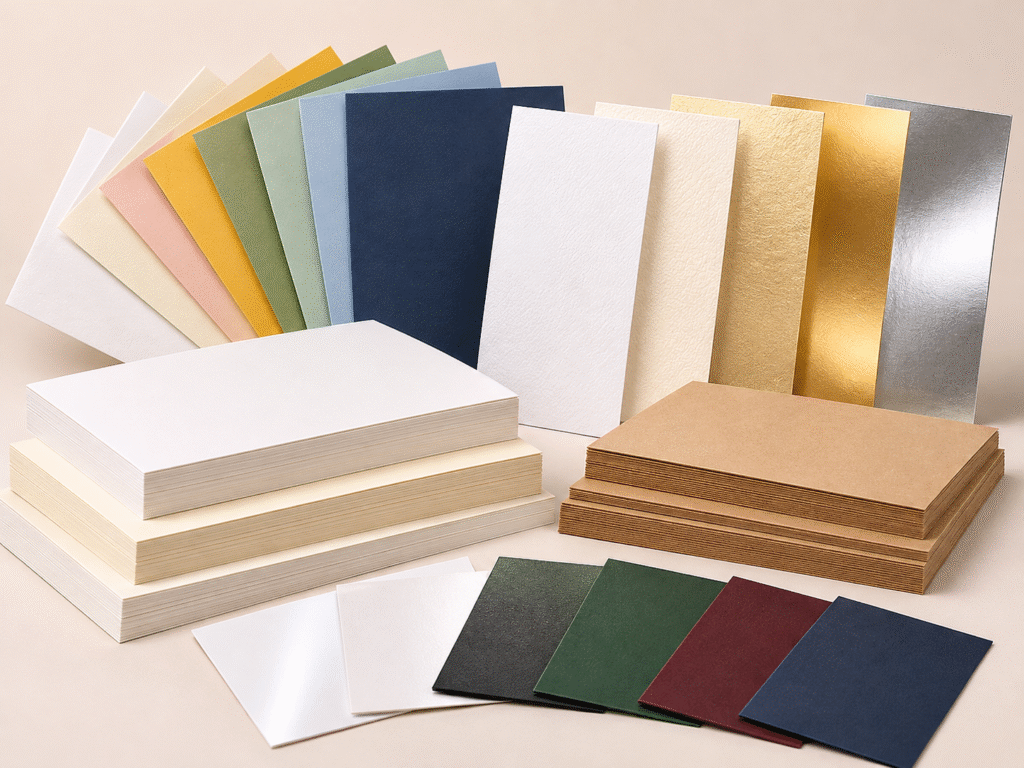
Cardstock is a relatively heavy, stiff paper material used where ordinary writing or printing paper lacks sufficient body. It is commonly associated with business cards, invitations, hang tags, covers, and lightweight packaging.
“Cover stock” is a related term used in commercial printing, although suppliers’ product categories and measurement conventions vary. Neither term establishes a universal thickness or load capacity.
Most commercial grades use cellulose fibers, often derived from wood pulp, with different combinations of virgin or recovered fiber, fillers, sizing, pigments, and surface treatments.
A smooth white sheet, a textured colored sheet, and a recycled brown sheet can all be sold as cardstock. Their shared label does not make them interchangeable.
For a packaging order, replace the broad description with a defined grade, grammage, caliper, surface specification, and intended converting process.
Cardstock, Paperboard, and Corrugated Board
These terms overlap in everyday conversation, but the structural differences matter.
| Material term | What it generally describes | Typical applications |
|---|---|---|
| Cardstock | Heavy paper used for printing and light structures | Cards, tags, sleeves, small cartons |
| Folding paperboard | Board engineered for printing, creasing, and carton conversion | Retail folding cartons and inserts |
| Rigid boxboard | Thick structural board, often covered with a separate wrap | Presentation boxes and set-up boxes |
| Corrugated board | Fluted paper bonded to liner sheets | Shipping cartons and protective structures |
There is no single worldwide boundary that makes every sheet “paper” below a particular weight and “board” above it. Product terminology depends on the market and grade.
For retail cartons, a packaging-grade paperboard may provide a more useful specification than generic craft cardstock. For shipping, a corrugated structure often serves a different role altogether.
Brands developing custom folding paper boxes should therefore consider the material and the assembled structure together.
Common Types of Cardstock
Cardstock can be classified by fiber composition, construction, surface, color, and intended print process. These categories overlap: a recycled sheet may also be coated, colored, or textured.
Uncoated Cardstock
Uncoated stock has no applied pigment coating of the type used to create a coated printing surface. It may still contain internal sizing or receive surface treatments.
It is often chosen for a natural feel, writable areas, and restrained graphics. Absorbency and surface texture can influence ink spread, color strength, and fine detail.
Do not assume every uncoated sheet accepts every pen or ink. Test the intended writing or printing method, especially where customers need to add information.
Coated Cardstock
Coated stock uses a surface layer that changes smoothness, ink holdout, and visual appearance. Depending on the grade, coating may be applied to one or both sides.
One-side-coated stock can suit a carton with exterior printing and a different interior surface. Two-side-coated stock can be useful when both faces need a similar print treatment.
A mill-applied coating is different from a protective varnish or film added after printing. Both influence the finished appearance, but they perform different functions.
Bleached Paperboard Grades
Bleached grades provide a light base for printed colors and clean-looking interiors. Solid bleached sulfate board, commonly abbreviated SBS, is one packaging example.
Its name identifies a material family, not an automatic guarantee of strength, food-contact suitability, or luxury appearance. Those properties require a specific grade and finished construction.
Folding Boxboard
Folding boxboard, often abbreviated FBB, commonly combines different fiber layers to balance bulk, stiffness, and surface properties.
Its construction can provide useful carton performance at a selected grammage. Actual results depend on the grade and carton design.
A buyer should compare the technical specification and converted sample rather than assuming all folding boxboard behaves identically.
Kraft and Brown Stocks
Brown stocks can create an understated appearance and work well with simple typography or limited-color graphics.
Their base shade affects printed colors. Light inks, photographs, and white elements may require a different print approach from the same artwork on white board.
Brown appearance alone does not prove recycled content, minimal processing, or superior environmental performance. Specify the properties that matter instead of relying on color.
Recycled, Colored, and Specialty Stocks
Recycled-content grades vary in fiber composition, surface, shade, and odor characteristics. Suitability depends on the product and use conditions.
Colored-through sheets can leave a colored edge after cutting. Textured sheets add tactile character, while metallic or pearlescent surfaces create other visual effects.
These choices can change ink adhesion, foil results, readability, and folding behavior. Packboxprint’s packaging material options provide a starting point for matching the desired appearance to a workable construction.
Cardstock Weight and Thickness Explained
Weight and thickness measure different things. Confusing them makes quotations difficult to compare and can lead to an unsuitable material substitution.
GSM: Mass per Unit Area
GSM means grams per square meter, also written g/m². A 300 GSM sheet has a nominal mass of 300 grams for each square meter.
For an illustrative rectangular sheet measuring 0.20 × 0.30 meters:
Area = 0.20 × 0.30 = 0.06 m²
Nominal sheet mass = 0.06 × 300 = 18 grams
That calculation does not establish how thick the sheet is or how much weight an assembled carton can carry. It also excludes added ink, adhesive, and finishing materials.
Points, Mils, and Millimeters
Caliper means thickness. In common paperboard thickness notation, one point equals one thousandth of an inch. A mil is also one thousandth of an inch.
This use of “point” is different from a typographic point used for font size.
| Nominal caliper | Inches | Millimeters |
|---|---|---|
| 10 pt | 0.010 | 0.2540 |
| 12 pt | 0.012 | 0.3048 |
| 14 pt | 0.014 | 0.3556 |
| 16 pt | 0.016 | 0.4064 |
| 18 pt | 0.018 | 0.4572 |
| 24 pt | 0.024 | 0.6096 |
These are unit conversions, not recommendations for particular products. Finished sheets also have manufacturing tolerances.
Why GSM Does Not Convert Directly to Thickness
Density, fiber composition, coating, and manufacturing treatment affect the relationship between mass and thickness. Two 300 GSM grades can have different calipers and bending properties.
There is consequently no universal conversion table that turns every GSM value into a reliable point thickness.
When a dieline depends on caliper, request that measurement for the exact grade. A supplier’s actual specification is more useful than an estimated online conversion.
What Does Pound Weight Mean?
In common US paper terminology, basis weight describes the mass of a specified number of sheets at a defined basic size.
The basic size varies by paper category. Cover, text, bond, and index weights therefore cannot be compared by their pound numbers alone.
For example, common cover-weight equivalents are approximately 80 lb cover at 216 GSM, 100 lb cover at 270 GSM, and 120 lb cover at 324 GSM. These figures do not apply to every paper category.
A request for “100 lb cardstock” should identify the category and preferably include GSM and caliper. Pound weight alone leaves room for misunderstanding.
Stiffness Is a Separate Performance Property
A thicker sheet may feel more substantial, but packaging performance depends on more than thickness.
Fiber orientation, layer construction, moisture, panel dimensions, and crease placement influence the assembled carton. A tall, unsupported panel behaves differently from a short panel made from the same board.
Bending stiffness also differs with grain direction. A sample should be evaluated in the orientation intended for production.
Rather than treating higher GSM as an automatic upgrade, assess whether the selected material delivers the required panel stability, closure behavior, and product support.
How Is Cardstock Manufactured?
Manufacturing differs between grades and mills, but the main stages explain why apparently similar sheets can behave differently.
1. Preparing the Fiber Furnish
The manufacturer selects and prepares the fibers and other ingredients used in the sheet. Virgin pulp, recovered fiber, or combinations may be used, depending on the grade.
Refining changes fiber characteristics and bonding behavior. Additives can influence properties such as sizing, strength, shade, and formation.
The formulation must balance several requirements. Printability, bulk, stiffness, and folding performance do not all improve simply by adding more material.
2. Forming the Sheet
A dilute fiber suspension is distributed onto a moving forming surface, where water drains and a fiber web develops.
Some boards use multiple plies formed and combined during manufacture. These layers are not necessarily the same as separate finished sheets glued together afterward.
Fiber orientation established during production contributes to machine-direction and cross-direction differences in the finished material.
3. Pressing and Drying
Pressing removes additional water and consolidates the web. Heated drying sections reduce moisture further.
The resulting moisture balance matters during later printing and converting. Uneven moisture exposure can contribute to curl and dimensional changes.
4. Surface Treatment and Finishing
Depending on the grade, the sheet may receive sizing, pigment coating, or other treatments. Calendering uses rolls to influence smoothness, surface, and thickness.
Treatment intensity affects the final combination of surface quality and bulk. A highly smooth sheet does not necessarily have the same structural behavior as a bulkier sheet at equal grammage.
5. Inspection, Cutting, and Packing
Production controls assess relevant properties such as grammage, caliper, moisture, shade, and surface quality.
The material is supplied in reels or sheets and protected for transport and storage. The technical specification should identify nominal values and applicable tolerances.
These manufacturing stages produce the substrate. Printing, die-cutting, creasing, and gluing are later operations that turn it into packaging.
Printing on Cardstock
Cardstock can be printed by several processes, but compatibility depends on the exact sheet and equipment.
Offset printing can suit many commercial packaging jobs. Digital printing can be useful for certain quantities, versions, and personalization requirements. Neither method works equally well with every stock.
For digital equipment, both grammage and caliper can affect feeding. Coating compatibility, sheet dimensions, surface properties, and the approved media range also matter.
A printer setting labeled “heavy paper” does not establish that an unsuitable material will run safely or print correctly. Follow the equipment requirements and use a representative print trial.
Check Color on the Intended Surface
The same artwork can appear different on coated white, uncoated cream, and brown stock. Base color, absorbency, and surface texture influence the result.
A screen proof establishes layout more effectively than tactile feel or exact material appearance. Where color is critical, agree an appropriate physical reference.
For packaging with barcodes or small product information, verify readability after printing and finishing rather than judging the design only at enlarged screen size.
Finishes Commonly Used on Cardstock
Finishes can modify appearance, handling, and surface protection. They should be selected alongside the board and converting method.
Varnishes and coatings can change gloss and resistance to rubbing. Actual performance depends on the formulation, application, and curing conditions.
Film lamination can add a distinct surface and improve certain handling properties. It also changes the construction and may affect folding, gluing, and recycling options.
Foil stamping can highlight a logo or short detail. Fine lines and small type need testing on the chosen surface.
Embossing and debossing create raised or recessed features. Their success depends on board properties, tooling, artwork, and the surrounding structure.
Soft-touch treatments create a particular tactile effect, but their resistance to fingerprints and scuffs varies. Review handled samples before approval.
Packboxprint’s custom packaging design services can help align the graphic treatment with the material and structural brief.
Creasing, Folding, and Die-Cutting
A suitable sheet can still produce a poor carton if the converting setup is wrong.
Creasing prepares a controlled hinge in the material. It is different from cutting, and it is more than drawing a fold line on a template.
Tool geometry must suit the board type and caliper. Grain direction, moisture, coatings, and printed coverage can also affect the folded result.
Common problems include cracked printed folds, springing panels, distorted closures, and rough cut edges. Increasing grammage without adjusting the structure or tools may introduce further problems.
Approve the dieline with the intended production material. If the grade or caliper changes, review the crease setup, clearances, and finished fit again.
Common Uses of Cardstock
Cardstock serves both printed communication and light structural functions.
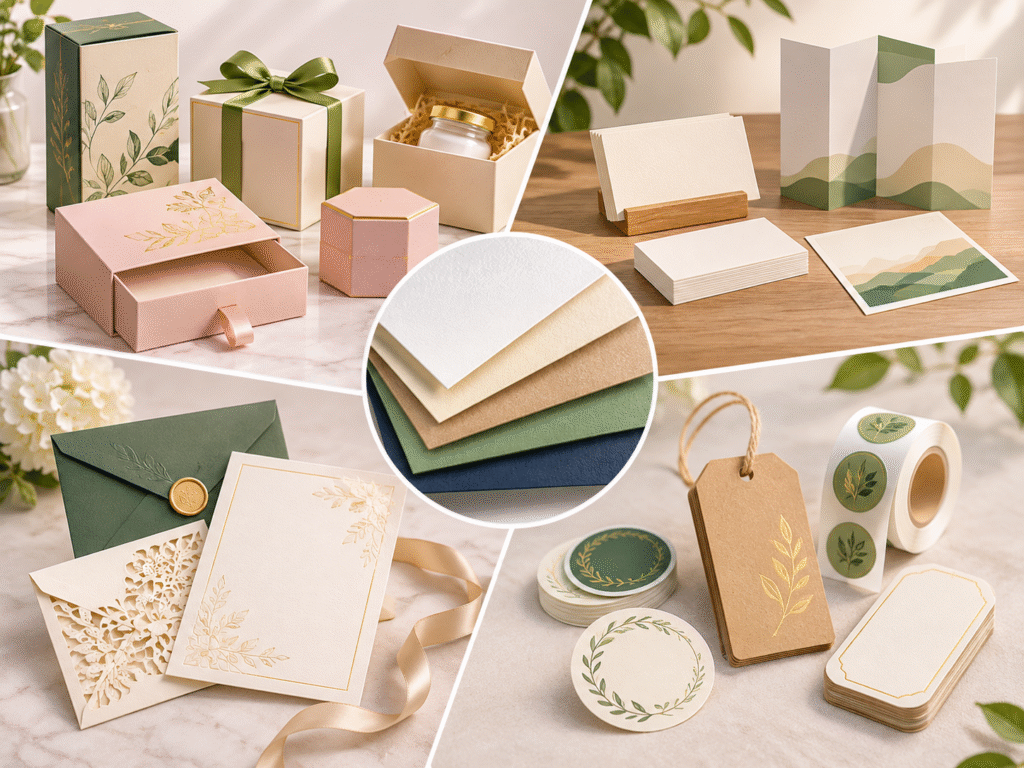
| Application | Useful material characteristics | Main checks |
|---|---|---|
| Business cards and invitations | Surface, opacity, tactile feel | Print detail, writing, finishing |
| Hang tags and backing cards | Stiffness and clean cutting | Hole strength and attachment |
| Product sleeves | Fold quality and dimensional consistency | Fit, sliding friction, closure |
| Folding cartons | Creasability and panel stability | Loading, base support, opening |
| Dividers and light inserts | Suitable geometry and support | Movement control and contact points |
| Promotional cards | Print quality and handling durability | Scuffing, legibility, consistency |
For retail packaging, the carton may provide identification and presentation around another primary container. It should not be assumed to deliver moisture, oxygen, grease, or electrostatic protection without appropriate additional measures.
Likewise, a cardstock carton is not automatically suitable as the sole parcel-shipping package. Evaluate protection at the complete package level.
How to Choose Cardstock for Packaging
Start with the product and distribution route, then define the material.
Record the product dimensions, packed weight, vulnerable surfaces, and filling method. Identify whether the package will be displayed, handled repeatedly, stacked, or shipped individually.
Specify the proposed board grade, GSM, caliper, coated sides, grain orientation, and finish. For direct-contact applications, obtain suitability information for the intended conditions rather than assuming all white board is appropriate.
Build and fill a structural sample. Check loading access, closure engagement, base stability, product movement, and removal. Then assess a production-representative sample for print, folds, adhesive performance, and handling marks.
Compare quotations on the same specification. A lower price may reflect a different grade, finish, quantity, or delivery basis.
When evaluating a custom packaging manufacturer, discuss how material substitutions and production approvals are controlled. A clear specification helps maintain consistency between the sample and repeat orders.
Storage and Environmental Considerations
Keep unused sheets and cartons protected from dirt, excess moisture, and unsuitable storage conditions. Follow the supplier’s conditioning guidance before printing or converting.
For environmental claims, assess the finished package rather than the base sheet alone. Recycled content, sourcing documentation, coatings, films, adhesives, and local collection systems all matter.
Brown appearance does not prove recycled content. A paper-based construction does not automatically establish home compostability or acceptance in every recycling program.
A Packboxprint packaging inquiry is more useful when it includes the product, required performance, quantity, print brief, and material preferences. Those details support a specification that can be sampled and checked.
Choosing cardstock well means matching the sheet to its job. Weight, thickness, surface, and converting performance each answer a different part of that decision.
Frequently Asked Questions
1. What is cardstock made from?
Most commercial cardstock uses cellulose fibers, commonly from wood pulp, combined with other ingredients and treatments. Grades may contain virgin fiber, recovered fiber, or a mixture.
2. Is cardstock the same as cardboard?
The terms are used loosely, but they are not precise substitutes. Cardstock usually describes heavy printing paper, while cardboard may refer to folding board, rigid board, or corrugated materials.
3. What is the difference between GSM and thickness?
GSM measures mass per unit area. Thickness, or caliper, measures the distance between the sheet surfaces. Different grades can have the same GSM but different thicknesses.
4. How thick is 16 pt cardstock?
In common paperboard caliper notation, 16 pt equals 0.016 inches, or 0.4064 mm. This is a unit conversion; the supplied grade will have its own nominal specification and tolerances.
5. What does 100 lb cardstock mean?
It describes a basis weight, but the paper category must be identified. For example, 100 lb cover is commonly about 270 GSM. Other basis-weight categories use different basic sheet sizes.
6. Which cardstock is best for packaging boxes?
There is no universal best grade. Select for product weight, carton dimensions, folding behavior, printing, and distribution. A packaging-grade paperboard may be more appropriate than a generic craft stock.
7. Can cardstock be printed on both sides?
Yes, provided the stock and print process support it. Check whether both surfaces have suitable properties, particularly for one-side-coated materials, and verify appearance on a sample.
8. Does cardstock need to be creased before folding?
Many heavier sheets benefit from properly designed creasing. The requirement and tooling depend on caliper, grade, grain direction, coating, and structure. Test the intended production combination.
9. Is cardstock waterproof?
Ordinary cardstock is not inherently waterproof. Some treatments improve particular resistance properties, but moisture protection must be specified and validated for the intended use.
10. Is cardstock recyclable?
Many paper-based grades can enter suitable recycling systems, but acceptance depends on the finished construction, contamination, and local rules. Added films, windows, and other components may affect the appropriate route.