A holographic carton changes as it moves. Under one light, its surface may look silver; under another, a band of color travels across the panel. That movement can give a product a distinctive presentation, but it also introduces questions that ordinary white board does not.
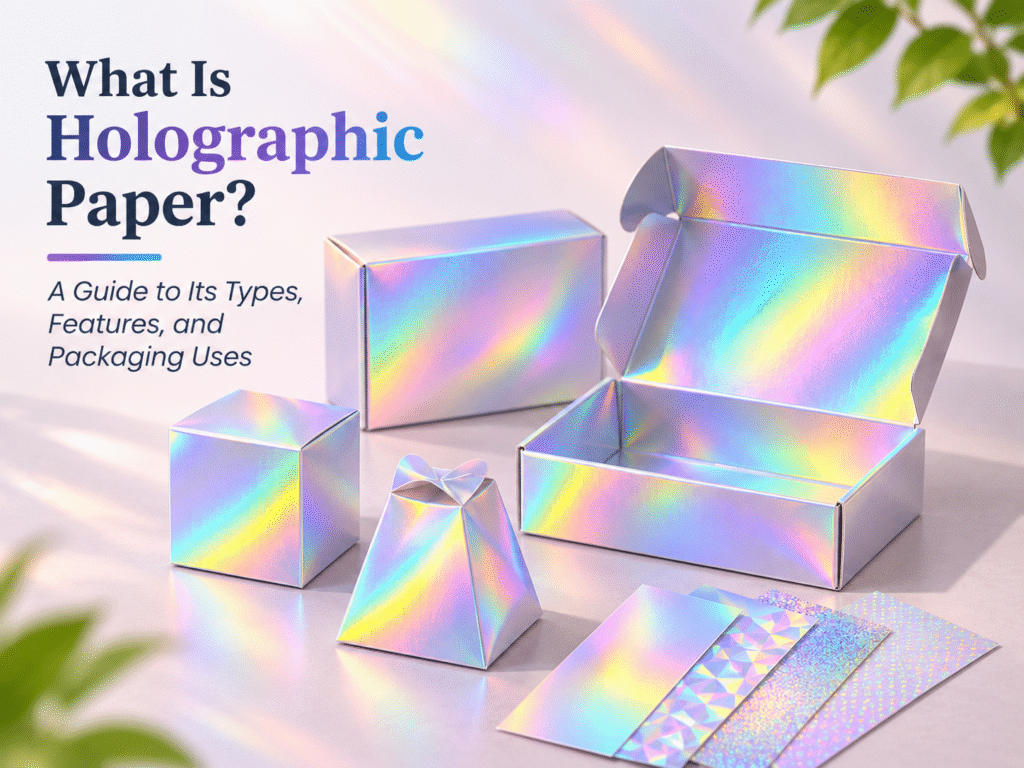
Will the brand color remain recognizable? Can the product information be read under retail lighting? Will the finish survive folding and handling? And what exactly is the material beneath the effect?
For packaging buyers, holographic paper is best understood as a decorative material system. Its optical surface, supporting substrate, print treatment, and converting method all influence the finished package.
This guide explains the main constructions, how they create their appearance, where they are useful, and what to verify before approving a custom packaging order.
What Is Holographic Paper?
Holographic paper is paper or paperboard carrying a surface structure that produces changing optical effects as lighting or viewing angle changes.
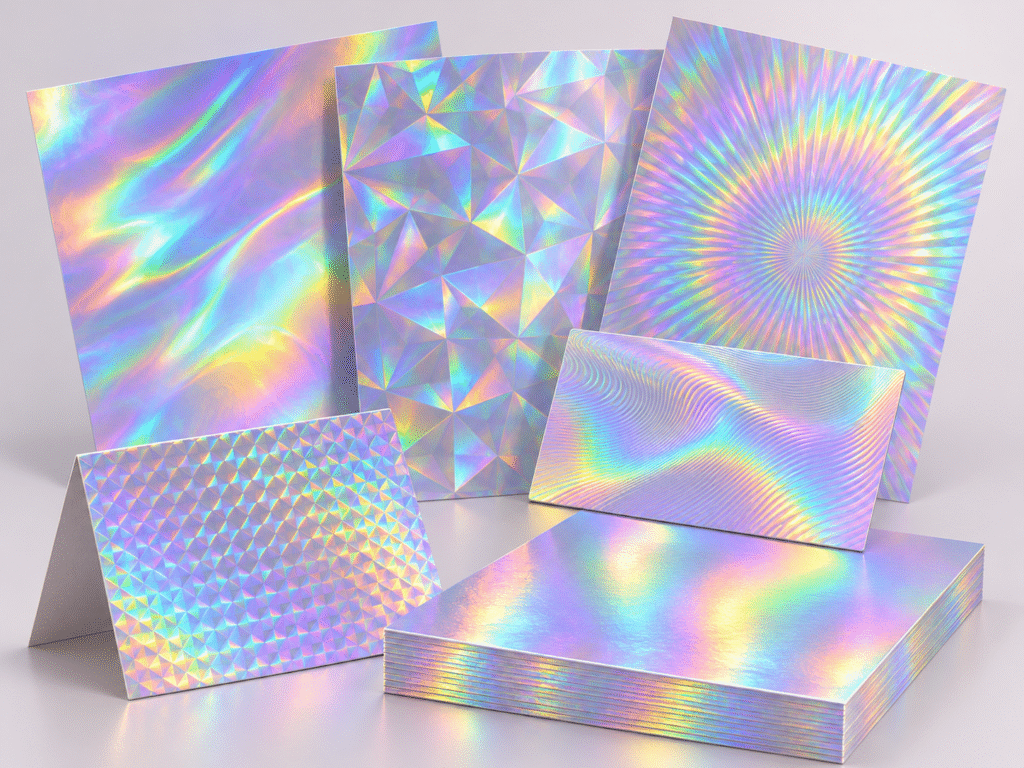
Many decorative grades use microscopic relief patterns to diffract light. These can create rainbow colors, apparent movement, geometric patterns, or an impression of depth.
The term does not identify one fixed composition. Some products retain a laminated plastic film. Others use a transfer process that leaves the decorative layers on the paper after a carrier is removed. A package can also gain a similar effect through selected areas of holographic foil.
A reflective plastic sheet with a removable paper backing is a different product again. The backing does not make the decorative face a paper material.
When comparing samples, ask for the complete construction rather than relying on a description such as “holographic silver paper.”
How the Holographic Effect Works
Ordinary glossy paper reflects light from a relatively smooth surface. Holographic decorative materials add an engineered microscopic structure.
That structure redirects different wavelengths of light into different directions. As the viewer, light source, or package moves, different colors and parts of the pattern become visible.
A reflective layer, often a very thin deposited metal layer, can strengthen the visual effect. Other constructions produce more transparent effects. The appearance depends on the pattern, material layers, and illumination.
A printed rainbow is not equivalent to this changing optical response. Its colors remain positioned in the printed image, while a diffractive surface changes with the viewing conditions.
Not every holographic pattern produces a recognizable three-dimensional image. Many commercial patterns are decorative gratings or repeating textures. “Holographic” is therefore broader in packaging terminology than a floating image or an image-recording process.
Main Types of Holographic Packaging Materials
Separate the construction from the pattern. “Rainbow” describes an appearance; “film-laminated board” describes how a material is built.
| Construction | What it involves | What buyers should confirm |
|---|---|---|
| Film-laminated paper or board | A decorative film remains bonded to the substrate | Film type, adhesion, crease performance, disposal route |
| Transfer-decorated paper or board | Decorative layers transfer from a carrier that is removed | Finished layers, print surface, supporting documentation |
| Holographic foil decoration | Selected areas receive a transferred optical finish | Detail size, registration, coverage, tooling |
| Decorative self-adhesive material | A face material is combined with adhesive and a liner | Face composition, adhesion, liner handling |
Film-Laminated Holographic Paper
In a laminated construction, the film remains part of the finished material. It can provide a continuous decorative surface over paper or board.
Performance varies with the film, adhesive, base sheet, and production process. Folding may reveal cracking, whitening, or separation if the combination is unsuitable.
Do not assume the presence of film makes the package waterproof. Exposed edges, folds, joints, and the underlying board can remain vulnerable to moisture.
Transfer Holographic Paper
Transfer constructions use a carrier during manufacture and remove it after the relevant decorative layers are transferred.
This can avoid retaining the carrier film in the finished paper. It does not establish that every coating or component is absent, nor does it prove that all transfer grades have identical recycling performance.
Ask the supplier to describe what remains in the finished sheet. Evaluate the specific product and the completed package rather than making claims from the process name alone.
Holographic Foil Accents
A holographic finish can be applied to a logo, border, pattern, or other selected area without using a fully holographic substrate.
This can suit a design that needs a controlled highlight and a conventional background for product information.
Hot- and cold-transfer routes have different equipment and artwork considerations. Confirm which process is proposed and review its capabilities on the actual substrate.
Adhesive Labels and Decorative Sheets
Labels can introduce an optical feature to an existing container or carton. Their performance depends on adhesive suitability, application conditions, face material, and the surface being labeled.
A removable liner is a separate waste component. Include it when evaluating the material system used during production.
Patterns, Direction, and Registration
Common stock appearances include broad rainbow effects, fractured geometric patterns, dots, stars, and directional bands. Names differ between suppliers, so a pattern code and approved sample are more precise than a verbal description.
Repeating and Registered Patterns
A repeating pattern continues across the material. Its exact position may vary relative to the printed artwork unless registration is controlled.
A registered design places a specific optical element in a defined position. This can be useful for a centered emblem or an image that must align with a product window.
Registered effects require coordination between material production, printing, and cutting. They may involve additional development, controls, and cost.
Pattern Direction
Some effects look different when rotated. Changing sheet orientation to improve material yield may alter the appearance across the package.
Mark the required direction on the specification and sample. Check that front, side, and lid panels behave as intended after assembly.
Pattern repeat boundaries also deserve review. A visible transition may be acceptable in an abstract background but distracting across a prominent front panel.
How Holographic Paper Is Manufactured
Production varies by construction, but a simplified sequence helps explain the major decisions.
First, an optical design is originated and prepared for replication. Different technologies can create decorative patterns; it is misleading to describe every commercial design as a laser-etched image.
The microscopic structure is then replicated into a suitable layer using controlled tooling and processing conditions.
A reflective treatment may be added where the construction requires it. The decorative system is subsequently laminated to the substrate or transferred using a carrier-based process.
Printable or protective treatments may be included. The material is then inspected and supplied in an appropriate sheet or roll format.
The order and details vary. Ask for the proposed construction when its composition affects printing, conversion, product contact, or environmental requirements.
What Determines Strength and Thickness?
The optical finish does not establish the structural capacity of the package.
A lightweight holographic wrap can decorate a thick rigid box. A holographic folding board may form the carton itself. These applications require different materials even if their surfaces look similar.
GSM measures mass per unit area. Caliper measures thickness. Neither one alone establishes stiffness, folding performance, or loaded strength.
There is no universal conversion from a holographic paper’s GSM to microns. Base-sheet density, coatings, films, and adhesives affect the relationship.
Packboxprint’s packaging material options provide a basis for discussing substrate and appearance together. Define the construction, nominal caliper, grammage, printable face, and intended use in the final specification.
A decorative surface should support the packaging brief without being mistaken for cushioning, impact protection, or a validated barrier.
Printing on Holographic Paper
Printing adds another optical layer to an already active surface. Transparent inks allow more of the background to influence the result, while opaque areas can suppress it.
A red printed over a reflective silver pattern will not necessarily match the same red on white board. For brand-sensitive colors, the print plan must address the substrate rather than treating it as a neutral background.
Use White Ink Deliberately
Opaque white can create a foundation beneath selected graphics. It can help separate a conventional logo or information panel from surrounding holographic areas.
Specify where opacity is required and where the optical effect should remain visible. The printer should establish the necessary ink system and coverage.
More white is not automatically better. Full coverage may conceal the effect the brand is paying for. Selective coverage can preserve movement while giving essential content a stable background.
Confirm Print-Process Compatibility
Offset, screen, flexographic, and digital processes may be appropriate for particular materials. Compatibility depends on the surface treatment, ink or toner system, equipment, and finishing sequence.
Digital printing is not one technology: toner and inkjet systems have different requirements. Likewise, UV curing does not automatically guarantee adhesion or eliminate every risk of marking.
Request confirmation for the exact substrate and press combination. A successful job on one holographic sheet does not establish suitability for another.
Proof Beyond the Screen
A digital rendering cannot reproduce the changing appearance of an optical surface reliably.
Use a representative printed sample where color, opacity, or visual movement is central to the design. Review it under several relevant lighting conditions and at different viewing angles.
Packboxprint’s custom packaging design services can help coordinate the artwork with the chosen structure and production brief. Agree how the reflective appearance will be approved before production begins.
Design for Readability First
The most effective holographic package does not need every panel to shimmer equally.
Give the product name, variant, quantity, and essential instructions a clear reading area. Surrounding optical effects can attract attention without competing with the information customers need.
Fine reversed text, dense patterns, and changing reflections can become difficult to read. Evaluate the artwork at finished size rather than judging it only while enlarged on a monitor.
For barcodes, provide a suitable background and verify the printed result with appropriate equipment. A code that scans once from a photograph has not necessarily been shown to perform consistently on the finished package.
For online sales, consider photography early. A reflective package may require controlled lighting to avoid glare while still showing the effect. Product images should keep the name and package shape understandable.
Folding, Cutting, Gluing, and Surface Durability
The printed flat sheet is an intermediate product. It still has to become a usable package.
Creasing and Folding
Crease design must suit the base board and decorative construction. Grain direction, caliper, coatings, and laminate behavior influence the result.
Test prominent folds, particularly where dark printing crosses the crease. Inspect the carton after assembly for cracking, whitening, or surface separation.
A decorative laminate does not remove the need for a properly engineered crease. Changing board thickness or surface construction after approval can require new trials.
Die-Cutting and Embossing
Cut edges should remain clean without unwanted peeling or distortion. Small apertures and intricate shapes may place additional demands on the material.
Embossing can add a tactile feature, but its interaction with an existing optical pattern should be reviewed physically. Additional relief can change how the surface reflects light.
Gluing and Handling
A smooth decorative surface may require a specific adhesive approach or a reserved glue area. Confirm the intended joints rather than assuming a standard carton adhesive will work everywhere.
Assess rubbing at lid edges, sleeve contact points, and other areas handled repeatedly. Added varnishes or protective treatments may change both durability and the optical appearance.
The acceptance sample should reflect the proposed treatment sequence.
Packaging Applications That Make Sense
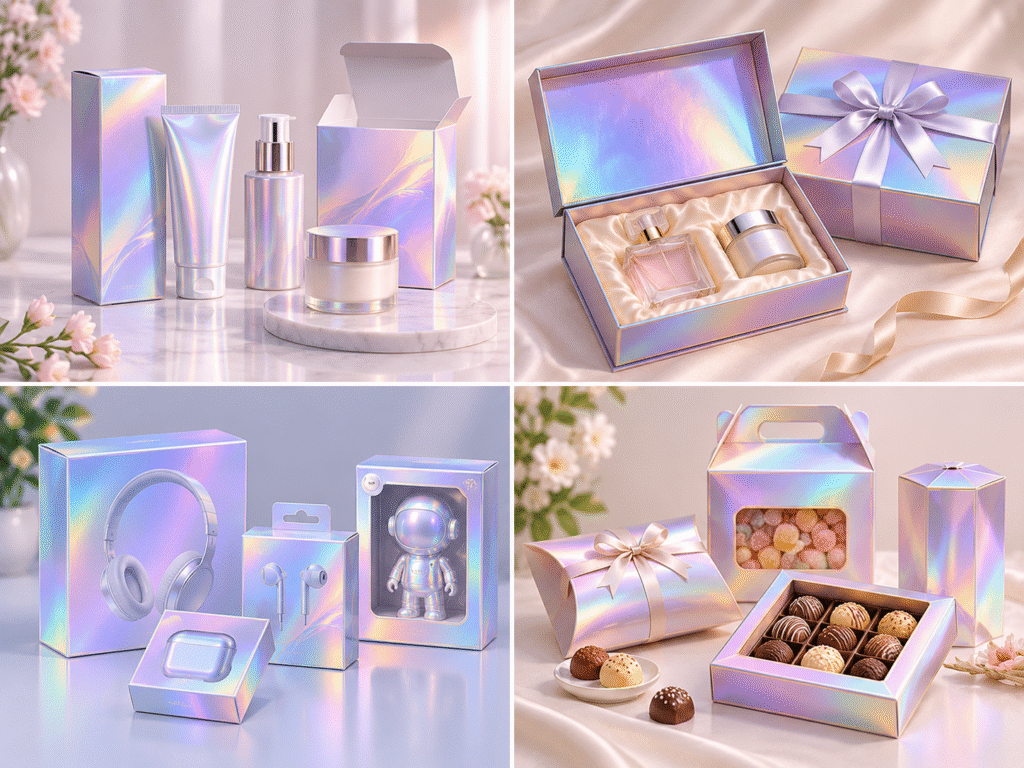
Cosmetics and Personal Care
Holographic surfaces can support a contemporary or expressive appearance for makeup, skincare, and special collections.
Keep ingredients, instructions, and variant identification legible. The effect should distinguish the collection while leaving room for clear product communication.
For custom folding paper boxes, assess the optical treatment alongside closure performance, filling access, and the packed product.
Gift Sets and Rigid Presentation Boxes
A holographic wrap can decorate a structured base or lid. It can also be limited to an internal panel revealed during opening.
With rigid presentation boxes, consider wrapped corners, edge wear, adhesive compatibility, and the relationship between the lid and base.
The supporting board and insert provide structure. The decorative wrap should not be credited with protection it has not been designed to deliver.
Electronics, Accessories, and Collectibles
Optical effects can complement certain technology products or collectible editions. Their suitability still depends on the brand and audience.
Do not confuse a metallic appearance with electrostatic protection. Sensitive products may need a separately specified protective system.
Confectionery and Food Gifts
Holographic cartons can act as decorative outer packaging around appropriately protected food.
Direct contact requires a suitable finished construction for the intended conditions. Appearance, metal content, or a generic “food-grade” description alone does not establish that suitability.
Decorative Effects and Authentication Are Different
A stock rainbow pattern can be purchased and reproduced in many packaging designs. It should not be presented as a dependable authentication feature by itself.
Purpose-designed security holography may involve controlled origination, distinctive optical elements, restricted supply, and a defined verification process.
Even then, the feature must be connected to a practical inspection method. Users need to know what to check, and supply-chain controls must support the physical feature.
If authentication is part of the brief, specify it separately from the decorative finish. Do not assume that adding a shiny seal prevents counterfeiting or reveals tampering.
Cost: Compare the Complete Construction
Cost depends on substrate, process, coverage, pattern availability, printing, finishing, conversion, order quantity, and yield.
A stock material with flexible pattern placement can have a different cost profile from a custom registered effect. A small foil accent can also require setup that matters on a short run.
For an illustrative comparison, suppose the decorative upgrade costs $0.18 per unit and adds a $300 setup charge. At 5,000 units:
Added cost = (5,000 × $0.18) + $300 = $1,200
Average added cost = $1,200 ÷ 5,000 = $0.24 per unit
These are hypothetical inputs, not a quotation. They show why setup and run costs should be separated when comparing options.
Visual distinctiveness does not guarantee higher sales or a positive return. Evaluate appearance, customer response, damage, assembly, and total cost in the context of the product.
Recycling and Environmental Claims
“Holographic” does not describe a disposal category.
A retained-film laminate, a transfer-decorated board, and a foil-accented carton can have different constructions. Local collection and processing systems also differ.
A carrier removed during transfer is different from a film retained in the final package. However, carrier removal alone does not establish that the complete package is plastic-free, compostable, or accepted in every paper stream.
Request evidence for the exact material and claim. Include windows, inserts, adhesives, and later coatings when evaluating the finished package.
Avoid broad environmental statements based solely on a supplier’s description of the undecorated paper.
What to Approve Before Ordering
A clear specification should identify the base grade, construction, pattern code, direction, caliper, printing, white-ink areas, finishing, and required quantity.
Agree which sample controls appearance and how normal variation will be assessed. Review pattern boundaries and registration where they affect the design.
When evaluating a custom packaging manufacturer, discuss material sourcing, converting trials, and how substitutions will be handled.
For a Packboxprint packaging inquiry, include product dimensions, weight, packaging style, artwork, and a reference for the desired effect. Confirm material and process availability before finalizing the design.
The aim is a finished package whose optical appearance, readability, construction, and cost have all been considered together.
Frequently Asked Questions
1. What is holographic paper?
It is paper or paperboard carrying a surface that produces changing optical effects. Many decorative grades use microscopic diffractive structures to create shifting colors, patterns, or apparent movement.
2. Is holographic paper the same as metallic paper?
No. Metallic paper can be reflective without producing a holographic color shift. Holographic materials use an optical structure that changes the visible effect with lighting and viewing angle.
3. Does holographic paper always contain plastic film?
No. Some constructions retain a film laminate, while others transfer decorative layers and remove the carrier. Request the finished material composition for the specific grade.
4. Can holographic paper be printed in full color?
Suitable grades can support full-color printing using an appropriate process. The substrate influences the result, so ink compatibility, opacity, and representative samples matter.
5. Why is white ink used on holographic packaging?
White ink can provide an opaque background beneath selected graphics. This helps control appearance and readability while leaving other areas exposed for the optical effect.
6. Is holographic paper waterproof?
Not inherently. Particular surfaces may resist some exposure, but paper edges, folds, and joints remain relevant. Specify and test moisture performance for the intended application.
7. Does holographic paper prevent counterfeiting?
A generic decorative pattern is not a reliable authentication system. Purpose-designed security features require separate development, controlled supply, and a practical verification process.
8. Can holographic board be folded into cartons?
Suitable grades can be converted into cartons, provided the structure and crease setup suit the material. Test cracking, separation, closure behavior, and printed folds.
9. Is holographic paper recyclable?
It depends on the finished construction and local recovery systems. Assess retained films, coatings, additional components, and supporting evidence rather than making a claim from appearance alone.
10. What should I provide for a custom holographic packaging quote?
Provide product dimensions, packed weight, box style, quantity, artwork, and the desired effect. Identify any required pattern position, print treatment, performance needs, and environmental documentation.