A headset, a circuit board, and a desktop printer may all be electronics, but they place different demands on packaging. Their vulnerable surfaces, weight distribution, electrical sensitivity, and routes to the customer determine what the package needs to do.
Material selection becomes difficult when those requirements are reduced to a single question: which material is strongest? A stiff presentation box may transmit an impact into the product. A well-designed fiber insert may provide useful cushioning inside a relatively simple shipping carton. Neither result can be predicted from appearance alone.
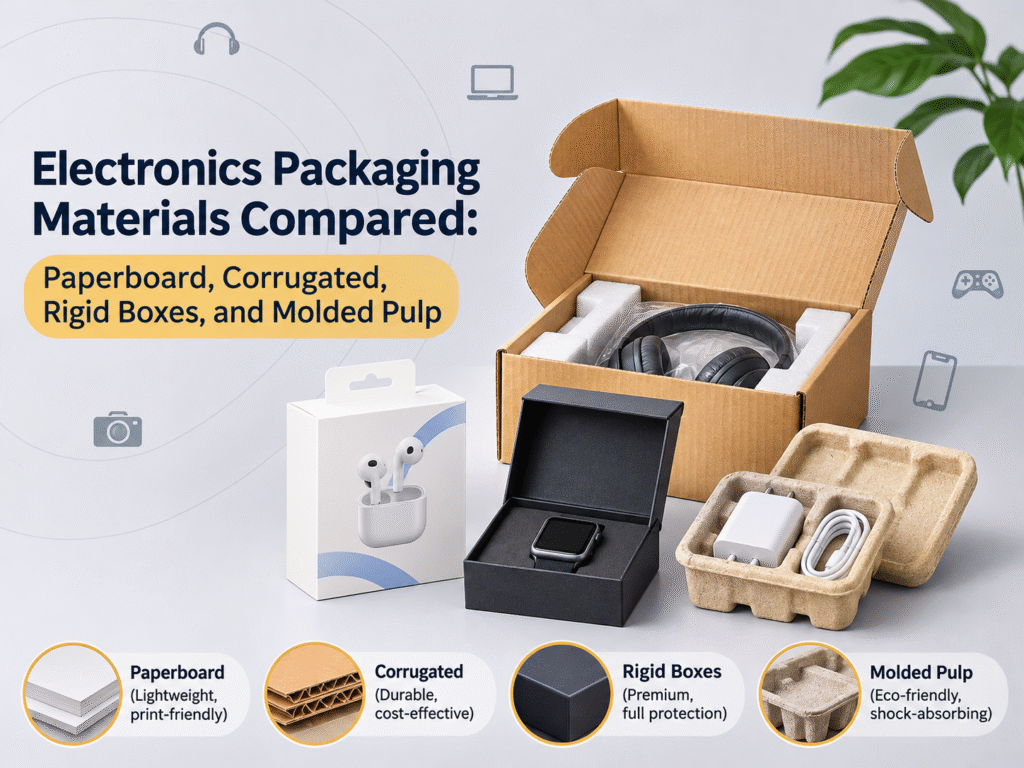
Paperboard, corrugated board, rigid boxes, and molded pulp each have a useful role. This guide compares them as parts of a complete packaging system and explains what to specify when developing custom electronics packaging with Packboxprint.
Compare Functions Before Comparing Materials
These four categories are not direct substitutes in every application. Paperboard and corrugated board describe sheet materials. A rigid box describes a construction, usually incorporating structural board, wrapping, and lining. Molded pulp describes a forming approach used to create trays, supports, and other shaped parts.
A package may combine several categories. A premium device can use a rigid retail box, a molded fiber tray, and a corrugated outer carton. A small accessory may use a folding carton with an integrated paperboard support.
Start by assigning responsibilities: which component resists stacking loads, which locates the product, which cushions an impact, and which protects the finish? Define any electrical or environmental protection separately.
| Option | Common role | Main advantage | Main qualification |
|---|---|---|---|
| Paperboard | Folding carton, sleeve, partition, or platform | Efficient printed retail structure | Limited cushioning unless engineered into the design |
| Corrugated board | Shipper, mailer, partition, or folded support | Versatile structural protection | Grade, geometry, and packed-system performance matter |
| Rigid box | Presentation case with fitted internal components | Firm construction and controlled presentation | Stiffness does not establish impact protection |
| Molded pulp | Shaped tray, end cap, or protective support | Integrated product location and support geometry | Tooling, contact surfaces, and cushioning need validation |
These are selection starting points, not performance ratings.
Paperboard: Efficient Retail Packaging for Accessories
Paperboard folding cartons are useful for chargers, cables, adapters, and other products that need a compact printed package. The same material can form an internal platform or partition.
Where Paperboard Works Well
A flat sheet can be printed, cut, creased, and glued into a structure that stores efficiently before filling. The printable surfaces support product identification and instructions without requiring a separate decorative wrap.
A folded platform can locate a small device above an accessory compartment. Partitions can keep a cable connector away from a finished surface. Hang-tab formats can support appropriate retail display requirements when the complete loaded construction is verified.
For brands considering custom folding paper boxes, the key decisions include board grade, closure, panel size, and the internal support arrangement.
Limits to Address
Paperboard does not provide a universal cushioning layer. A carton that keeps its shape on a shelf may still need an outer shipper and protection for individual parcel delivery.
Large unsupported panels can flex, and closures need enough retention for the load. Integrated supports should be checked for buckling, tearing, and incorrect assembly. Product weight alone cannot determine the correct board.
Specify thickness and relevant material properties separately from grammage. Grams per square meter describes mass per area; it does not uniquely identify thickness or finished-package strength.
Paperboard is a strong candidate when compact retail presentation and efficient conversion matter, provided the rest of the system supplies the necessary transport protection.
Corrugated Board: A Flexible Structural Option
Corrugated board combines liner papers with a fluted medium. The Fibre Box Association describes how those components work together. The fluted construction creates a different structure from a solid folding-carton sheet.
Where Corrugated Works Well
Corrugated can form shipping cartons, mailers, dividers, and folded protective elements. It can accommodate a wide range of layouts, including end supports for longer products and compartments for accessories.
A corrugated mailer may combine the customer-facing box and shipper in one structure. That can simplify packing, but only if the package meets the required appearance and distribution criteria after transit.
Review custom mailer boxes when evaluating that approach. Agree whether shipping labels, tape, and transit scuffing are acceptable on the box the customer first sees.
What to Specify
Flute designation is one part of the specification. Liner and medium selection, wall construction, flute direction, converting quality, and box geometry also affect performance.
Edge-crush measurements can inform material selection, but they do not directly establish the cushioning performance of a packed device. Likewise, a material test does not by itself approve a completed box for a particular stacking arrangement.
Check the insert and closure alongside the outer board. A stronger shipper cannot stop a loose power adapter from striking a screen inside it.
Corrugated is often a useful starting point for distribution packaging. Its suitability still depends on the completed design, environmental conditions, and actual handling route.
Rigid Boxes: Presentation With Additional Engineering Needs
A conventional rigid box uses structural board assembled into a case, often covered with printed or specialty paper. The product usually sits in a separate tray or support system.
Where Rigid Boxes Work Well
Rigid construction gives designers control over panel shape, lid fit, surface texture, and the sequence of opening. It can suit headphones, wearables, and other products where the package contributes to the retail experience.
A lift-off lid, hinged case, or drawer changes how customers reach the product. Those choices should support comfortable access and secure retention rather than adding layers without purpose.
The custom rigid boxes page provides a starting point for discussing case structures. Define the product support and shipping arrangement at the same time.
Costs and Limitations
Conventional setup boxes occupy space before filling. Collapsible designs offer a different supply arrangement but introduce their own assembly and structural details. Include storage and handling when comparing quotations.
Rigid board resists deformation, but a stiff wall is not a tuned cushion. The insert must manage contact and support, and the shipping system must protect both product and retail presentation.
Wrapped corners, surface finishes, and lid alignment also create quality requirements. A functioning device inside a visibly damaged premium case may still be unacceptable for sale.
Choose rigid construction when its presentation and usability justify the complete cost. Product price alone is not a reliable rule for deciding when a rigid box is necessary.
Molded Pulp: Shaped Support for the Product
Molded pulp, also called molded fiber, is formed into three-dimensional components from a fiber suspension. Processes and finishing methods vary, producing different surface qualities and geometries.
Where Molded Pulp Works Well
A molded tray can locate the device, separate accessories, and create ribs or supports within one part. End caps can support larger products while leaving selected surfaces clear of the outer carton.
Its value lies in the engineered shape. Supporting strong areas of a housing and maintaining clearance around vulnerable features can be more useful than copying the product outline closely.
Molded pulp can work inside paperboard, corrugated, or rigid packaging. It is usually evaluated as part of that combination rather than as an alternative outer box.
Development Considerations
Custom parts require tooling and a design that can be formed and removed from the mold. Draft, wall transitions, nesting, and dimensional variation need discussion with the converter.
Assess the proposed fiber composition, surface finish, and process. Check for abrasion, dust, and marking on glossy plastics, coatings, lenses, or displays. Add a suitable interface where needed rather than assuming direct contact is harmless.
Cushioning depends on geometry, material behavior, load, and impact conditions. A tray that holds a product securely during unboxing may still be too stiff or too easily compressed during transit.
Confirm tooling cost, sample stages, production capacity, and change-control arrangements. There is no universal order quantity at which molded pulp becomes the cheapest option.
Design Protection Around the Failure Mode
A useful packaging brief identifies what can fail. For a monitor, that may include screen contact or housing distortion. For a router, it may include a projecting antenna. For a precision instrument, internal movement can matter even when the enclosure appears undamaged.
Ask the product team for vulnerable zones, approved support areas, and available shock or vibration information. A close fit does not automatically provide the right protection.
The support system needs enough working space to manage the expected impact without allowing the product to strike the outer wall. Excessive compression can leave insufficient movement available; excessive freedom can let the device accelerate inside the package.
Separate accessories from critical surfaces. Check the cable, plug, manual, and charger in every relevant orientation. A neatly arranged opening view does not show what happens when the package is inverted.
Treat Electrostatic Protection as a Separate Specification
Ordinary paperboard, corrugated board, rigid board, and molded pulp should not be assumed ESD-protective. Their appearance and fiber content do not establish the electrical properties needed for a sensitive item.
The EOS/ESD Association’s control guidance distinguishes low charging, conductive or dissipative behavior, and discharge shielding. Those properties serve different purposes. An “anti-static” description alone does not establish the complete protection required.
Have the responsible electronics or ESD team define the packaging requirements for the product and handling environment. Exposed boards and modules require particular attention, but an enclosed consumer device should also be assessed from its documented susceptibility rather than appearance alone.
Where a qualified protective bag or other enclosure is used, preserve its closure, fit, and condition within the mechanical design. Avoid sharp folded edges or pressure points that could damage it.
Request evidence for any claimed electrical performance. Test methods, conditions, and applicable material specifications should be agreed before substitution. Color alone is not evidence that a bag, foam, or tray provides the required protection.
Account for Moisture, Dust, and Surface Damage
Fiber-based packaging responds to its environment. Evaluate the proposed construction under the humidity and storage conditions relevant to the route, particularly where compression or close fits matter.
A retail coating does not create a sealed moisture barrier. If the device needs controlled humidity, define the barrier system, sealing method, and any associated moisture-control components with the product team. A loose desiccant packet inside an unsealed carton is not a complete specification.
Cleanliness is a separate issue. Test contact materials against the actual finish, including any protective film. Paper dust, cut edges, or repeated movement can be unacceptable around optical or highly polished surfaces.
Record the required condition on arrival. “No functional damage” is incomplete if scratches, contamination, or crushed retail packaging also make the product unsaleable.
Use Combinations That Match the Sales Channel
These examples show potential architectures to evaluate, rather than ready-approved specifications.
| Product and channel | Possible combination | Main validation questions |
|---|---|---|
| Cable or adapter sold through retail | Paperboard carton with folded retention; master shipper | Closure, display strength, and accessory restraint |
| Premium headphones sold online | Rigid retail case, fitted tray, corrugated shipper | Contact pressure, surface condition, and complete transit performance |
| Router shipped directly to customers | Corrugated mailer with folded or molded supports | Antenna clearance, adapter separation, and support behavior |
| Larger appliance | Corrugated carton with engineered end supports | Load paths, conditioning, compression, and impact |
| ESD-sensitive module | Qualified electrical protection inside mechanical support and shipper | Electrical properties, enclosure integrity, and handling process |
The same product may need different packaging for different channels. Bulk pallet distribution, retail replenishment, and individual parcel shipment expose packages to different arrangements and handling.
Do not remove the outer shipper simply because the retail box appears substantial. If one box is intended to perform both roles, validate that configuration directly.
Measure Fit and Shipping Space Separately
Specify the clear internal cavity around the complete protected assembly. Include accessories, bags, and any agreed loading clearance.
Keep the maximum closed exterior in the specification where logistics constrain the design. Reinforced walls, lids, wraps, and inserts make the relationship between internal and external size construction-specific.
For example, reducing an external package from 300 × 220 × 120 mm to 280 × 210 × 110 mm reduces geometric volume from 7.92 liters to 6.468 liters, approximately 18.3%. That may improve storage or shipping efficiency, but the actual benefit depends on the logistics arrangement and applicable pricing.
Treat the smaller design as a proposal to test. Removing required protective space to reach a target volume can create a larger cost through damaged products.
Compare Total Cost, Including Development
Compare quotations for complete systems meeting the same requirement. Include the outer box, insert, electrical protection where specified, printing, tooling, assembly, freight, and storage.
Consider two illustrative insert proposals:
| Proposal | Tooling | Unit price | Cost at 5,000 units | Cost at 20,000 units |
|---|---|---|---|---|
| A | $500 | $1.20 | $6,500 | $24,500 |
| B | $3,000 | $0.80 | $7,000 | $19,000 |
Under these assumptions, the additional $2,500 tooling cost for B is recovered through a $0.40 unit saving at 6,250 units. This is a financial illustration, not a material-specific quotation.
Both proposals must meet the required performance. Include tool changes and product redesign risk when forecasting the useful production volume. A lower unit price is less attractive if a changing device requires new tooling before the savings are realized.
Evaluate Environmental Claims at Package Level
A fiber-based package can support material-reduction and recovery goals, but its full construction matters. Coatings, laminates, adhesives, plastic windows, magnets, and bonded inserts can affect separation and recovery.

Specify recycled content and sourcing requirements precisely. Recyclability depends on the finished package and the collection and processing systems serving the intended market. Do not infer compostability from the word “paper.”
Evaluate the complete bill of materials through Packboxprint’s material options, then confirm the proposed grades and evidence. Reducing unnecessary layers while maintaining product protection is a practical starting point.
Keep the protection function in the assessment. A material saving that causes avoidable product loss can undermine the purpose of the change.
Validate the Product and Package Together
Choose a test program that reflects the distribution route. ISTA’s test procedures distinguish parcel, less-than-truckload, and unitized-load environments, among others. Ask the laboratory to confirm the appropriate procedure and current requirements.
A blank box test or informal drop cannot establish the performance of every device packed inside that structure. Evaluate production-representative products, accessories, inserts, closures, and shipping arrangements.
Define acceptance criteria before testing. Include product function, connector condition, display and enclosure appearance, package retention, and any required retail presentation.
Document sample revisions and environmental conditioning. If failures occur, investigate the load path and failure mechanism before simply increasing board thickness. Retest relevant changes, and keep electrical protection verification alongside the mechanical program.
Prepare a Useful Manufacturer Brief
Send the device dimensions, packed weight, product variation, vulnerable areas, approved support zones, accessories, and distribution route. Include electrical and environmental requirements from the responsible technical team.
Add the target quantities, launch schedule, artwork, cost scope, assembly method, and acceptance criteria. Identify which components the supplier is expected to develop or source.
Use Packboxprint’s design services to discuss structural options. Review the company’s manufacturing background and request a project-specific quotation, including sampling and performance verification.
The best choice is the material combination that meets those documented requirements consistently. A credible proposal explains the construction, its limitations, and how the completed package will be approved.
Frequently Asked Questions
1. Which packaging material is best for electronics?
It depends on the device, vulnerabilities, and distribution route. Paperboard suits many retail structures, corrugated provides versatile shipping structures, rigid boxes support presentation, and molded pulp provides shaped internal support.
2. What is the difference between paperboard and corrugated board?
Paperboard used for folding cartons is a solid sheet construction. Corrugated board incorporates a fluted medium and liners. Their geometry and intended roles differ; neither name alone specifies finished-package performance.
3. Does a rigid box provide better shock protection?
Not automatically. Stiffness and cushioning are different characteristics. The product supports, protective spacing, outer shipper, and complete test results determine whether the package manages impacts effectively.
4. Can molded pulp replace foam?
It can in suitable applications after redesign and validation. Compare cushioning, contact surfaces, dimensional variation, and environmental behavior. Copying a foam outline into molded fiber does not guarantee equivalent performance.
5. Are ordinary paper boxes anti-static?
No electrical protection should be assumed. Specify required ESD properties with the product’s technical team and obtain appropriate evidence for the materials and packaging configuration.
6. Does an enclosed device need ESD packaging?
Assess its documented susceptibility, exposed interfaces, and handling conditions. A housing alone is insufficient evidence to make a universal decision. The responsible electronics team should define the requirements.
7. Can a corrugated mailer also be the retail box?
Yes, if the complete configuration meets distribution, closure, and appearance requirements. Test it without an additional shipper when that is the intended delivery method.
8. Is molded pulp always recyclable?
Do not assume universal acceptance. Fiber composition, treatments, contamination, and local recovery systems matter. Confirm the finished component and intended market before making a claim.
9. What tests should electronics packaging undergo?
Select mechanical and environmental evaluations suited to the product and route, with functional and cosmetic acceptance criteria. Verify any specified electrical protection separately as part of the overall approval process.
10. What should I send Packboxprint for a quote?
Provide the device and accessory details, dimensions, weight, vulnerabilities, channel, technical protection requirements, artwork, quantity, and schedule. Ask the quotation to identify materials, tooling, assembly, samples, and validation responsibilities.