A bakery needs a liner that releases a baked product cleanly. A barbecue kitchen needs a wrap that survives handling while giving the meat the surface texture the cook wants. A food retailer may need a sheet that folds neatly, contains juices during service, and carries a brand design.
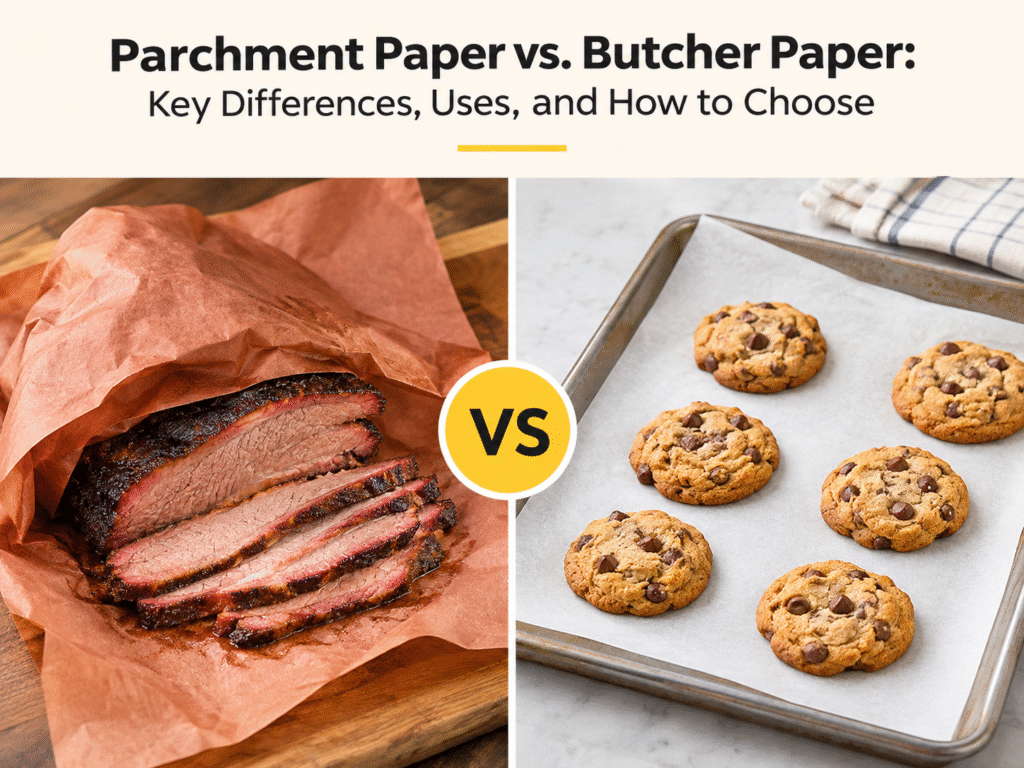
Parchment paper and butcher paper can look similar on a roll, yet these jobs call for different properties. Choosing by color or thickness alone can leave food stuck to a liner, a wrap tearing at a fold, or a paper used beyond its stated conditions.
Choose parchment paper for a specified baking-release task. Choose butcher paper for a suitable wrapping or barbecue application, using a grade approved for that operation. For food-service packaging, define the food, contact time, temperature, and handling method before selecting either.
This guide compares their construction and performance, then explains what to specify when developing a paper liner, wrap, or coordinated custom packaging project.
What Is Parchment Paper?
Parchment paper, commonly called baking paper, is a paper product developed for grease resistance and release in baking and food preparation. Many commercial baking grades have a silicone treatment on one or both surfaces. The treatment helps food separate from the sheet.
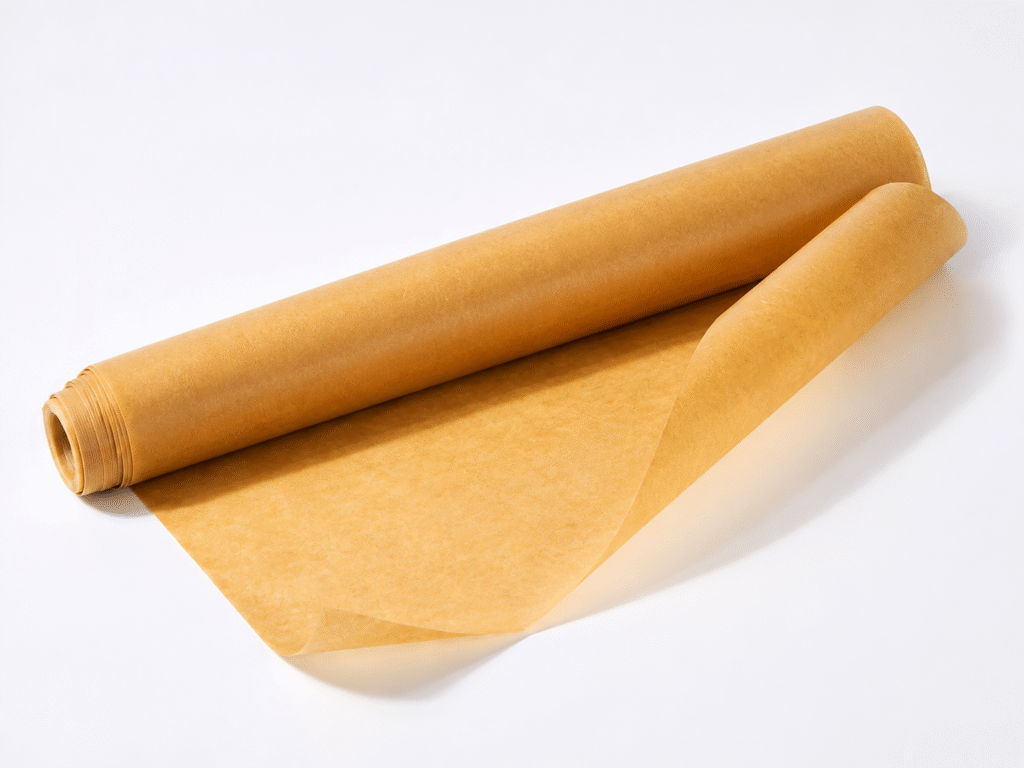
The base paper and surface treatment both matter. Nordic Paper, for example, describes its Silidor Parchment grade as a silicone-treated natural greaseproof paper with wet strength and heat stability. A buyer should identify the actual grade and treatment instead of assuming all baking papers have the same construction. Nordic Paper Silidor Parchment
Typical applications include lining baking trays, separating sticky products, rolling dough, and preparing certain cooking packets. Suitability depends on the product instructions. A sheet that performs well under a cookie can behave differently under a sugary filling, a wet mixture, or repeated production cycles.
Parchment is sold as rolls, flat sheets, and formed liners. Sheet size affects coverage, handling, and waste. For a tray operation, confirm the usable tray dimensions and whether the paper needs to turn up at the edges.
White and Brown Parchment
White and brown options refer to different processing and appearance choices. Bleaching concerns the fiber treatment used to obtain a lighter sheet. Silicone treatment concerns release performance. These are separate specification points.
Ask for the fiber, treatment, food-contact, and environmental declarations relevant to the product. Color alone cannot establish heat tolerance, release quality, recycled content, or a particular disposal route.
What Is Butcher Paper?
Butcher paper is a commercial category of strong paper used for food wrapping and related handling. Products sold under that name vary in fiber, sizing, wet strength, color, and surface treatment.

For smoking, manufacturers offer specific uncoated barbecue grades designed for the stated cooking method. For chilled retail wrapping or display, another grade may be selected for appearance and resistance to wet handling. Identify the grade and intended use before treating two rolls as equivalent.
Reynolds describes its pink butcher paper as a product for wrapping meats during suitable smoking operations and for serving applications. It is designed to resist tears and leaks during the intended use. Those product properties should be confirmed on the particular item being purchased. Reynolds pink butcher paper
Butcher paper is generally not selected for the same non-stick baking release as silicone-treated parchment. A food-contact wrapping sheet can meet its wrapping requirements while still adhering to a sticky baked surface.
Pink, Brown, and White Butcher Papers
Color can help distinguish stock in a kitchen, but approval should follow the product label and specification. Pink paper is commonly marketed for barbecue. Brown and white sheets also appear in food-service wrapping ranges.
A colored sheet may contain a dye or another treatment. Establish what the supplier declares about the actual construction and contact conditions. Ordinary brown packing paper, decorative paper, and a food-contact barbecue grade can look similar.
Parchment Paper vs. Butcher Paper at a Glance
| Selection factor | Baking parchment | Butcher paper |
|---|---|---|
| Main task to evaluate | Release during baking or specified food preparation | Wrapping, serving, or a stated barbecue use |
| Surface | Commonly silicone-treated for release | Depends on grade; barbecue products are often uncoated |
| Food release | Developed for relevant non-stick applications | Test sticking where the food surface is wet or tacky |
| Moisture behavior | Depends on base sheet, treatment, and package form | Uncoated barbecue grades are selected partly for their moisture-transfer behavior |
| Heat use | Follow the exact paper’s equipment and temperature instructions | Use only a grade identified for the intended heated operation |
| Strength | Compare dry and wet performance for the task | Compare tear resistance and fold integrity under actual use |
| Custom printing | Requires evaluation of surface, ink, and intended contact | Requires evaluation of ink, contact side, heat, and handling |
| Cost comparison | Price per usable liner or successful operation | Price per usable wrap or successful operation |
The table describes what to investigate. A commercial paper name leaves several properties open. Obtain a sample and the relevant product documents before choosing a substitute.
Heat Resistance Depends on the Product and Equipment
Published limits differ between products. Reynolds lists its parchment rolls for conventional oven use up to 425°F, approximately 218°C, with specific restrictions on equipment and exposure. Metsä lists SAGA Baking Paper Sheets with heat resistance up to 220°C. Use the instructions for the sheet being supplied. Reynolds parchment rolls · SAGA Baking Paper Sheets
For its pink butcher paper, Reynolds describes suitable indirect, low-and-slow cooking at 300°F or below, approximately 149°C. That is a product-specific example, not a category-wide rating. Check both the paper instructions and the cooking-equipment requirements. Reynolds butcher paper guidance
An oven or smoker setting is one part of the exposure. Contact with a heating element, direct flame, or a broiler creates different conditions. Keep paper away from those exposures and follow the product’s restrictions. Heat resistance does not make either sheet flameproof.
For a commercial process, record the temperature, duration, equipment, and contact arrangement in the approval brief. A supplier can then assess the intended operation against its product data.
Release, Grease Resistance, and Breathability
Clean Release for Baking
Parchment’s release surface helps separate the food from the liner. In production, that can affect breakage, appearance, tray cleaning, and handling time.
Test the recipe that creates the hardest release condition. A plain biscuit and a sticky glazed pastry can leave different residues. Check both immediate removal and removal after the intended cooling period.
Silicone treatment can be present on both sides, but confirm the selected grade. Metsä describes two-sided treatment on specified SAGA products. A one-sided product requires orientation control during cutting, dispensing, and use. Metsä guide to baking and greaseproof papers
Moisture Transfer in Barbecue
Uncoated butcher paper used for barbecue allows moisture to move through the wrap differently from a less breathable construction. The resulting surface texture depends on the food, wrap method, and cooking process.
Reynolds specifically advises against using its parchment paper as a substitute for butcher paper when smoking. Follow that guidance for those products rather than assuming an oven temperature rating authorizes smoker use. Reynolds smoking-paper guidance
In a comparison trial, keep the meat size, preparation, wrap timing, and evaluation method consistent. Record surface texture, tearing, sticking, and fluid reaching the outside of the wrap. Changing several process variables at once makes the paper comparison difficult to interpret.
Grease Resistance During Serving
Grease resistance, absorbency, and leak containment are separate characteristics. A sheet can absorb some liquid while resisting tearing, yet still allow visible staining or fluid passage over time.
For a tray liner or wrap, test contact with the actual food for the intended service period. Include the folds and overlaps. A second sheet may solve one issue while increasing cost or changing how the food is presented.
Review the outer carton at the same time. A correctly chosen liner can protect a printed surface, but the full package still needs suitable support, closure, and ventilation for its use.
Keep Wax Paper, Freezer Paper, and Greaseproof Wraps Separate
These products can resemble parchment or butcher paper, particularly when sheets are removed from their labeled cartons.
Wax paper has a wax-treated surface. It can be useful for certain wrapping or preparation tasks, but it is not a general baking-parchment replacement. Check the manufacturer’s instructions before any heated use. Reynolds wax paper
Freezer paper commonly has a barrier coating on one side. Reynolds identifies a plastic-coated food side on its freezer paper and explicitly says that product should not be used in an oven. Its freezer-storage function does not establish cooking suitability. Reynolds freezer paper
Greaseproof wrapping paper is a broader purchasing description. Specify whether the job requires heat use, baking release, short-term wrapping, or grease resistance during service. A sheet sold for sandwiches may meet that requirement without being suitable for an oven or smoker.
Keep rolls and sheets traceable to their product codes in a commercial kitchen. Color-coded storage can help, but the original label and approved use should remain accessible.
Which Paper Fits Each Application?
| Operation | Starting material to evaluate | What the trial should establish |
|---|---|---|
| Baking cookies or pastries | Parchment approved for the process | Release, browning, residue, and sheet integrity |
| Rolling sticky dough | Suitable parchment | Release during handling and removal |
| Wrapping meat for smoking | Specifically approved barbecue butcher paper | Wrap integrity and the intended surface texture |
| Short-term meat wrapping | Food-contact paper specified for that storage use | Wet strength, fluid containment, and folds |
| Lining a serving tray | A suitable food-contact liner | Staining, tearing, presentation, and contact duration |
| Frozen storage | A specified freezer-packaging construction | Barrier and package integrity under storage conditions |
For a bakery, define whether the sheet stays with the product through cooling and display. It may need to function as a baking liner first and a presentation liner later. The second stage can expose it to condensation, handling, or contact with printed packaging.
For a barbecue kitchen, approve the specific paper for the smoker and wrapping process. Commercially printed serving sheets and smoking wraps should have separately identified uses if their material systems differ.
For takeaway packaging, trial the liner with the folding paper box or tray it will accompany. Check the packed food and outer package at the intended service interval.
Custom Printing Requires More Than a Food-Safe Base Paper
A printed wrap includes the base sheet, treatment, ink, drying or curing, and converting process. Its intended conditions can differ from those approved for an unprinted stock.
Specify which side contacts food and whether sheets are stacked, folded, or rolled before use. Ink transfer can occur through mechanisms beyond direct contact with the printed face. EuPIA provides guidance on migration and good manufacturing practice for printing inks used on food-contact materials. EuPIA food-contact ink guidance
A silicone release surface may also present ink-adhesion challenges. Ask the converter to identify the printable surface and verify adhesion under the intended handling conditions. For a heated application, obtain approval covering the printed construction and exposure.
FDA explains that food-contact assessment considers intended use and migration. Request documentation applicable to the actual food, time, temperature, and destination market. A generic declaration for the base paper leaves the finished printed construction unresolved. FDA food-contact packaging information
Discuss artwork, contact-side positioning, and the outer pack through Packboxprint’s packaging design services. Ask the team to confirm the available material and production route for the particular liner or wrapping requirement.
Specify Sizes and Grammage for the Workflow
Grammage, expressed in g/m² or gsm, describes mass per unit area. It helps calculate material consumption, but release, wet strength, and grease resistance need their own approval criteria.
A 400 × 500 mm sheet has an area of 0.20 m². At 45 g/m², its calculated paper mass is 9 g. Across 50,000 sheets, that is 450 kg before packaging and production waste.
Changing the cut size to 380 × 480 mm reduces the area to 0.1824 m². At the same grammage, each sheet weighs 8.208 g, a reduction of 39.6 kg across 50,000 sheets. Verify coverage, overlap, and operator access before making the cut smaller.
Pre-cut sheets can reduce measuring and cutting at the workstation. Rolls can accommodate varying food or tray sizes. Compare the actual tasks, dispenser position, sheet curl, and time needed to produce a usable piece.
For wrapping, establish the overlap and fold sequence using a real product. For tray liners, check the usable base dimensions, corner shape, and required edge coverage. Keep a drawing or physical template with the purchasing specification.
How to Evaluate Samples and Record Specifications
Build a Trial Around the Actual Workstation
For a baking liner, use the intended tray, recipe, oven program, and cooling sequence. Mark the sheet orientation if the treatment is one-sided. Check whether the paper stays flat during loading and whether the product lifts cleanly at the point when staff normally remove it.
For a meat wrap, reproduce the product size, fold pattern, and number of layers. Inspect corners and seams after the relevant handling period. Record whether a failure begins at a cut edge, a sharp food projection, or a saturated fold. Those observations help distinguish a material problem from a sheet-size or wrapping-method problem.
For a serving liner, evaluate the food and container together. Look for fluid reaching the table, tearing as the customer lifts the food, and ink transfer under the actual contact conditions. A sheet that looks clean immediately after packing may show different staining at the intended service interval.
Keep trial comparisons consistent. Use the same food preparation, starting condition, handling steps, and assessment time for each candidate. Record failures as well as successful runs, then agree on the acceptance criteria with the supplier before production.
Record the Approved Purchasing Specification
Keep the commercial paper name alongside its product code, grammage, cut size or roll dimensions, treatment, and contact side. Attach the supplier’s current use instructions and relevant declarations. This gives a substitute supplier a concrete brief and gives the kitchen a way to identify the approved material.
If the supplier proposes another grade, review the properties that control the task. Equivalent GSM alone cannot establish equivalent release or wet strength. Recheck the affected operation when the base paper, coating, printing, or cut size changes, and preserve the approved sample with the revised record.
Compare Cost Per Successful Use
Compare quotations using the same area, count, grammage, treatment, printing, and delivery basis. A lower roll price can conceal a shorter length or narrower width.
Include cutting waste, double-sheet use, breakage, cleaning, and labor. Suppose one approved liner costs $28 per 1,000 sheets and another costs $34. Across 100,000 uses, the second adds $600 in material cost.
If a measured trial shows that it saves two seconds per use, the operation saves about 55.6 labor hours. At an assumed $18 per hour, that models $1,000, leaving $400 before other costs. These figures illustrate a comparison, rather than a claim for a particular paper.
Reuse also needs a defined policy. Follow the product instructions and the food operation’s hygiene controls. Repeated heating, contamination, tears, and loss of release can affect whether another use is appropriate. Keep raw-food tasks separate from ready-to-eat handling.
Environmental Claims Need Product Evidence
Brown color, paper fiber, or a silicone treatment alone does not establish recyclability or compostability. Check the finished sheet, ink, food residue, and available collection route.
Some baking-paper manufacturers make specific compostability claims for identified products. Obtain the evidence and conditions for the grade being bought. Home composting and commercial composting have different operating conditions and acceptance requirements.
FTC guidance explains that environmental claims need supporting evidence and appropriate qualifications. For a business, retain the supplier documents behind the claim and keep disposal instructions relevant to the market. FTC environmental marketing guidance
Working With Packboxprint on a Packaging Brief
For a coordinated food-packaging project, send the product, proposed use, sheet size, and outer-box requirements. Include food-contact conditions, print coverage, order quantity, and any performance or disposal claims.
Use the packaging materials page to begin the material discussion. When reviewing a packaging manufacturer, ask which construction and converting process can meet the brief and which documents cover the intended use.
Approve samples with the actual food and process. Record release, tearing, grease transfer, print adhesion, odor, and the condition of the outer package. Keep the grade, treatment, artwork revision, and approval conditions together for repeat orders.
Send those requirements through the custom packaging inquiry page. Have the supplier confirm the applicable product and production options before committing to a printed run.
Frequently Asked Questions
Can butcher paper replace parchment for baking?
Use a baking paper approved for the recipe and equipment. Butcher paper generally lacks the release surface selected for that task and may have a different temperature limit.
Can parchment replace butcher paper in a smoker?
Only use paper specifically approved for the equipment and process. Reynolds advises against using its parchment in smoking or grilling applications. An oven rating alone does not authorize smoker use.
Which paper tolerates higher temperatures?
Compare the exact products. Published parchment and barbecue-paper limits vary. Include equipment, duration, and exposure conditions in the comparison.
Are parchment and butcher paper both non-stick?
Baking parchment is developed for release. Butcher paper is usually selected for other wrapping properties. Test the actual food where sticking matters.
Is brown parchment better than white parchment?
Color does not establish overall performance. Compare the grade’s release, strength, contact documentation, heat instructions, and environmental evidence.
Is butcher paper the same as freezer paper?
Products vary, but freezer paper commonly includes a barrier coating. A freezer-storage grade must not be assumed suitable for cooking. Check its label and instructions.
Can both papers be custom printed?
Printing suitability depends on the surface and intended use. The finished paper and ink system require approval for the relevant contact and temperature conditions.
Can parchment paper be reused?
Follow the specific manufacturer’s instructions and the operation’s hygiene policy. Consider contamination, damage, and release performance before further use.
Are these papers compostable?
Some identified grades carry supported claims. Verify the finished construction, certification or test evidence, composting conditions, and local acceptance.
What should a business provide when ordering?
Supply the food, task, temperature, contact duration, dimensions, treatment, artwork, quantity, and documentation requirements. A representative sample helps establish the performance target.