A tuck box looks simple until the wrong detail interrupts a packing line. A flap that catches on a bottle cap slows filling. A loose closure opens during handling. A carton that fits the product perfectly may still leave no room for an instruction leaflet.
These are small problems with expensive consequences. For businesses choosing retail packaging, understanding how a tuck box works is more useful than choosing a style by appearance alone.
Tuck boxes combine compact construction, printable surfaces, and convenient opening. They suit many lightweight products, from playing cards and soap to cosmetics and small accessories. Their performance depends on the relationship between the product, paperboard, closure geometry, and packing process.
This guide explains the main structures, how to specify dimensions, and what to check before ordering custom printed tuck boxes.
What Is a Tuck Box?
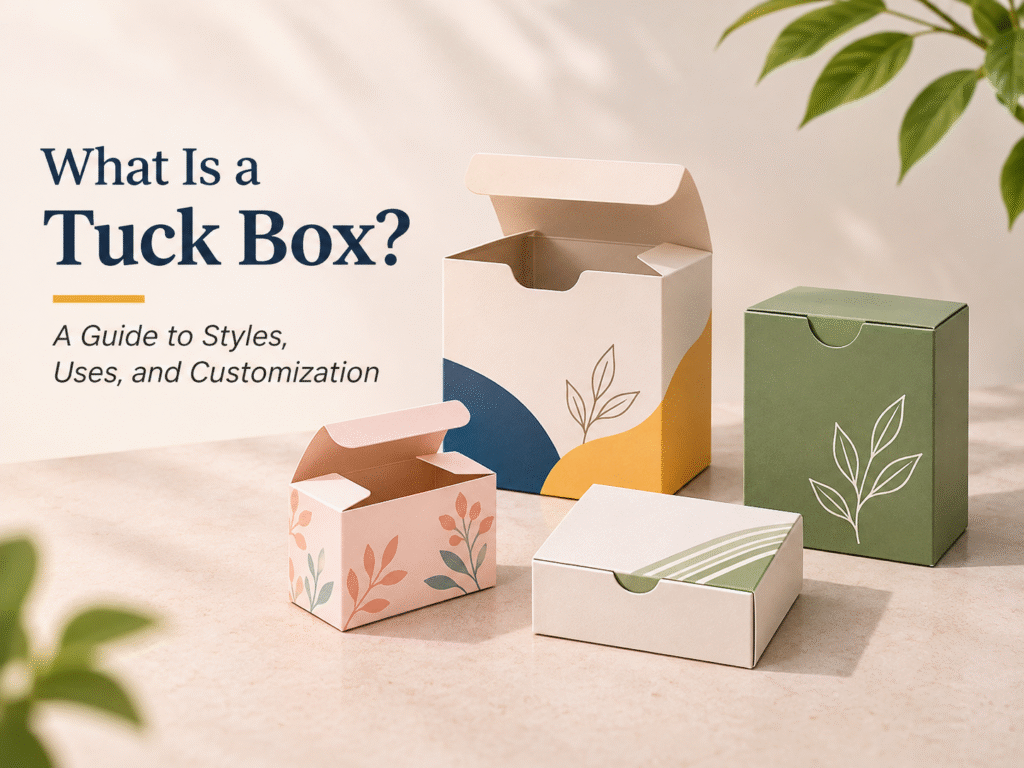
A tuck box is a carton with a closure flap whose extended tab folds into the box body. In a typical paperboard version, the manufacturer cuts and creases a flat blank, glues its side seam, and supplies the carton flattened. The packer opens the carton into shape, fills it, and closes the flaps.
The word “tuck” describes the closure. It does not define the board grade, weight capacity, printing method, or complete box structure.
Most familiar retail tuck boxes are folding cartons. A tuck-top box can also have a manually locking or preglued automatic bottom. Corrugated mailers may use tuck closures too, although their construction and distribution role differ from those of thin paperboard retail cartons.
For brands comparing custom folding paper boxes, the first decision is therefore practical: which closure and material combination suits the product and the way it will be packed?
How Does a Tuck Box Work?
A conventional rectangular tuck carton has front and back panels, two side panels, a side-seam glue flap, and end closures. Crease lines control where the board folds. Smaller dust flaps fold inward beneath the main closure panel.
The main flap spans the opening, and its tuck tab enters between the contents and an inside wall. Depending on the design, retention comes from friction, shaped shoulders, or additional locking features.
Dust flaps help cover the opening and support the closed end. They do not make the box airtight, moistureproof, or suitable for unwrapped food without further assessment.
Likewise, a glue-free opening does not mean the entire carton is adhesive-free. The side seam is commonly glued during manufacture, and automatic-bottom structures contain additional glued areas.
A good closure balances retention with opening effort. Excessive friction can buckle the tab or make the carton frustrating to use. Too little engagement can let it spring open. The product must also leave enough room for the tab to enter without catching.
Common Tuck Box Styles
Style names are helpful, but an approved structural drawing is more precise. Suppliers may use slightly different terminology for related constructions.

Straight Tuck End Boxes
A straight tuck end carton has top and bottom major closure flaps hinged from the same body panel. This arrangement gives both ends a consistent closure orientation.
It is often considered for cosmetics, small consumer products, and presentation-focused retail packaging. The arrangement can help designers manage the main display face and opening experience.
Its suitability still depends on the complete dieline. Straight tuck construction does not automatically provide greater strength or better printing than every reverse tuck alternative.
Reverse Tuck End Boxes
A reverse tuck end carton has its top and bottom major closure flaps hinged from opposite body panels. The ends consequently close in opposite directions.
It is a versatile option for lightweight retail products. Depending on the carton proportions and sheet layout, its blank may nest efficiently during production.
That potential material advantage should be checked in the actual quotation. Board yield depends on sheet dimensions, grain direction, print layout, and tooling. Reverse tuck is not invariably the cheapest choice.
Tuck Top with Snap-Lock Bottom
A snap-lock bottom, often called a 1-2-3 bottom, uses interlocking base flaps assembled in sequence. The top retains a conventional tuck closure.
This can suit products whose base needs a different support arrangement from a simple tuck end. However, the extra folding steps affect manual packing time.
The completed base should be tested with the real product. A broad, evenly distributed load behaves differently from a small metal component pressing against one flap.
Tuck Top with Automatic Bottom
An automatic-bottom carton uses a preglued base that forms as the flattened carton is opened. It is also commonly described as an auto-bottom or crash-lock carton.
This construction can reduce base-assembly work, particularly when packing larger quantities. It introduces additional converting and gluing requirements, which may increase the carton purchase price.
An automatic bottom is not a universal heavy-duty rating. Its capacity depends on board properties, dimensions, glue performance, and loading conditions.
| Structure | Main distinction | Useful consideration |
|---|---|---|
| Straight tuck end | Both major end flaps hinge from the same panel | Presentation and opening orientation |
| Reverse tuck end | Major end flaps hinge from opposite panels | Layout efficiency and filling direction |
| Tuck top, snap-lock bottom | Base flaps interlock manually | Assembly sequence and base support |
| Tuck top, automatic bottom | Preglued base forms during erection | Packing speed and converting cost |
None of these styles is the best choice for every product. A sample filled with the intended contents provides a better comparison than an empty carton.
Where Are Tuck Boxes Used?
Cosmetics and Personal Care
Serums, creams, soap, and small beauty accessories often benefit from compact cartons with clear product identification. Side panels provide space for ingredients, directions, batch information, or multilingual copy.
For bottles, check the cap, pump, and shoulder dimensions. A bottle may fit inside the body while its dispenser obstructs the tuck tab. Glass containers may also need an insert and separate transit protection.
Playing Cards and Games
Card decks are a familiar application because a tuck carton is compact and can be opened repeatedly.
The important measurement is the actual finished stack. Card count, stock thickness, coatings, sleeves, and instruction cards all affect depth. A carton sized for an unsleeved deck may be unsuitable once protective sleeves are added.
Repeated opening also places extra demand on the hinge and tab. Ease of access deserves as much attention as the first closed appearance.
Food, Tea, and Confectionery
Tuck cartons can group individually wrapped chocolates, tea sachets, or other packaged foods. They provide structure and printable space around the primary packaging.
Direct food contact requires separate consideration of the board, inks, coatings, adhesives, and intended use conditions. A paperboard appearance alone establishes no food-contact suitability.
Where freshness depends on a sealed pouch or liner, the outer carton should be designed around that primary pack.
Small Electronics and Accessories
Chargers, cables, and compact accessories can use tuck cartons with folded supports or partitions. The support should prevent movement without making removal difficult.
A paperboard carton does not inherently protect sensitive components against electrostatic discharge. Where required, an appropriate protective system must be specified separately.
Tuck Boxes, Rigid Boxes, and Shipping Cartons
Tuck boxes belong within the broader folding-carton category. Comparing “tuck boxes versus folding cartons” as if they were mutually exclusive creates unnecessary confusion.
The more useful comparison is between packaging systems.
| Packaging format | Typical construction | Common role |
|---|---|---|
| Paperboard tuck carton | Cut, creased, and usually side-seam glued | Retail presentation and product grouping |
| Rigid presentation box | Thick board with wrapped surfaces | Structured presentation and gifting |
| Corrugated shipping carton | Fluted board with suitable closures | Distribution and transport protection |
Rigid construction may suit a more substantial presentation brief, while a folding carton can offer efficient flat storage and simpler handling. Either format may need a separate shipping package.
A thin retail tuck carton should not be assumed suitable for direct parcel delivery. Drops, vibration, compression, and moisture exposure introduce requirements beyond normal shelf handling.
Choosing Paperboard for Custom Tuck Boxes
Board selection affects stiffness, crease quality, surface appearance, and closure behavior. Specifying only “thick cardboard” leaves too much open to interpretation.
Bleached and Coated Boards
Bleached paperboards can provide a bright printing surface for product images, small text, and controlled brand colors. Coated surfaces influence ink holdout and finish appearance.
A clean white face does not establish a particular strength level. The carton still needs a suitable grade, thickness, and structural design.
Folding Boxboard
Folding boxboard commonly uses a layered construction to balance bulk, stiffness, and printing requirements. It can be considered where a carton needs structure without unnecessary weight.
Different grades behave differently. Ask for a defined material specification and assess samples in the intended production thickness.
Kraft and Recycled Grades
Brown boards can support a restrained, natural-looking design. Their surface color also changes the appearance of printed inks, particularly pale colors and fine reversed text.
Recycled-content boards offer another sourcing option, but recycled content alone does not establish fitness for every application. Odor, cleanliness, appearance, and contact requirements should match the product.
Packboxprint’s packaging material options provide a useful basis for discussing the required surface, structure, and finish.
GSM, Caliper, and Grain Direction
GSM measures mass per unit area. Caliper measures thickness. Two boards with the same GSM can have different thicknesses and bending properties.
Grain direction and crease design also affect folding resistance and cracking. Changing the board after approving a dieline can alter how the carton erects and closes.
A production specification should identify the board grade and nominal caliper as well as grammage, where relevant.
How to Measure a Tuck Box Correctly
Begin with the product as it will actually be packed, including labels, caps, bags, leaflets, and protective components.
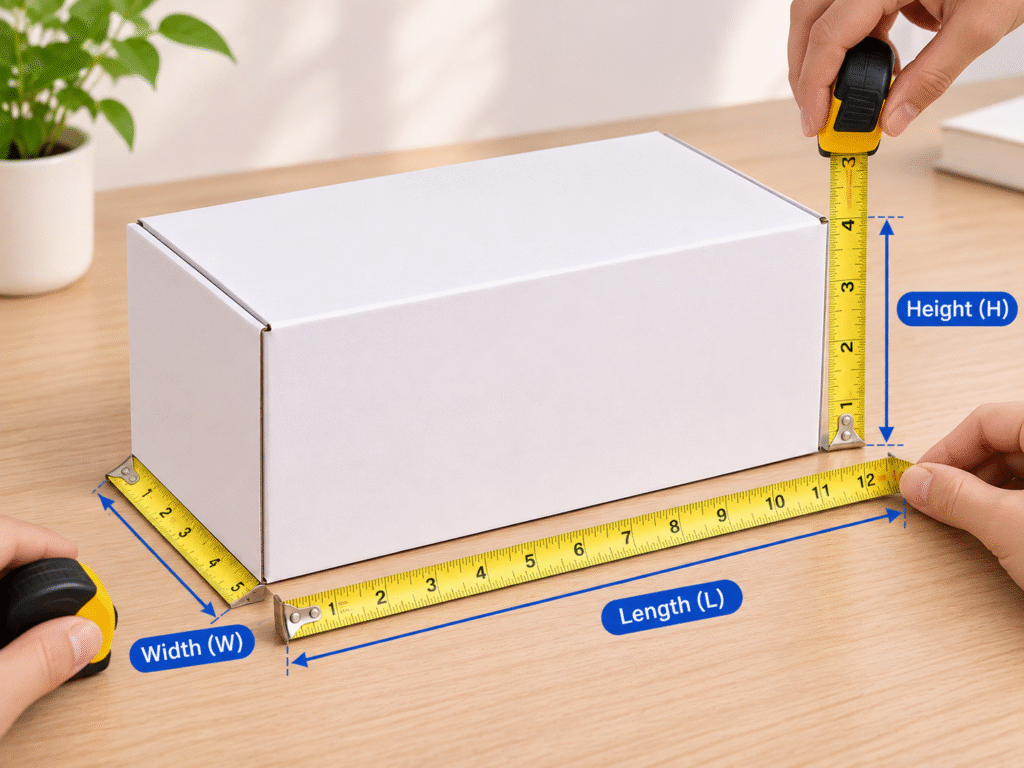
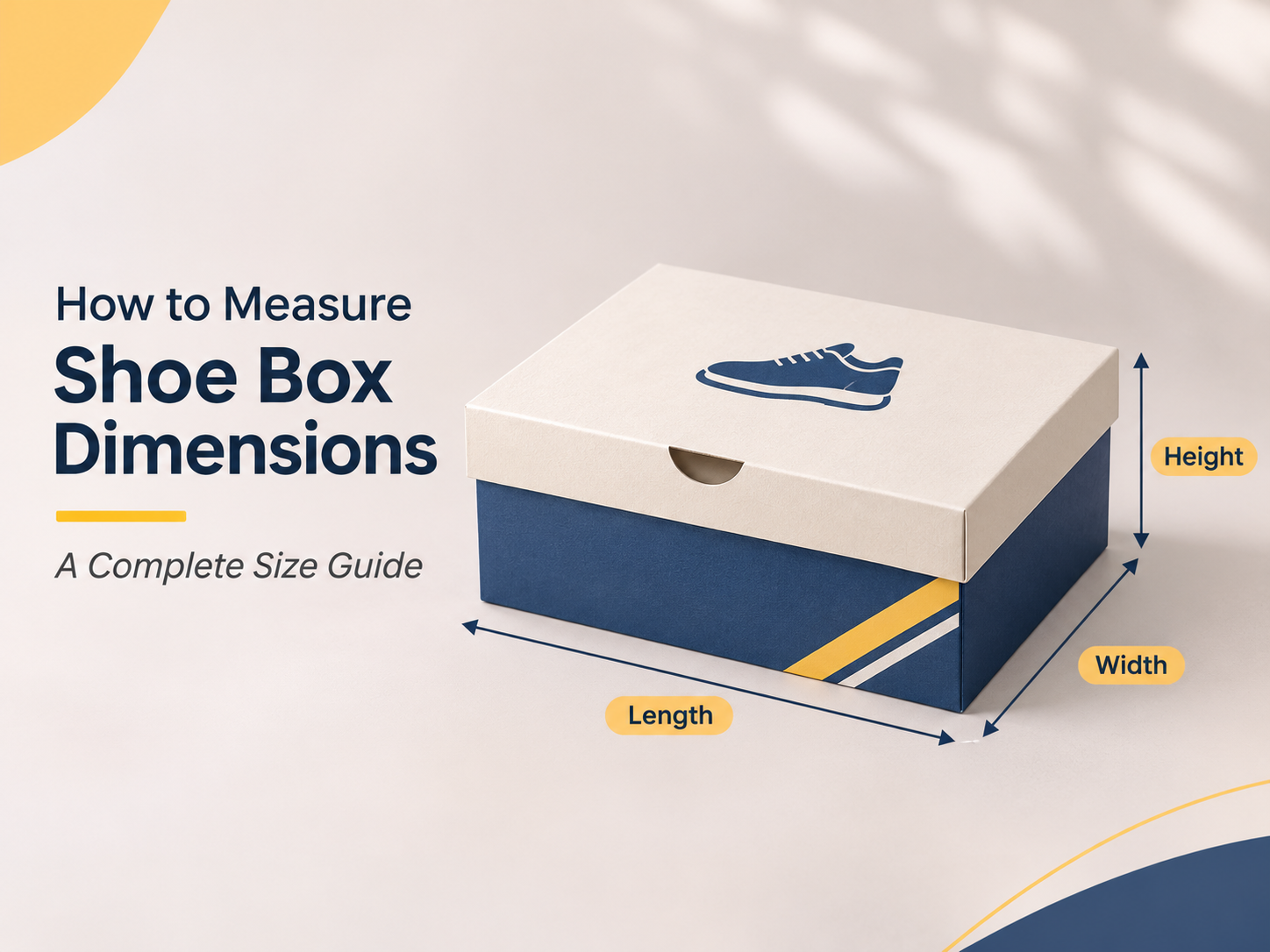
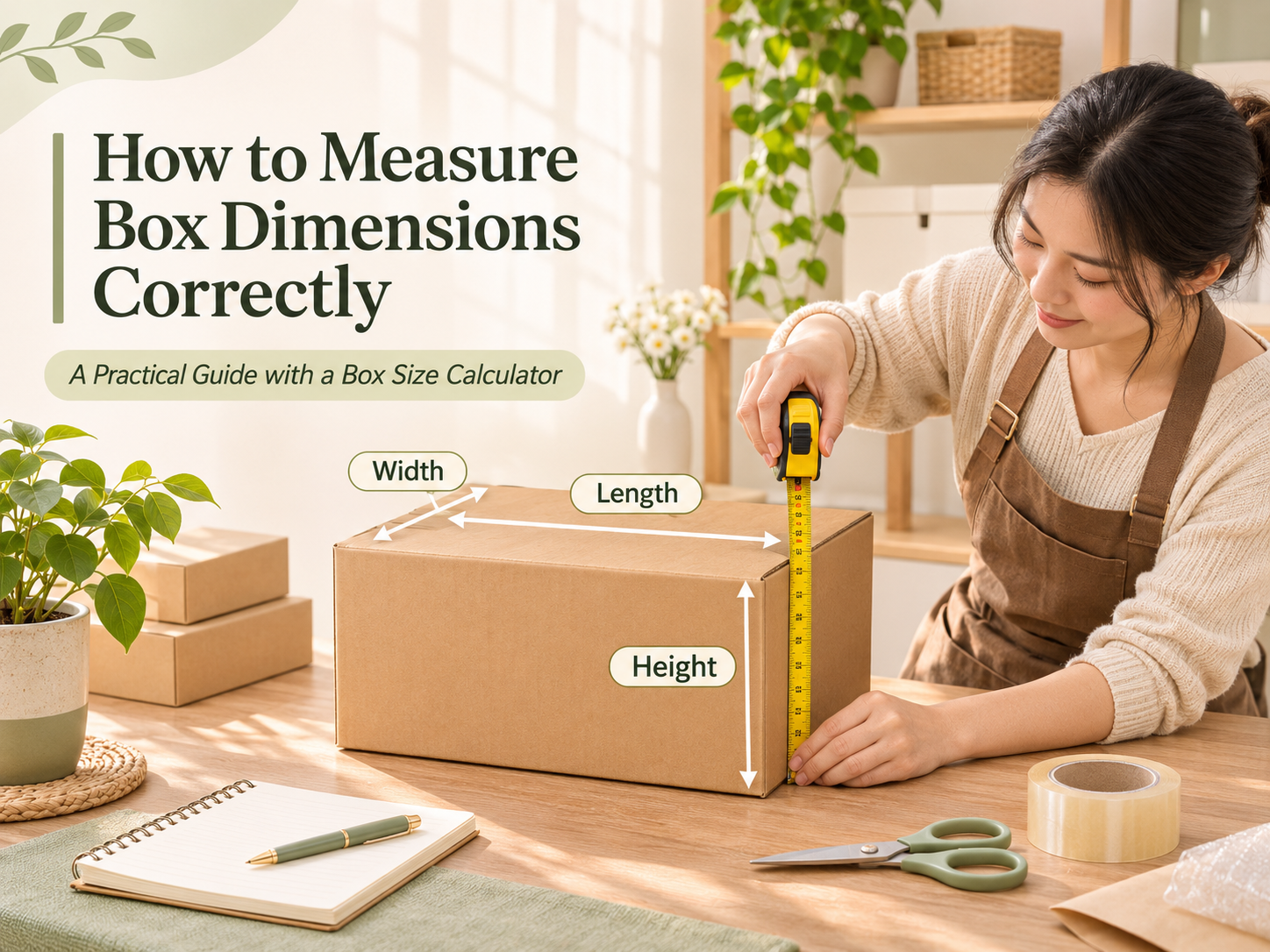
Record the maximum dimensions rather than measuring only a convenient flat surface. For a bottle, the closure may be wider than the body. For a card deck, the wrapped stack may be thicker than the loose cards.
Use clearly labeled length, width, and height measurements, and confirm their orientation on the drawing. A supplier may describe the same upright retail carton using width, depth, and height.
Internal and External Dimensions
Internal dimensions describe the available space inside the assembled carton. External dimensions describe its outside envelope.
Product fit depends on the usable interior. Shelf planning, master-carton packing, and shipping calculations depend on the outside dimensions of the relevant package.
The difference is affected by material thickness, folded layers, and construction. Do not estimate a finished carton simply by subtracting twice the board thickness from every outside measurement.
Clearance and Closure Space
There is no universal clearance allowance that works for all tuck boxes. It depends on product variation, loading method, insert geometry, and acceptable movement.
Consider an illustrative product measuring 60 × 30 × 100 mm. A trial cavity of 64 × 34 × 106 mm provides 4 mm of total additional space in each horizontal direction and 6 mm vertically. These figures are a prototype starting point, not a production recommendation.
The sample must confirm that the product loads easily, remains stable, and leaves room for the closure tab. Adding an insert changes the space calculation again.
For automated filling, small dimensional differences may affect feeding and insertion. Agree tolerances with both the carton manufacturer and the packing operation.
Designing Artwork Around the Structure
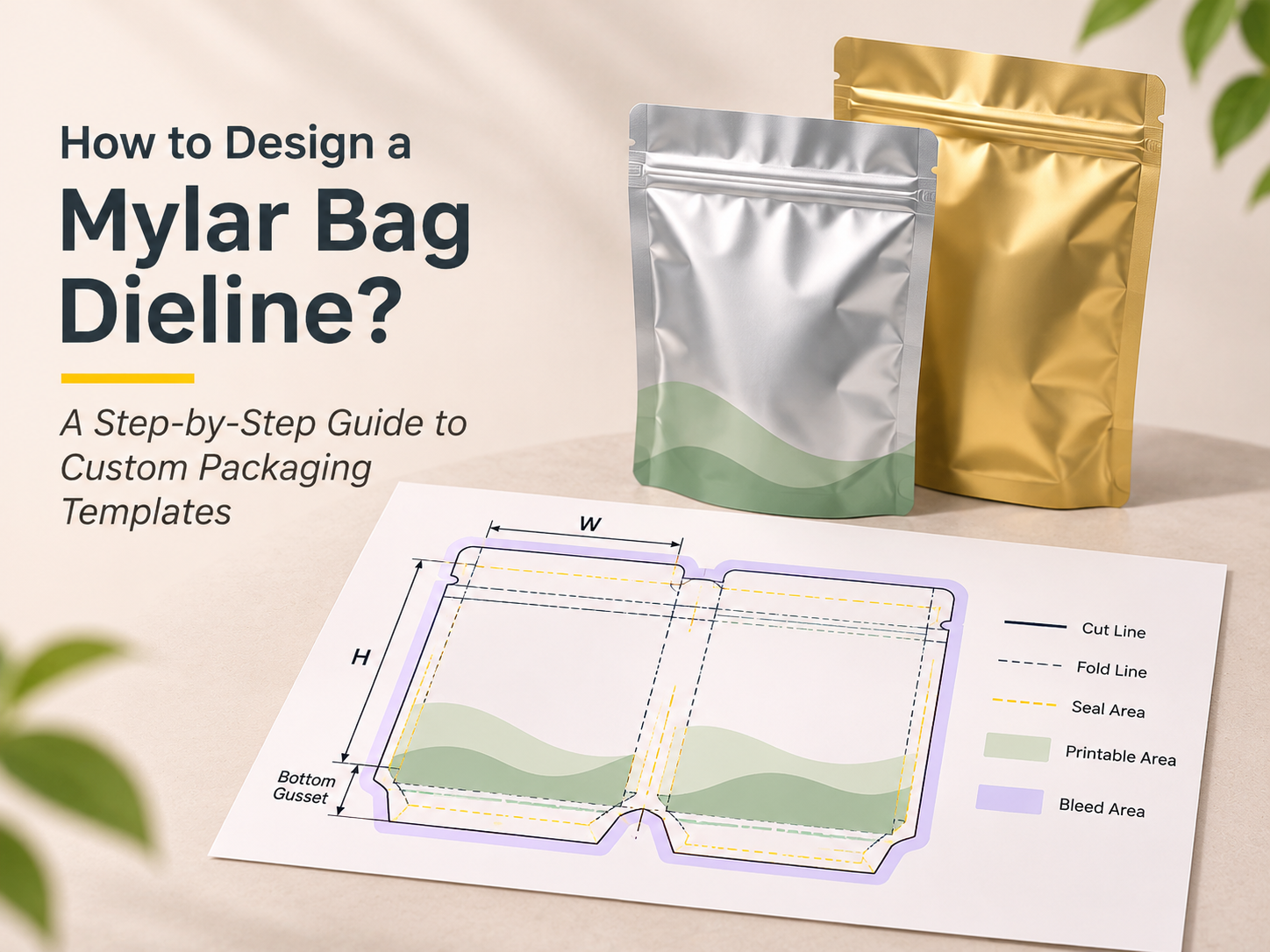
Artwork should follow an approved production dieline. A generic template can help explain an idea, but it may not account for the selected board, glue area, closure details, or converting equipment.
Separate cut lines, crease lines, and artwork into clearly identified layers. Follow the manufacturer’s bleed and safe-area requirements rather than applying an arbitrary margin.
Keep essential text away from folds, tuck edges, and glue zones. Check the orientation of every panel on an assembled sample; a layout that looks correct when flat can produce upside-down copy on the finished box.
Packboxprint’s custom packaging design services can form part of the discussion between structural development and print preparation.
Printing and Finishes
Choose decoration according to the product positioning and handling conditions. A subtle finish may suit a simple soap carton; detailed illustration may help distinguish collectible card editions.
Dense printed areas crossing folds deserve particular attention because creasing can reveal cracking. Foil and embossing also need suitable spacing from structural features and readable detail sizes.
A screen rendering cannot show every material effect. Where color or surface feel is critical, approve a physical reference representative of the intended production process.
Identification and Tamper Evidence
Reserve space for barcodes, batch codes, and other variable information before completing the artwork. Verify readability on the actual surface and in the intended scanning conditions.
An ordinary tuck closure is reclosable and does not inherently reveal opening. Where tamper evidence is required, a suitable seal or structural feature must be developed and evaluated separately.
What to Check Before Bulk Production
A structural prototype answers fit questions; a production-representative sample helps assess the combined effect of board, printing, creasing, and gluing.
Review the filled carton through the sequence it will encounter in use:
- Erection: Does the flattened carton open squarely without excessive force?
- Loading: Does the product enter without catching on panels or flaps?
- Closure: Does the tab engage fully without buckling or pushing the product?
- Base support: Does the loaded bottom remain stable under expected handling?
- Opening: Can the customer access the contents without tearing the carton unintentionally?
- Distribution: Does the complete packed system protect the product through its intended route?
For reusable applications such as cards, include repeated opening and closing. For products sold inside a shipping carton, assess the complete shipping configuration.
Approval should identify the sample version, material, dimensions, and artwork revision. Otherwise, teams may unknowingly approve different versions of the same project.
Understanding the Real Cost of Tuck Packaging
The cheapest empty carton is not always the least expensive package to use. Compare costs per acceptable packed unit, including assembly labor, inserts, packing waste, transport, and damage.
For example, suppose an automatic-bottom version costs an additional $0.04 per carton and saves eight seconds of manual work. At an assumed labor cost of $18 per hour, that time represents $0.04:
8 ÷ 3,600 × $18 = $0.04
Under those illustrative assumptions, the purchase-price increase equals the direct labor saving. Actual productivity, overhead, and rejects determine the business result.
Quotation comparisons should use the same dimensions, board specification, printing, finishes, quantity, delivery basis, and sample requirements. Comparing a plain lightweight carton with a decorated heavier version provides little useful purchasing information.
Are Tuck Boxes Recyclable?
A predominantly paper-based tuck carton may suit established paper recycling systems, but the finished construction and local collection rules determine the appropriate disposal route.
Plastic windows, laminations, substantial non-paper inserts, contamination, and other components can complicate recovery. Brown paper is not automatically more recyclable than printed white board.
Reduce unnecessary material through accurate sizing, and use environmental claims supported by evidence. If recycled content or certified sourcing is part of the brief, specify the documentation required.
A practical design should also protect the product adequately. Removing necessary support and causing more breakage can undermine the purpose of a material reduction.
Planning a Custom Tuck Box Order
A useful manufacturing brief includes product samples, maximum dimensions, packed weight, quantity, proposed closure, loading method, and distribution conditions. Add artwork requirements, intended finishes, and any special contact or protective needs.
When evaluating a custom packaging manufacturer, discuss how structural samples, specification changes, and final approvals will be managed.
For a Packboxprint custom packaging inquiry, a filled sample or accurate product drawing gives the discussion a stronger starting point than a photograph alone.
The objective is a carton that loads consistently, closes reliably, displays information clearly, and supports the product through its intended handling. Those details make a tuck box work well beyond its first appearance.
Frequently Asked Questions
1. What is a tuck-end box?
A tuck-end box has an end closure with a tab that folds into the carton body. The carton can have tuck closures at both ends or combine a tuck top with another bottom construction.
2. What is the difference between straight tuck and reverse tuck?
In a straight tuck end carton, both major closure flaps hinge from the same body panel. In a reverse tuck end carton, they hinge from opposite panels. Confirm the arrangement on the supplier’s drawing.
3. Are tuck boxes supplied flat?
Paperboard tuck cartons are commonly supplied flattened with the side seam already glued. The packing operation erects, fills, and closes them. Delivery format should be confirmed when ordering.
4. Do tuck boxes require glue?
Many use a glued side seam, while their tuck closures open and close without additional adhesive. Automatic-bottom versions contain further glued areas. Closure adhesive may also be added for specific applications.
5. Can tuck boxes hold heavy products?
Some suitably engineered structures can carry heavier contents, but there is no universal capacity. Evaluate the board, bottom design, product geometry, and loaded performance before approval.
6. Can a tuck box be used for shipping?
A retail paperboard tuck carton often needs an outer shipping package. A corrugated tuck-style mailer is a different construction. Assess the complete packed system against the intended distribution conditions.
7. What size should a custom tuck box be?
Base the size on the finished product, protective components, required loading clearance, and closure space. Specify the measurement convention and validate usable internal dimensions with a physical sample.
8. Are tuck boxes suitable for food?
They can be used in food packaging, including around sealed primary packs. Direct-contact applications require materials and components suitable for the particular food and intended use conditions.
9. Is an automatic-bottom box better than a regular tuck box?
It may reduce assembly work, but it also changes manufacturing cost and construction. Compare packing speed, product support, order quantity, and total cost using representative samples.
10. What should I provide when requesting custom printed tuck boxes?
Provide product dimensions, packed weight, quantity, intended use, filling method, artwork, and finish preferences. Include a sample where possible, and request confirmation of material, tolerances, closure style, and approval requirements.