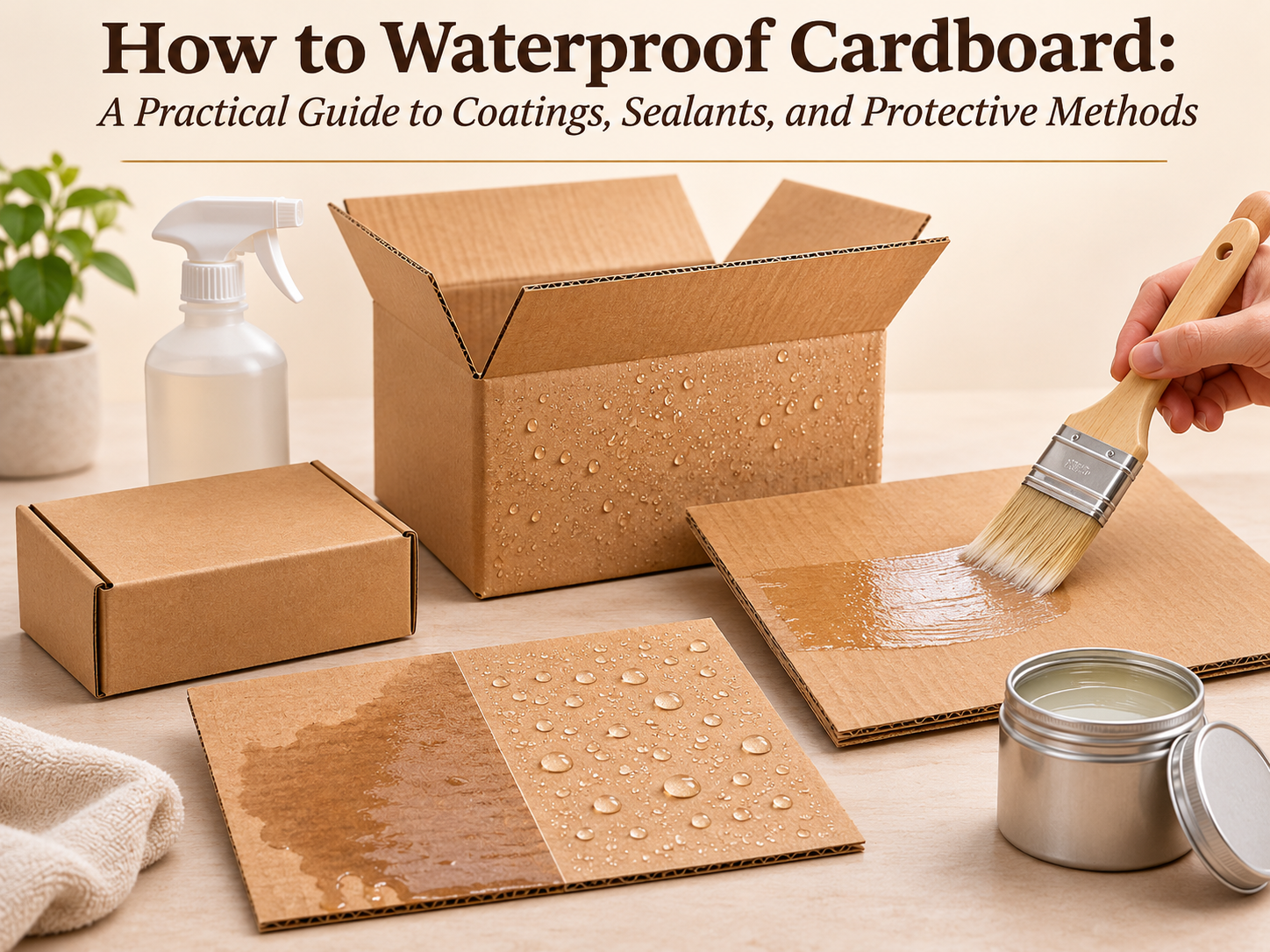
Water protection starts with a question that is often missing from the brief: what exposure must the cardboard survive?
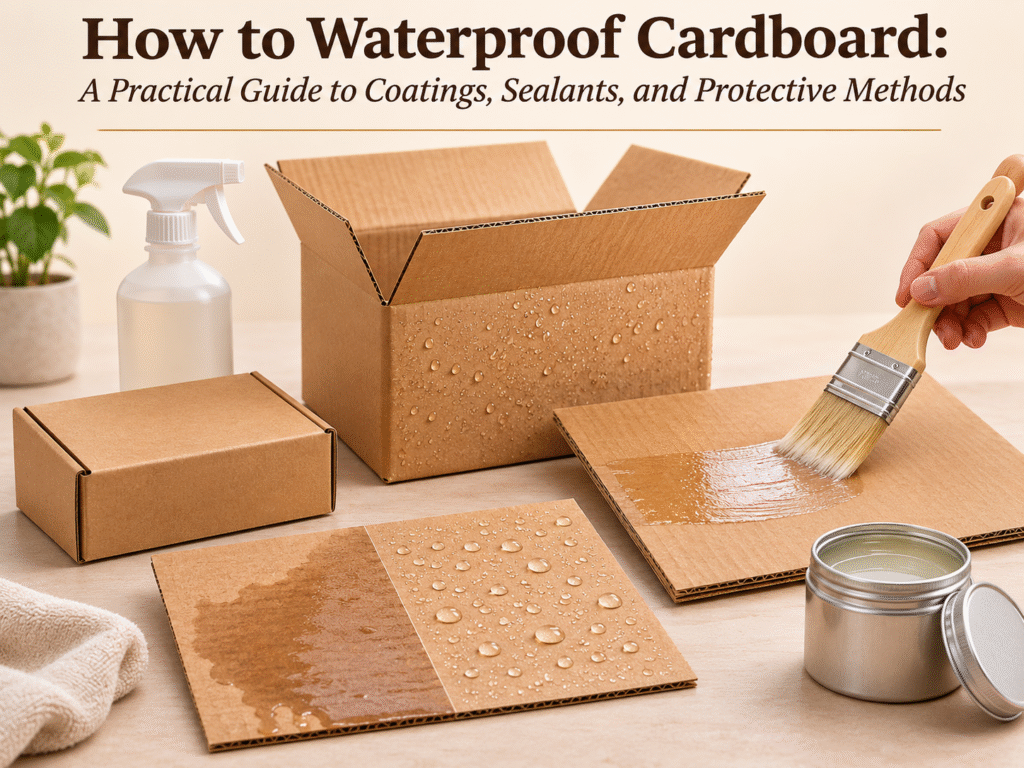
A brief splash during delivery is different from condensation in a chilled display. Both differ from a damp warehouse, a leaking primary container, or prolonged outdoor rain. A treatment that works in one situation may fail in another.
Cardboard can be made more resistant to water through suitable coatings, films, liners, and protective package design. Making an entire box withstand sustained wet exposure is a more demanding task because water can enter through cuts, folds, joints, and closures.
This guide explains the available methods, how to choose between them, and how to check the finished result without mistaking a water-beading surface for a fully waterproof package.
Can Cardboard Be Made Waterproof?
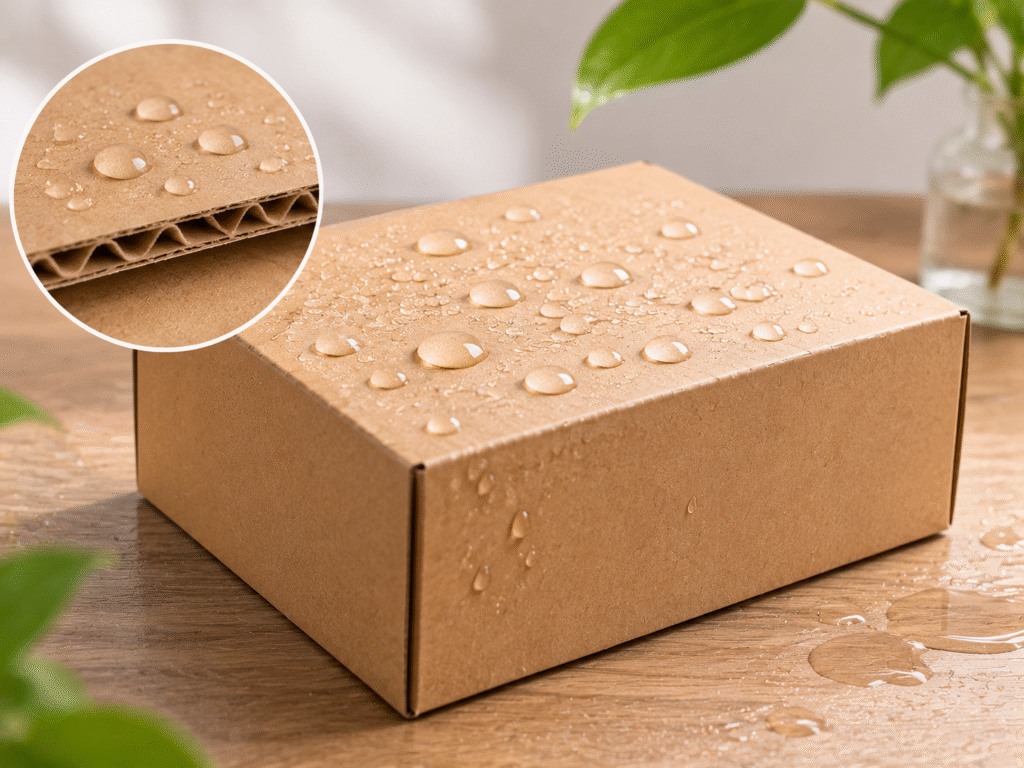
Its resistance can be improved substantially, but “waterproof” needs a defined meaning.
Paperboard and corrugated board are fiber-based materials. Their behavior changes as they take up moisture, which can affect stiffness, shape, and load performance.
A surface barrier can reduce exposure through a face. It does not automatically protect exposed edges or keep water out of an assembled container.
For a practical specification, state the water source, duration, temperature, orientation, and acceptable outcome. “No liquid reaching the inner product pack during the defined splash test” is more useful than “waterproof cardboard.”
Where immersion or prolonged outdoor exposure is unavoidable, an appropriate non-paper enclosure or separate sealed barrier may be necessary.
Water Resistance, Humidity, and Vapor Barrier Are Different
These requirements should not be treated as interchangeable.
| Exposure | Main concern | Protection to evaluate |
|---|---|---|
| Brief splashes or droplets | Liquid wetting of the surface | Suitable water-resistant coating or protective covering |
| Rain during handling | Liquid reaching joints and openings | Complete outer enclosure and closure design |
| High humidity | Moisture exchange with surrounding air | Material performance, storage control, and suitable barrier system |
| Chilled-product condensation | Moisture on or inside the package | Relevant coatings, liners, and temperature-cycle evaluation |
| Product leakage | Liquid released inside the box | Reliable primary containment and secondary protection |
| Sustained water contact | Prolonged entry or immersion | A purpose-designed enclosure validated for the exposure |
Liquid-water resistance does not establish low water-vapor transmission. Likewise, grease resistance does not establish either property.
A protective layer should be selected for the actual exposure rather than for a broad marketing description.
Where Water Enters a Cardboard Box
The large printed panels are only part of the system.
Cut edges expose the fiber structure. Corrugated edges also expose the fluted construction. Water can enter locally even when the face looks dry.
Folds can stress or crack a barrier layer. Glue joints may be incomplete, and tuck closures usually leave paths that are not liquid-tight.
Tape covers a defined area but does not necessarily seal every corner or opening. Windows, handles, perforations, and ventilation holes introduce further details.
For custom folding paper boxes, review these features on an assembled sample. Testing a flat coated sheet will not reveal every weakness of the finished carton.
Method 1: Use a Purpose-Designed Water-Resistant Coating
A packaging-grade coating can reduce liquid-water uptake where it is correctly selected and applied.
Water-based barrier coatings are one commercial option. After drying, their remaining layer or treatment provides the intended properties. “Water-based” describes the application system; it does not mean the finished layer simply dissolves on contact with water.
Formulations differ in water resistance, flexibility, printability, gluability, friction, and other properties. A decorative aqueous varnish is not automatically a functional water barrier.
Agree the substrate, application route, coverage, and required performance with the converter. The coating must work with printing, drying, creasing, and gluing.
Packboxprint’s packaging material options provide a basis for discussing the substrate and complete treatment. Confirm whether a particular barrier construction is available and suitable for the intended project.
Why Coat Weight Matters
Performance depends on application quality, not just the product name. Uneven coverage, pinholes, or insufficient drying can undermine the intended barrier.
More coating is not automatically better. Excessive application can affect drying, curl, flexibility, cost, or later operations.
Use the coating supplier’s and converter’s recommended operating window, then validate the package made within it.
Specify Film Lamination or Polymer-Coated Board
A retained film or polymer layer can form part of a liquid-water barrier.
Film lamination bonds a separate film to the substrate. Other processes apply a polymer layer directly. These constructions have different production requirements and should not be described as identical.
They can provide useful face protection, but their performance at edges, folds, and joints remains critical.
A laminated carton may resist wiping on its exterior while still taking up water through the bottom edge. A film can also separate or crack if the material and converting process are incompatible.
Confirm the exact layer structure, adhesion, treatment coverage, and closure arrangement.
Recycling options depend on the finished construction and relevant recovery system. A laminated paper package should not be described as universally recyclable or unrecyclable without specific evidence.
Add an Appropriate Inner Liner
A liner separates the contents from the box and can be more practical than coating every cardboard surface.
For moisture-sensitive products, the liner may need a defined vapor barrier and suitable sealing. For possible leakage, its material and closure must contain the relevant liquid.
A loose bag does not provide the same protection as a sealed barrier. Folding its opening over is not automatically a dependable moisture seal.
Check puncture risks from product corners, inserts, and staples. The protective layer should remain intact during loading and distribution.
If moisture is trapped inside, the liner cannot solve that problem by itself. Product condition, packing environment, and closure process must be considered together.
Protect the Outside with an Overwrap or Enclosure
An outer bag or weather-resistant enclosure can protect a cardboard package during defined exposure.
This can preserve a conventional inner carton while placing the water-control function in a separate component.
The enclosure needs an appropriate closure and sufficient resistance to tears and punctures. A covering that is open underneath can still admit water.
Stretch wrap used around a pallet can improve handling and provide some shielding, but it should not be assumed to form a complete weatherproof envelope.
Consider where water can collect or drain. A small opening positioned above the load can admit water that remains trapped against the cardboard.
Use Wax Treatments Where the Application Justifies Them
Wax-based treatments have been used to improve water resistance in selected paper-based applications.
A surface-applied wax treatment and a more extensive impregnation are different constructions. Their behavior depends on formulation, coverage, temperature, and converting.
Wax can affect printing, adhesive bonding, surface feel, and recovery options. It is not automatically the best choice for a general retail carton.
A natural wax source does not by itself establish that the completed package is compostable or more sustainable.
For commercial packaging, specify an appropriate industrial treatment rather than assuming hand-applied candle wax is equivalent. Consistency and compatibility matter as much as water repellency.
Use Tape and Joint Protection as Supporting Measures
Suitable tape can help protect a seam, but it does not make an untreated box waterproof.
Tape performance depends on the backing, adhesive, board surface, temperature, pressure during application, and exposure.
A glossy or water-repellent surface may require a different tape or adhesive system. Confirm attachment to the actual treated board.
Plan seams and overlaps to limit entry rather than merely adding more tape after a failure. Corners, flap gaps, and cut edges still need review.
Treat tape as part of an engineered closure, not a substitute for the required face protection or sealed enclosure.
What About Acrylic Sprays, Varnishes, and Household Sealants?
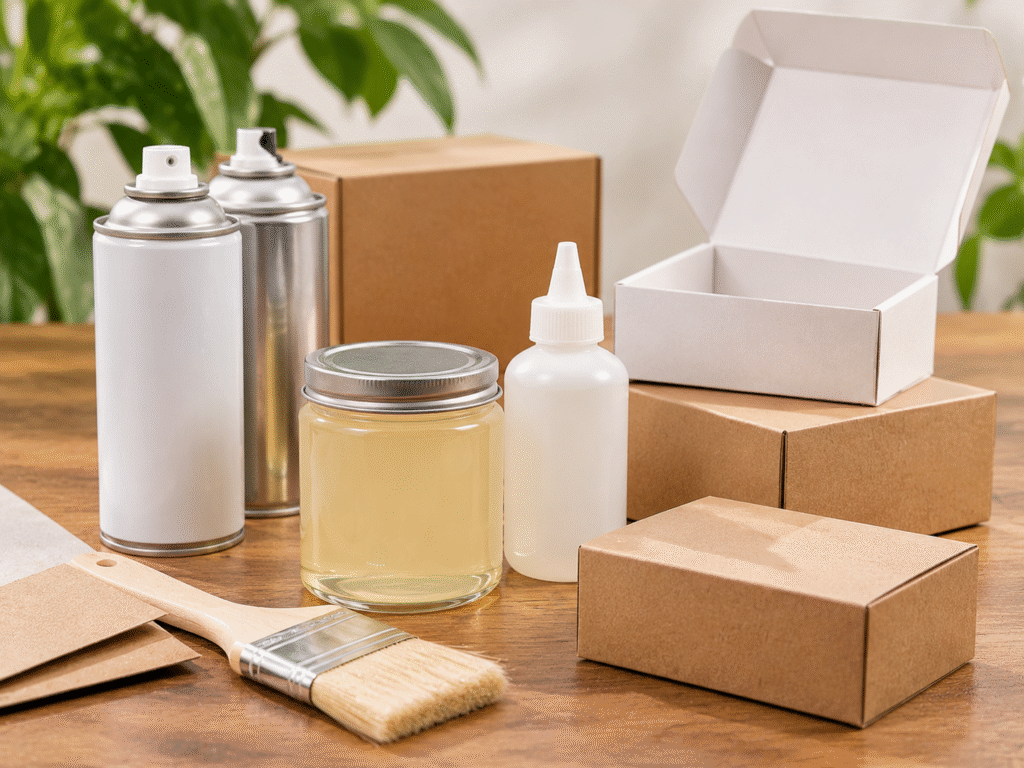
For a small non-food display or craft prototype, a compatible clear coating may reduce surface wetting. That does not establish commercial package performance.
Use only a product whose instructions support the substrate and intended use. Check appearance, odor, flexibility, adhesion, and handling after full drying or curing.
A product suitable for wood, fabric, or outdoor furniture is not automatically appropriate for cardboard packaging. Solvents or application moisture can also affect print, adhesives, or shape.
Do not assume a dry household finish is suitable for direct food contact, cosmetics, or sensitive products. Those applications need appropriate material information.
Oil soaking is generally a poor starting point for professional packaging development. It can stain the surface, create odor, interfere with printing and bonding, and provide uncertain protection.
For repeat production, a specified packaging treatment is easier to control than an improvised surface recipe.
A Practical Small-Sample Treatment Process
A trial can help decide whether a proposed method deserves further development.
1. Define the Trial
Choose a representative cardboard sample and write down the expected exposure. State whether the trial concerns a flat panel, folded display, or assembled box.
Keep an untreated sample for comparison.
2. Inspect and Prepare the Material
Begin with clean, sound, dry material appropriate to the trial. Do not trap existing moisture inside a coating or covering.
Check printed surfaces and adhesives for compatibility. A damaged or already softened box is not a reliable starting point.
3. Follow the Treatment Instructions
Apply the product using the specified method and conditions. Follow the label and safety information for ventilation, protective equipment, handling, and drying.
Use the recommended application quantity and number of coats. Avoid inventing a universal drying time or assuming extra coats can compensate for an unsuitable formulation.
4. Allow Full Drying or Cure
A touch-dry surface may not have reached its intended properties.
Observe the stated interval before folding, stacking, or exposure testing. Keep the trial in suitable conditions during that period.
5. Assemble and Inspect
Check corners, folds, cut edges, and joints. Look for cracking, lifting, whitening, distortion, or unexpected tack.
Confirm that closures still work and that any labels or printing remain usable.
6. Test Against the Defined Exposure
Expose the trial to the relevant conditions and inspect both faces, the edges, and the interior.
Record the time, orientation, and observed result. A successful small trial is useful evidence for that configuration, not approval for every use.
For a commercial package, proceed to production-representative validation.
Choose Protection According to the Application
A retail display exposed to occasional wiping may need a different solution from a chilled food carton or a long-distance shipment.
For an ordinary parcel with a brief risk of rain, evaluate an appropriate outer protective layer and closure arrangement.
For a chilled product, review condensation and temperature changes alongside the product’s storage requirements. The primary container may manage product containment while the outer package provides structure and identification.
For humid storage, address the warehouse conditions and required load performance. A splash-resistant exterior may not adequately limit moisture exchange over a long period.
For sustained wet outdoor use, assess whether cardboard remains the appropriate structural material. Adding more surface treatment may be less practical than selecting a purpose-designed enclosure.
Preserve the Functions of the Package
Water protection can affect other requirements.
A treatment that repels water may change how ink, a label, or a glue joint attaches. A film can alter folding behavior or a close-fitting sleeve. A tacky surface can cause blocking when cartons are stacked.
For printed packaging, inspect color, gloss, and scuffing after treatment.
Packboxprint’s custom packaging design services can support coordination between artwork, structure, and surface treatment. The technical specification should also address packing-line and closure compatibility.
Do not evaluate water performance in isolation from opening, handling, scanning, and product protection.
How to Test Water Resistance
Choose tests that answer the actual question.
Surface Water Uptake
A Cobb-type test measures water absorbed by a defined surface area under specified conditions. It can help compare suitable paper and board samples.
The result needs its exposure time and method. A value without those details is difficult to interpret.
A lower measured uptake under comparable conditions does not prove that an assembled box is leakproof, vapor-tight, or suitable for immersion.
Edge and Fold Exposure
Inspect whether water reaches untreated material through cut edges or stressed barrier layers.
Test after converting, because the folding and cutting operations can change performance.
Complete-Package Exposure
A splash or rain evaluation should use the filled box, closure, supports, and orientation expected in service.
Check product wetting, internal moisture, staining, panel distortion, joint condition, and continued usability.
Load Performance After Exposure
Where the package carries or supports weight, assess the relevant performance after environmental exposure.
A box can look acceptable while losing stiffness. Passing a surface test alone does not establish that it can still support the intended stack.
Agree methods and acceptance criteria with the converter or testing specialist. A droplet that beads for a few seconds is an observation, not a complete performance specification.
Example: Turn a Vague Claim into a Testable Brief
Suppose a retailer currently requests “waterproof cartons” for a boxed product handled between a covered loading area and a delivery vehicle.
A better development brief would describe:
- The expected source and direction of water
- The relevant exposure duration
- The product and packed weight
- The closure and shipping orientation
- Whether print staining is acceptable
- Whether internal water entry is acceptable
- The handling and load requirements after exposure
The supplier can then propose a coating, enclosure, or other system and an appropriate evaluation.
Avoid assigning arbitrary test values without understanding the route. The purpose is to replace an absolute claim with agreed conditions that represent the application.
Cost: Compare Complete Protective Systems
The cheapest treatment per square meter may not produce the lowest packed cost.
Include application labor, drying space, added materials, rejected units, sealing, inspection, and packing speed.
For a hypothetical order of 5,000 units, a coating operation costing $0.09 per unit plus $250 setup totals:
5,000 × $0.09 + $250 = $700
A separate protective enclosure costing $0.16 per unit totals $800 before any additional handling.
Those figures do not establish which option is better. They illustrate why equivalent protection and operational requirements must be compared before choosing.
A less expensive coating that fails at the closure is not equivalent to an enclosure that meets the brief. Conversely, an elaborate barrier may be unnecessary for a limited splash requirement.
Storage and Recovery Matter
Keep paper-based packaging away from standing water and unsuitable storage conditions. Raise loads appropriately from damp floors and maintain a suitable warehouse environment.
A barrier treatment does not eliminate the need for sound storage practices.
Recycling claims should describe the finished construction. Wax, films, coatings, adhesives, and separate liners can affect recovery, while some purpose-designed treatments have supporting repulpability data.
Water-based does not automatically mean recyclable or compostable. Natural ingredients do not establish those outcomes either.
Where components can be separated, provide disposal information appropriate to the actual materials and local systems.
Work with a Defined Packaging Specification
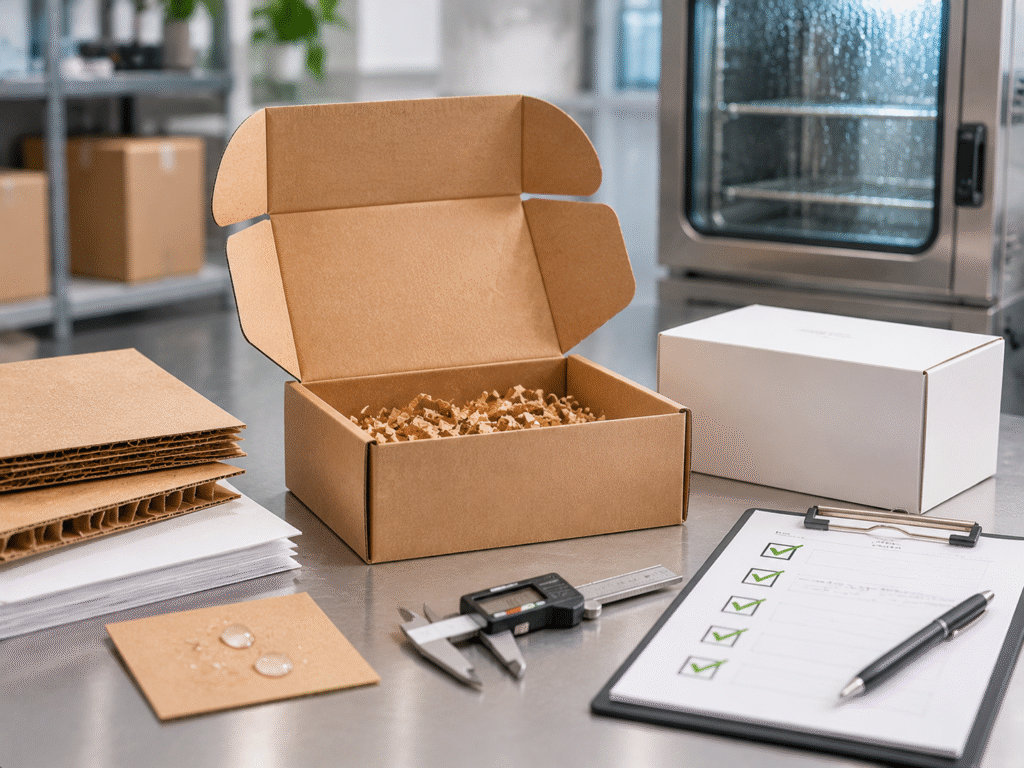
Provide the substrate, box style, product dimensions, packed weight, exposure conditions, closure, and required outcome.
Ask which faces are treated, how edges and folds are addressed, and what evidence supports the proposed performance. Confirm any sensitive-contact or recovery requirements.
When assessing a custom packaging manufacturer, discuss trials, quality checks, and how material or process substitutions will be approved.
For a Packboxprint packaging inquiry, explain where the moisture comes from and what failure must be prevented.
The most reliable approach combines suitable materials, controlled application, protected openings, and testing of the complete package.
Frequently Asked Questions
1. Can cardboard be completely waterproof?
A treated face can resist water, but a complete box also has edges, folds, joints, and closures. Any waterproof claim needs defined exposure conditions and package-level evidence.
2. What is the best way to protect cardboard from rain?
Evaluate an appropriate complete outer enclosure and closure, or a validated treated packaging system. The choice depends on the rain exposure and handling requirements.
3. Does lamination make a box waterproof?
Not automatically. It can improve face protection, but water can still enter through exposed edges, damage, seams, or openings.
4. Can I use a clear spray on cardboard?
For a suitable non-food trial, use a compatible product according to its instructions and test the result. Do not assume it establishes commercial barrier or contact suitability.
5. Is wax a good waterproofing treatment?
It can improve water resistance in suitable applications. Printing, gluing, temperature behavior, and recovery implications must also be considered.
6. Will packing tape stop water entering a box?
It can help protect a defined seam, but untreated panels, corners, and other gaps remain vulnerable. Evaluate the complete closure and package.
7. Does water beading prove a package is waterproof?
No. It shows surface behavior under that observation. It does not establish resistance at edges, long-term vapor protection, or load performance after exposure.
8. Can treated cardboard be used for food packaging?
Only where the finished components are suitable for the intended contact and use conditions. A general-purpose sealant is not automatically appropriate.
9. Are water-resistant cardboard boxes recyclable?
It depends on the complete construction and relevant recovery system. Request evidence for the specific treatment and finished package.
10. What should I ask a supplier before ordering?
Ask about substrate compatibility, treated areas, converting, closures, test conditions, performance criteria, and relevant documentation. Approve representative samples before bulk production.