An empty 12-inch cube can weigh less than another box with the same listed dimensions. The difference may come from its paper grades, wall construction, flap design, or added layers. The size printed on a quotation tells only part of the story.
For packaging buyers, empty box weight matters because it contributes to material consumption, packed weight, handling, and transport. But a lighter box is useful only if it still protects the product.
A reliable comparison starts with a defined structure and material specification. This guide provides a transparent weight chart, explains the calculation behind it, and shows when reducing box weight can improve a packaging operation.
The Quick Answer
There is no single standard empty weight for a cardboard box of a given size.
A small corrugated carton may weigh around a hundred grams, while a larger or reinforced construction can weigh well over a kilogram. Those are broad orders of magnitude, not purchasing specifications.
The most useful relationship is:
Approximate board mass = net material area × finished board grammage
A completed box also contains relevant joint materials, printed layers, coatings, or attached components. Its moisture condition can affect the measured result.
For early planning, a calculation can help. For an approved specification, inventory record, or shipment, weigh representative finished samples.
Empty Cardboard Box Weight Chart by Size
The following table is a calculated planning model, not a set of measured stock-box weights.
It uses a conventional regular slotted container, or RSC, with these assumptions:
- Nominal dimensions are entered in inches and converted exactly to meters.
- The model uses a 35 mm manufacturer’s joint allowance.
- Approximate blank area equals [2 × (L + W) + 0.035] × (H + W).
- Board grammages of 450, 550, and 650 g/m² are hypothetical comparison inputs.
- Slot removal, caliper allowances, joint adhesive, printing, and added components are not separately modeled.
The same assumptions are used throughout so buyers can see the effect of size and board mass.
| Nominal box size, L × W × H (in) | At 450 GSM (g) | At 550 GSM (g) | At 650 GSM (g) | At 550 GSM (oz) |
|---|---|---|---|---|
| 6 × 6 × 6 | 88 | 108 | 128 | 3.8 |
| 8 × 8 × 8 | 155 | 190 | 224 | 6.7 |
| 10 × 10 × 10 | 240 | 294 | 347 | 10.4 |
| 12 × 12 × 12 | 344 | 421 | 497 | 14.8 |
| 14 × 14 × 14 | 466 | 570 | 674 | 20.1 |
| 16 × 16 × 16 | 607 | 742 | 877 | 26.2 |
| 18 × 18 × 18 | 767 | 937 | 1,108 | 33.1 |
| 20 × 20 × 20 | 945 | 1,155 | 1,365 | 40.7 |
| 24 × 18 × 18 | 892 | 1,091 | 1,289 | 38.5 |
Values are rounded for readability. Actual boxes can fall outside these figures.
A nominal size may refer to the interior, while the production blank requires adjustments for the selected construction. This model is deliberately simplified and should be replaced with the converter’s net dieline area when available.
What Counts as Empty Box Weight?
Define the measurement boundary before comparing suppliers.
A bare carton body is different from a ready-to-pack box that includes a fixed insert, attached tear strip, or other component.
For consistent records, separate:
| Measurement | Included |
|---|---|
| Empty box mass | Defined carton body and its manufacturing joints |
| Total packaging mass | Box, inserts, cushioning, closures, labels, and other packing components |
| Packed gross mass | Product plus all packaging |
| Dimensional weight | A calculated shipping quantity based on package size and applicable rules |
A flat and an erected box have essentially the same mass if nothing is added or removed. Assembly changes occupied space, not the amount of board.
Packing tape changes the result because it adds material. So do inserts, tissue, protective pads, and document pouches.
Why Two Boxes of the Same Size Weigh Differently
Material Area
A box uses more material than the six exposed faces suggest. Flaps, joints, overlapping panels, and reinforced edges contribute to the blank.
For geometrically similar boxes made from the same board, surface area approximately follows the square of the scale factor. Doubling every dimension therefore tends toward four times the board mass.
Real cartons depart from exact scaling because joint widths, caliper allowances, and structural details do not necessarily grow proportionally.
Board Grammage
GSM means grams per square meter. For a defined net area, increasing finished board grammage increases estimated board mass.
However, GSM is not thickness, load capacity, or a complete strength specification. Two boards with similar mass can have different stiffness and compression performance.
Packboxprint’s packaging material options provide a basis for discussing the required structure and material properties together.
Added Materials
A printed outer paper bonded to corrugated board adds mass. Films, heavy coatings, reinforcing strips, and attached fittings can also matter.
A calculation using only the base board will miss these additions. Establish whether a quoted material weight describes the base board or the final construction.
Flute Profile Does Not Determine a Fixed Box Weight
Single-wall corrugated board typically consists of two flat liners with one fluted medium between them. The flute geometry contributes to thickness and structural behavior.
Common flute designations include E, B, and C. Their dimensions can vary, and the letter does not specify a universal finished GSM.
The medium follows a wave-shaped path, so it uses more paper than its projected flat area. This is described using a take-up factor.
For an illustrative construction:
Outer liner: 150 g/m²
Medium: 125 g/m² × assumed take-up factor of 1.40 = 175 g/m²
Inner liner: 150 g/m²
Assumed combining adhesive contribution: 10 g/m²
Illustrative combined grammage = 485 g/m²
These figures describe an example, not a prescribed board grade.
When the supplier provides the finished combined-board GSM, the flute take-up is already reflected in that value. Multiplying the entire combined-board weight by another take-up factor would double-count the effect.
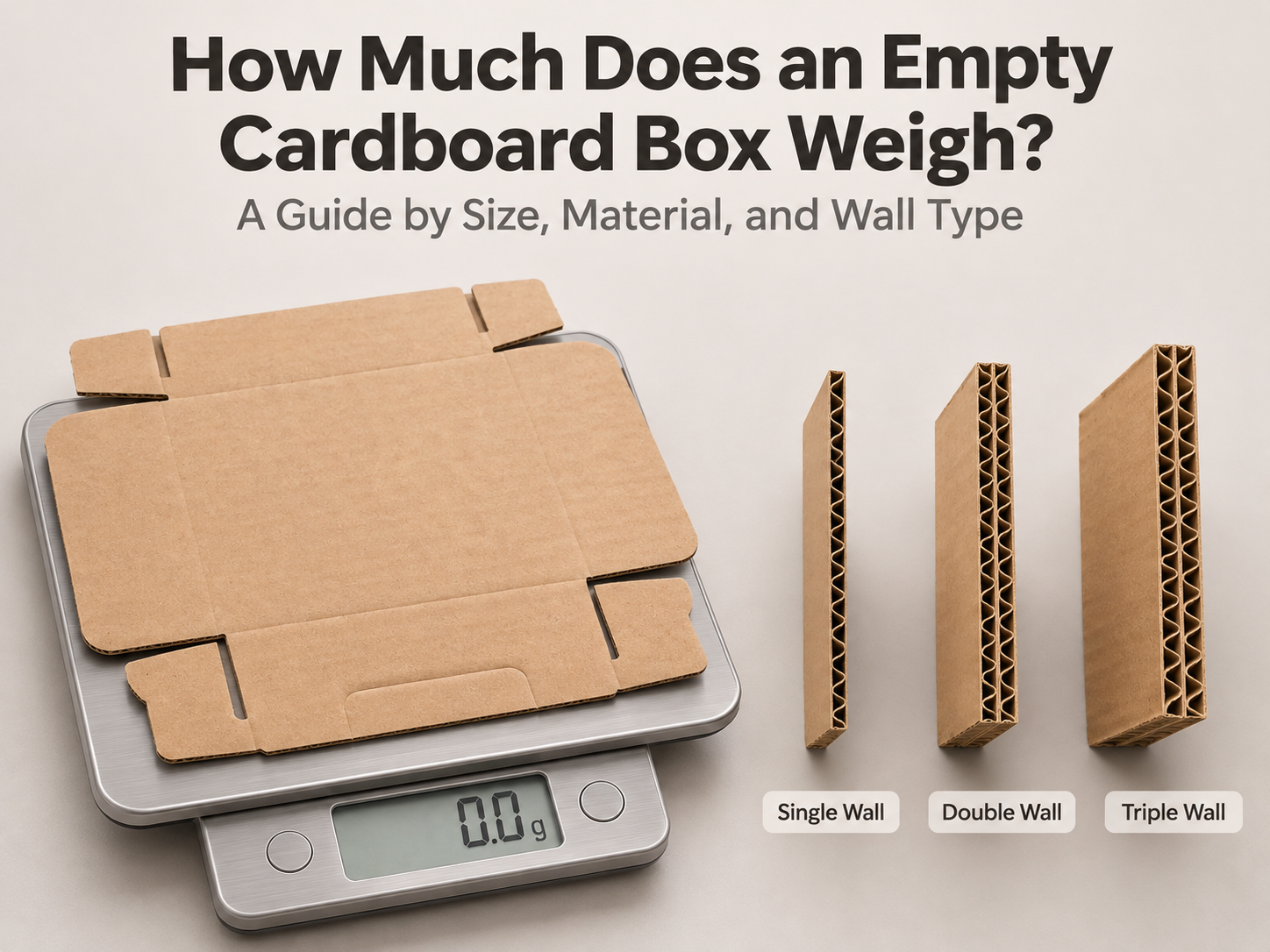
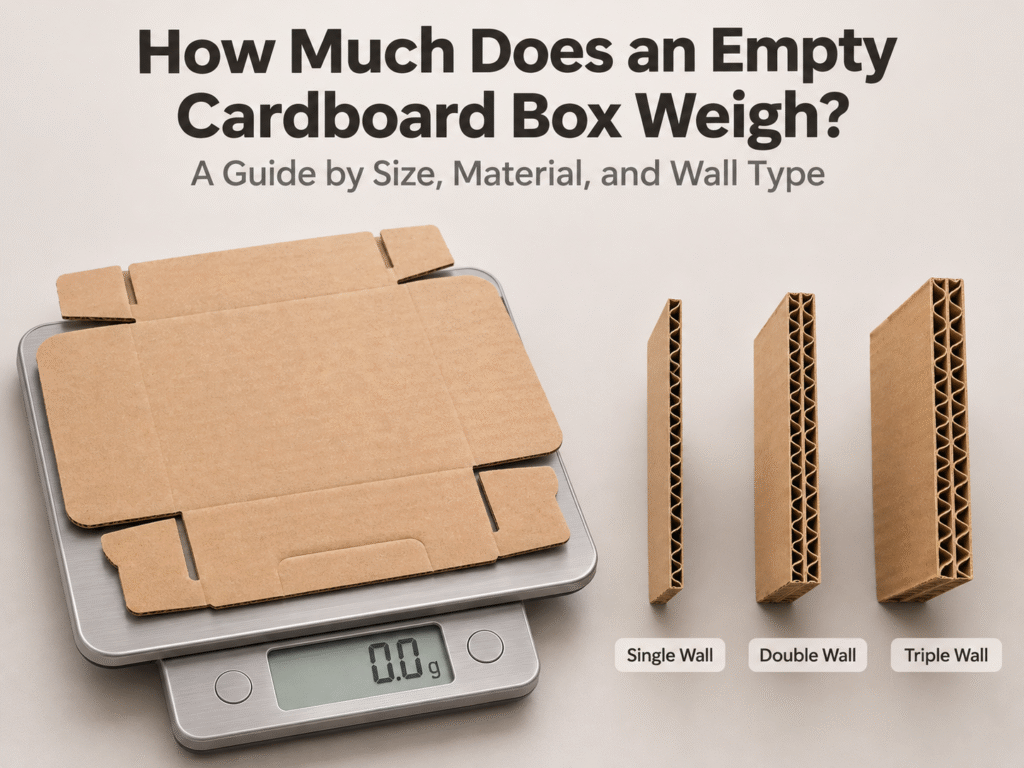
Single-Wall, Double-Wall, and Triple-Wall Boxes
A conventional single-wall structure has one fluted layer and two liners. Double-wall adds another fluted layer and an intermediate liner; triple-wall adds another such combination.
More layers generally add mass, but there is no universal percentage increase. The paper grades, basis weights, flute combinations, and joint construction can change simultaneously.
For the same net material area of 0.765 m², hypothetical combined-board values give:
| Illustrative structure | Assumed finished GSM | Estimated board mass |
|---|---|---|
| Single-wall | 550 | 421 g |
| Double-wall | 800 | 612 g |
| Triple-wall | 1,100 | 842 g |
These are arithmetic comparisons, not standard grades or guaranteed weight ratios. A production change can also alter the required blank area.
Wall count does not establish a safe product-weight limit. Stacking, humidity, box dimensions, load distribution, and the distribution route all influence the required construction.
Likewise, edge-crush performance is not an empty-weight measurement. It should not be converted into a carrying capacity without evaluating the package.
Are Mailer Boxes Lighter Than Regular Shipping Boxes?
Sometimes, but the style name alone cannot answer the question.
A thin-flute mailer may use a relatively light board. It may also have rolled side walls, locking tabs, and multiple overlapping panels that increase net material area.
A conventional RSC has its own flap and joint requirements. Both constructions can be made in different board grades.
Suppose one design uses 0.60 m² at 450 GSM, while another uses 0.48 m² at 550 GSM:
First design: 0.60 × 450 = 270 g
Second design: 0.48 × 550 = 264 g
The first design uses lighter board per square meter but produces a slightly heavier board component.
For custom mailer boxes, compare the actual dieline, material, insert, and closure system. A mailer may deliver useful presentation or assembly benefits even when its empty weight is similar to another format.
Do not remove necessary support merely to make one style win a weight comparison.
How to Calculate Box Weight
The most reliable estimate uses the converter’s actual net material area.
Step 1: Obtain the Net Blank Area
For a die-cut box, measure or calculate the area of material remaining in the finished blank, including functional tabs and overlaps.
The surrounding sheet includes production waste. Multiplying that whole sheet by GSM estimates purchased material mass, not the finished box mass.
For a simple RSC at an early design stage, an approximate rectangular blank can be useful. Its limitations should remain visible.
Step 2: Confirm the Board Weight
Use the finished combined-board grammage where available. If only the component papers are specified, the calculation needs the medium take-up factors and other relevant contributions.
Do not mistake a single liner’s GSM for the weight of the complete corrugated board.
Step 3: Calculate and Add Relevant Components
With area in square meters and GSM in grams per square meter, the result is grams:
Board mass in grams = area in m² × GSM
Add components excluded from that board specification. Avoid counting the same adhesive or decorative layer twice.
Worked RSC Example
Take a nominal 12 × 12 × 12-inch carton. Each dimension is 0.3048 m.
Using the simplified model and a 0.035 m joint allowance:
Blank length = 2 × (0.3048 + 0.3048) + 0.035 = 1.2542 m
Blank width = 0.3048 + 0.3048 = 0.6096 m
Approximate area = 1.2542 × 0.6096 = 0.76456032 m²
At an assumed 550 GSM:
Estimated board mass = 0.76456032 × 550 = 420.508176 g
That is approximately 421 g, 14.8 oz, or 0.927 lb.
This result is a model output. It is not a promise of a particular accuracy percentage. Slot removal, design allowances, material variation, joints, coatings, and moisture can move the actual result in either direction.
Board crushing changes geometry and performance; it does not inherently create additional material mass.
How to Weigh Empty Boxes Properly
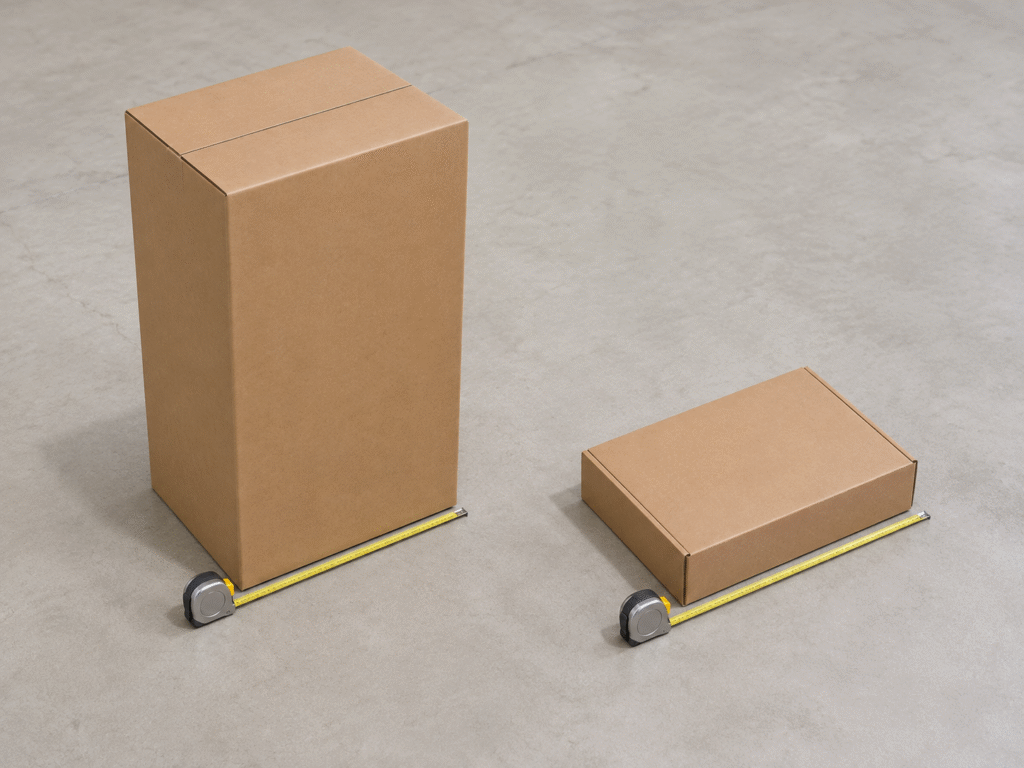
Use a scale with suitable capacity and resolution for the intended decision. A coarse parcel scale may be inadequate for comparing small changes in a lightweight carton.
Zero the scale and confirm what the weighing setup includes. Large blanks must be supported without touching nearby surfaces that carry part of their weight.
Weigh representative samples from the relevant production batch. Record the sample count, individual results, average, and range.
For very light boxes, weighing a defined group together and dividing by the count can improve readability. It also hides individual variation, so separate checks may still be useful.
Keep the sample condition consistent. Compare cartons with the same closure materials, inserts, and moisture exposure.
For shipment preparation, weigh the completed parcel separately. A verified empty-box record does not replace a packed-weight measurement.
Humidity and Storage Conditions
Paper-based materials exchange moisture with their surroundings. A carton stored under more humid conditions can show a different mass from the same carton under drier conditions.
The amount and timing depend on the paper, environment, exposure, and starting condition. A universal percentage gain cannot be assumed.
Moisture can also affect strength. A heavier reading after damp exposure does not imply a stronger box.
Record relevant storage conditions when investigating differences between samples or deliveries. For formal testing, agree conditioning and measurement methods with the laboratory or supplier.
Do not adjust every shipment by a guessed humidity factor. Measure the package in its actual preparation condition.
When Empty Box Weight Affects Shipping Costs
A shipment contains the product and all packing materials:
Packed gross mass = product mass + total packaging mass
Consider a hypothetical product weighing 360 g. A 90 g box and 30 g of other packaging produce a 480 g parcel. Replacing the box with a 130 g alternative produces a 520 g parcel.
If the applicable service has a relevant boundary at 500 g, that difference may change the price bracket. The example assumes such a boundary; it does not describe a universal shipping tariff.
Dimensional weight introduces a different calculation:
Dimensional weight = applicable external volume ÷ specified divisor
For illustration, a 40 × 30 × 20 cm parcel has a volume of 24,000 cm³. With an assumed divisor of 5,000 cm³/kg, its raw dimensional weight is 4.8 kg.
Where a service compares actual and dimensional weight, the applicable higher figure can govern the weight basis. Rounding, minimums, surcharges, account terms, and other conditions still matter.
There is no universal one-pound point above which box mass becomes irrelevant. A dense heavy product may remain actual-weight-driven, while a very light bulky parcel may be dimensionally rated.
Use the current rules for the actual service and account. Nominal internal box dimensions are not a substitute for the closed parcel’s external measurements.
Physical Weight Savings Are Not Automatically Billing Savings
Suppose a redesign removes 25 g per package across 10,000 shipments.
25 × 10,000 = 250,000 g = 250 kg of physical material
That is a useful material and handling reduction. It does not establish a 250 kg reduction in billed weight.
If each shipment remains in the same price bracket or continues to be governed by dimensional weight, the direct parcel-rate saving may be zero.
Conversely, reducing exterior dimensions can change dimensional weight even when box mass stays similar.
Keep material savings, transport-weight savings, and invoice savings as separate calculations.
Reduce Weight Through Design and Validation
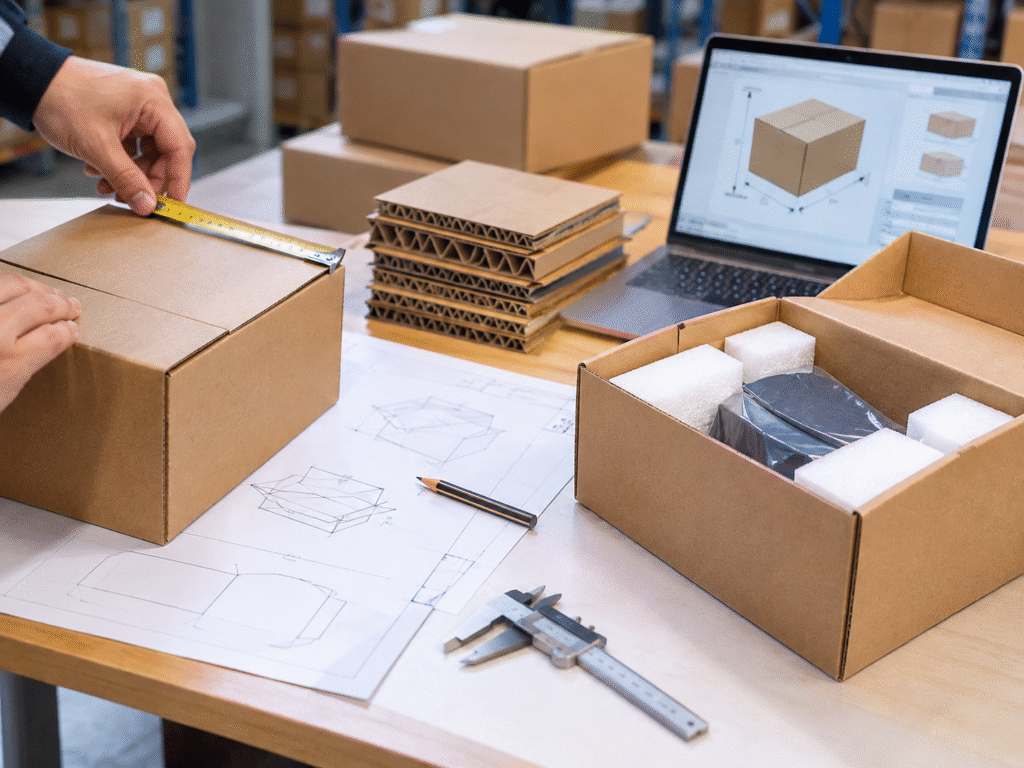
Begin with fit. Removing unnecessary space can reduce board area and the need for void fill. Preserve room for the cushioning and handling clearances the product requires.
Review the entire packaging system. A slightly heavier fitted support may permit a smaller outer box and less loose filler.
Evaluate alternative board constructions against agreed performance requirements. Do not drop a wall or select a finer flute solely because it lowers the estimated grams.
Packboxprint’s custom packaging design services can support this comparison by coordinating structure, material use, and presentation.
Approve representative packages through appropriate filled handling and distribution evaluation. Record damage, assembly time, closure performance, and packed dimensions alongside mass.
Recycled content and low weight are separate specifications. A recycled and a virgin paper at the same grammage have the same nominal mass per square meter, but their properties and suitable design requirements may differ.
What to Request from a Packaging Manufacturer
A useful quotation brief includes box style, dimension convention, packed product weight, material requirements, distribution route, printing, finishes, and inserts.
Ask whether the quoted empty mass is estimated or measured and what components it includes. Agree tolerances and the sample condition where weight is an important acceptance criterion.
When evaluating a custom packaging manufacturer, discuss how material substitutions and structural changes affect the approved sample.
For a Packboxprint packaging inquiry, provide product dimensions, target quantities, and any external-size or packed-weight constraints.
The objective is an appropriately light package that performs reliably. The empty-box figure becomes useful when it is connected to a defined construction, verified sample, and real shipping scenario.
Frequently Asked Questions
1. How much does an empty cardboard box weigh?
It depends on size, net material area, board grammage, structure, and added components. Use a transparent estimate for planning and weigh representative samples for an actual specification.
2. How much does a 12 × 12 × 12-inch box weigh?
The model in this guide gives about 421 g at an assumed 550 GSM. It is an illustrative RSC calculation, not a standard weight for every carton of that size.
3. Is double-wall always a fixed percentage heavier?
No. Its mass depends on paper grades, flute combinations, material area, and joints. Compare the proposed finished specifications rather than using a universal multiplier.
4. Is E-flute lighter than B-flute?
Not necessarily at box level. Board grammage and the amount of material in the blank both matter. Flute designation alone does not determine finished box mass.
5. Does the empty box count toward shipping weight?
Yes. It contributes to actual packed mass along with the product and other packaging. The service’s applicable rating rules determine how that mass affects the charge.
6. How do I estimate box weight?
Multiply net material area in square meters by finished board GSM. Add components excluded from that material specification, then verify the estimate using a completed sample.
7. Does humidity make a box heavier?
It can, because paper absorbs moisture. The change depends on conditions and the material. There is no single percentage suitable for every warehouse or carton.
8. Are mailer boxes always lighter than RSC boxes?
No. Mailers may use thinner board but require more overlapping material. Compare net blank area, grammage, closures, and inserts for the actual designs.
9. Does reducing box weight always reduce postage?
No. The parcel may remain in the same bracket or be rated using dimensional weight. Calculate the result under the applicable service rules.
10. What is the lightest suitable shipping box?
It is the lightest complete design that meets the product’s protection, handling, and distribution requirements. Identify it through structural development and validation rather than a style name alone.