“Matte with a foil logo” sounds like a complete packaging specification. For the designer, it may describe the intended appearance clearly. For the converter, several decisions remain open: matte coating or film, which foil grade, what substrate, which process sequence, and what level of handling resistance?
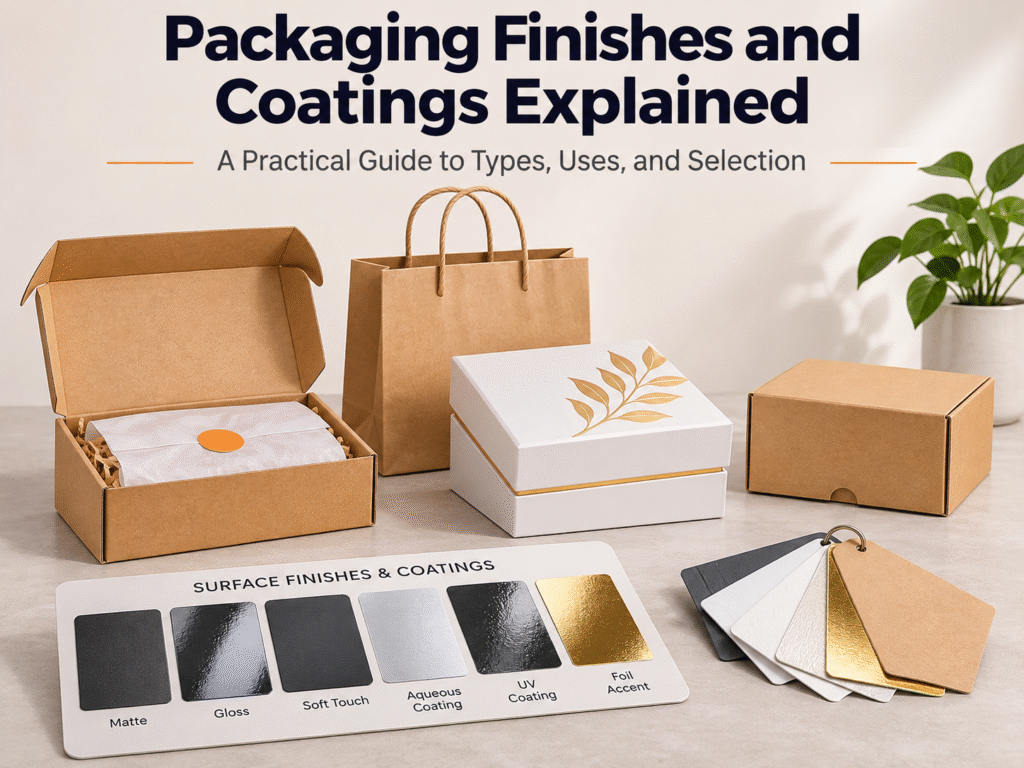
Those unanswered details can change the price, production route, and finished result.
Packaging finishes should be selected as part of the product brief. They influence how a box looks and feels, how its print survives handling, and whether later operations such as gluing, labeling, or date coding work reliably.
This guide explains the principal options for paper-based packaging and provides a practical approach to choosing, specifying, and approving them.
Begin with the Job the Finish Must Do
A useful finishing brief starts with an outcome rather than a process name.

A cosmetics carton may need a low-glare background and a tactile focal point. A subscription package may need to resist repeated surface contact during fulfillment. A gift box may require clean metallic detail and consistent lid movement.
Define the priorities: appearance, handling resistance, readability, tactile feel, or a particular functional property. Rank them where they conflict.
For custom packaging development, those priorities should be considered alongside dimensions, substrate, structure, and the distribution route. The treatment is one part of the package, not a substitute for the rest of the design.
Understand the Four Main Process Families
The language used in quotations can obscure important differences.
A coating is applied as a liquid and forms a layer through drying or curing. Lamination bonds a separate film to the substrate. Transfer decoration deposits selected decorative layers from a carrier. Embossing and debossing reshape the material to create relief.
| Process family | Typical examples | Main distinction |
|---|---|---|
| Applied coatings | Aqueous, UV-cured, conventional varnish | A formulation forms the surface layer |
| Film lamination | Gloss, matte, soft-touch film | A separate film remains attached |
| Transfer decoration | Hot foil, cold transfer, selected digital effects | Decorative layers transfer from a carrier |
| Relief processes | Embossing and debossing | The substrate is raised or recessed |
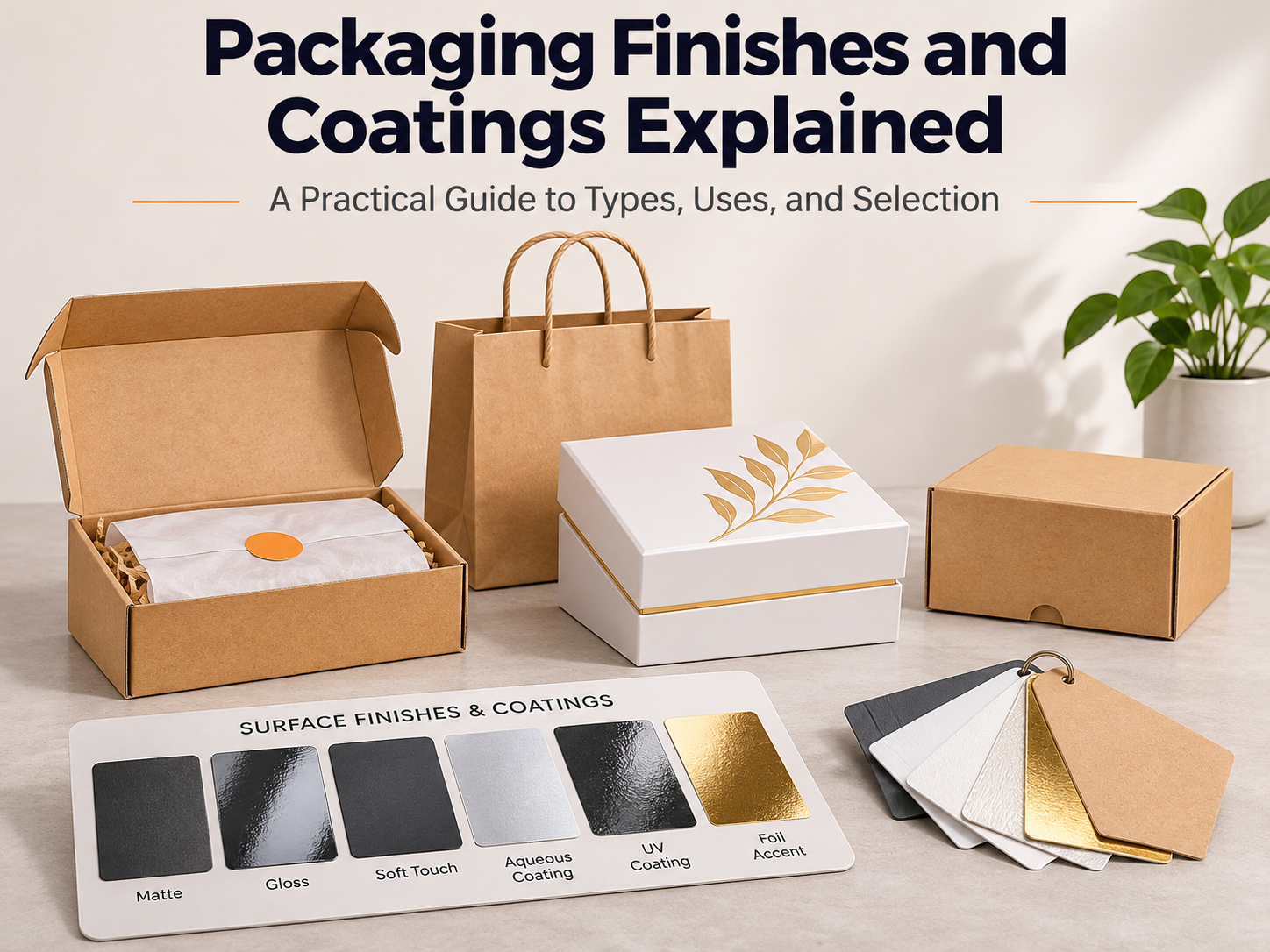
Matte, gloss, and soft-touch describe effects. They do not identify one unique manufacturing process.
A supplier can offer a similar-looking result using different constructions. Confirm what is being supplied before comparing quotations.
Matte, Gloss, and Satin Finishes
Matte: Lower Sheen, with Material-Specific Behavior
A matte surface reduces concentrated reflections and can make a design feel restrained. It can help when strong glare would distract from the graphics.
Matte does not mean that the surface absorbs all light. Nor does it establish resistance to fingerprints, oils, or abrasion.
Some matte surfaces show polished rub marks, particularly over dark solid printing. Others are formulated for improved handling resistance. Evaluate the actual combination rather than assuming that a finish name guarantees the result.
Gloss: Stronger Reflections and Visual Contrast
Gloss can reinforce photographic detail and make colors appear more saturated. It suits designs where a polished surface is part of the intended presentation.
Reflections can also interrupt readability. View product names, instructions, and codes under relevant lighting before approval.
The underlying surface matters. A rough or absorbent substrate can produce a different result from a smooth coated board even when both receive the same treatment.
Satin and Intermediate Effects
An intermediate sheen can be useful when neither very low nor very high gloss fits the brief.
Terms such as satin, silk, and semi-matte vary between suppliers. A physical reference is more reliable than the name alone.
Where appearance consistency is critical, agree the evaluation method, lighting, sample orientation, and any instrumental measurements.
Aqueous Coatings: Water-Based Surface Treatments
Aqueous coatings use water as a carrier for the coating system. Drying removes water and leaves the functional layer on the sheet.
Different formulations can provide gloss, matte, satin, tactile, slip, or resistance properties. The category is much broader than a lightly shiny protective coat.
For a folding carton, an aqueous treatment may be considered to improve print handling and provide the required appearance. The exact formulation must suit the substrate, ink, application equipment, and later operations.
Drying and stacking conditions matter. A surface that appears ready for handling may still need an appropriate production sequence before another process.
Water-based does not mean automatically biodegradable, plastic-free, or suitable for every recycling system. It also does not establish direct food-contact suitability.
Specify the required performance and obtain information for the selected formulation and intended application.
UV-Cured Coatings: A Curing Method, Not a Single Look
UV coatings form their cured layer through an appropriate ultraviolet process. Their behavior differs from simply removing water or solvent.
High gloss is a familiar use, but UV systems can also produce matte and textured effects.
Application, cure conditions, ink compatibility, flexibility, and surface adhesion influence the result. The process must be matched to the material and equipment.
For folding packaging, check whether the cured layer accommodates the crease and fold. For further decoration, confirm compatibility with foil, adhesives, or other treatments.
A UV coating should not be described as scratchproof or waterproof without a defined performance requirement and supporting evaluation.
Likewise, a low-migration formulation is part of a controlled system, not a blanket statement that every finished package is suitable for food contact.
Varnish, Flood Coverage, and Spot Treatment
“Varnish” may refer to a conventional printing varnish or be used broadly for a clear surface treatment. Ask the supplier to identify the chemistry and application route.
Flood coverage treats the defined overall surface. It may still leave glue regions or coding panels untreated.
Spot coverage applies the effect selectively. A glossy logo over a matte field is a familiar example, but selective treatments can also add texture or a different sheen.
Coverage is separate from chemistry. Spot UV means a selected UV-cured treatment, not every type of glossy highlight.
Narrow outlines and small type require close registration. A wider graphic shape may tolerate normal process variation more gracefully.
Design the effect with the converter’s capabilities in mind rather than using a highly detailed mask that cannot be reproduced consistently.
Film Lamination: An Added Layer with Its Own Requirements
Lamination leaves a film bonded to the paper or board.
A selected film can change sheen, touch, or resistance to particular exposures. It also changes the construction.
Confirm the film type, surface grade, adhesive approach, and relevant thickness. Matte, gloss, and soft-touch films should not be treated as interchangeable.
Review creasing, cut edges, glue joints, and any later decoration. A film that suits a flat printed panel may behave differently around a tight fold or wrapped corner.
Lamination can improve some surface properties without making the whole box waterproof. Paper edges, joints, and exposed interior areas remain relevant.
Packboxprint’s packaging material options provide a starting point for discussing the base substrate and surface construction together.
Soft-Touch and Textured Effects
Soft-touch can be produced through an applied coating or a film. Similar tactile descriptions may therefore represent different material systems.
Decide whether the goal is a velvety feel, a restrained visual appearance, or a particular combination. Then assess the treatment under realistic handling.
Skin oils, rubbing, stacking, and contact with packing equipment can change the surface. A new sample handled gently at a meeting does not reveal all these effects.
Texture can also come from the paper itself, embossing, or a patterned applied treatment. It can influence fine printing and the contact area available for decoration or adhesive.
A textured substrate may provide the intended identity without another full-surface treatment. Compare complete samples before adding processes simply because they sound premium.
Metallic and Holographic Decoration
Metallic ink, foil transfer, and holographic treatments produce different results.
Metallic ink uses reflective pigment. Foil transfer can create a more continuous reflective effect. Holographic decoration introduces an optical structure that changes with viewing conditions.
Hot Foil Stamping
Hot stamping uses heat, pressure, tooling, and a suitable transfer material to apply the design.
The carrier is normally removed, leaving the transferred decorative layers. This differs from laminating the whole carrier film onto the package.
Cold Transfer
Cold transfer typically uses a patterned adhesive and pressure to deposit the decoration. The carrier is removed afterward.
It can support different production workflows and overprinting effects. It is not merely hot stamping with a reduced temperature.
For either route, match the material to the substrate and design. Fine lettering, broad solids, and textured surfaces create different demands.
Embossing and Debossing
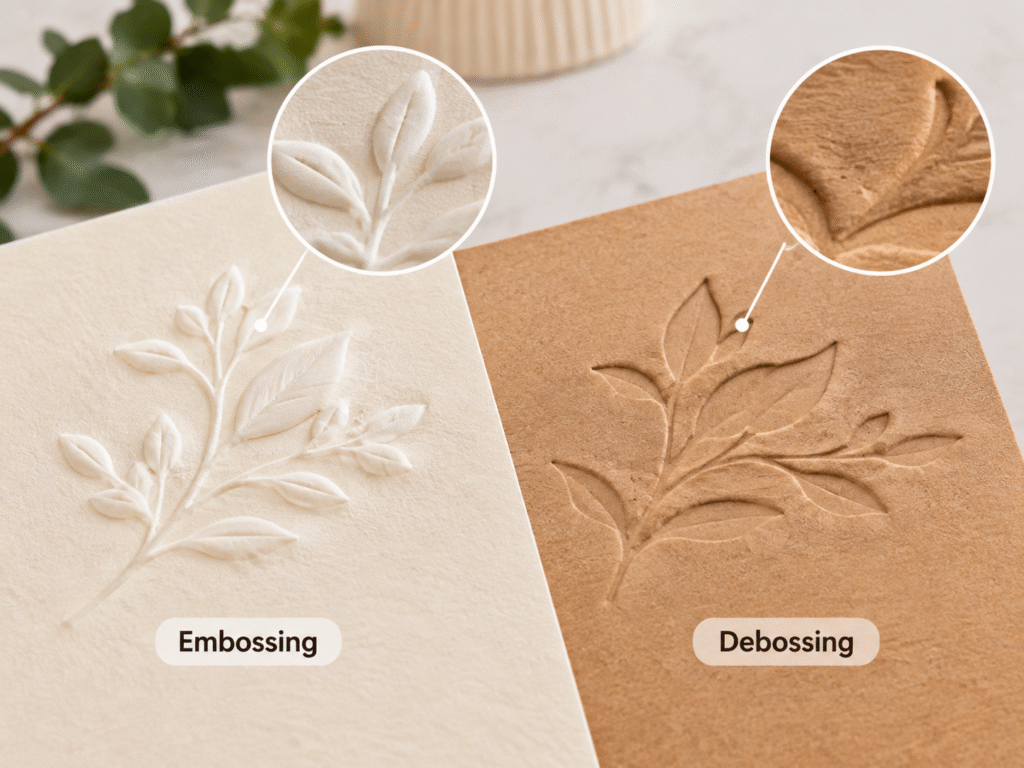
Embossing raises a design; debossing creates a recessed impression. Both use tooling and pressure to reshape the substrate.
A blind treatment relies on relief without needing a matching printed image. A registered treatment aligns the relief with print or transfer decoration.
Material caliper, fiber structure, tooling, and design detail influence the result. Deep relief can affect the reverse face or nearby folds.
Do not assume the same artwork can be printed, foiled, and embossed at identical detail sizes. Ask for the converter’s limits and review the actual result.
The relief should also suit the package’s use. A raised element on a tightly sliding sleeve may experience rubbing or affect movement.
A Practical Selection Matrix
The following options are candidates to assess, not automatic prescriptions.
| Packaging requirement | Options to evaluate | Main approval point |
|---|---|---|
| Low-glare retail presentation | Matte or satin coating, matte film | Readability and handling marks |
| Strong graphic sheen | Gloss aqueous or UV system, gloss film | Reflections and color appearance |
| Selective brand highlight | Spot coating, foil, relief | Registration and detail |
| Tactile surface | Soft-touch coating or film, textured paper | Feel after repeated handling |
| Repeated sliding contact | Suitable resistant surface system | Wear at actual contact points |
| Handwriting or batch coding | Reserved compatible panel | Mark adhesion and legibility |
| Recycling-related brief | Documented finished construction | Evidence and local acceptance |
Select a short list that meets the essential requirements. A large sample collection is less useful than two or three options tested against a clear brief.
Match the Finish to the Box Structure
For custom folding paper boxes, crease quality and glue performance deserve early attention.
Inspect printed folds, locking features, and the manufacturer’s joint. A broad coated surface may be attractive while creating difficulty exactly where a carton must bend or bond.
For rigid presentation boxes, the wrap, adhesive, supporting board, and corner construction interact. Test lid movement, sleeve contact, and edge wear.
A surface treatment can alter friction. Too much resistance may make opening difficult; too little can affect how parts remain together.
For an outer shipping package, consider contact with conveyors, other parcels, labels, and handling equipment. The most delicate decorative effect may belong on an inner presentation layer.
Plan the Process Sequence with the Converter
Printing, coating, lamination, foil transfer, relief, cutting, and gluing cannot be arranged arbitrarily.
An existing layer can influence how the next process adheres or responds to heat and pressure. A coating suitable for general surface protection may be unsuitable beneath a particular foil.
The converter should propose a production sequence using compatible materials. Specify the desired final result and review the proposed method before approving artwork.
Packboxprint’s custom packaging design services can support this coordination between graphics, structure, and the production brief.
Leave room for technical adjustments that preserve the design intent. Moving a small accent away from a fold can be more effective than repeatedly trying to force an unsuitable detail through production.
Prepare Artwork That Separates Each Operation
Provide distinct, clearly named separations for spot coating, foil, embossing, and other selective effects.
Confirm the required file conventions. A colored screen overlay is not sufficient unless prepress understands exactly which production operation it represents.
Keep the dieline separate from the printed graphics. Identify glue exclusions, coding panels, and other functional areas.
Fine reversed type and narrow gaps need evaluation in the intended process. Avoid specifying universal minimum sizes without considering the material and equipment.
Retain an editable master and identify the approved production revision. Every variant should be checked for its own product name, quantity, instructions, and code information.
Protect Readability and Operational Features
The finished package must still communicate clearly.
A glossy or metallic field can make some text and codes difficult to read at certain angles. Relief can distort a machine-readable symbol. A textured surface may affect very small lettering.
Provide a suitable area for barcodes and verify them on representative finished samples.
Check date coding, handwriting, label adhesion, and tamper seals where they apply. A treatment that resists marking can also resist an intended code.
Resealability and child-resistant opening are structural or closure functions. Adding a decorative coating does not establish either capability.
Approve Samples for Appearance and Function
Use a sample that represents the proposed material, print system, finish, and converting sequence.
A digital proof can support layout review. It cannot reproduce tactile feel, actual relief, or changing reflections reliably.
Evaluate the package under agreed lighting and in normal viewing positions. Handle it, open it, and place it beside neighboring units.
Then assess the relevant functional requirements:
- Rub and scuff behavior under defined contact conditions
- Adhesion of print and applied layers
- Fold cracking or surface separation
- Blocking, or unwanted sticking in a stack
- Glue-joint performance
- Label, code, and barcode compatibility
- Fit and movement of lids, drawers, and sleeves
Specify test methods and acceptance criteria with the supplier where these properties matter. An informal scratch with a fingernail is not a universal quality standard.
Retain the approved sample and record its construction. A later material change can affect performance even when the finish name stays the same.
Investigate Defects Before Changing the Specification
A defect can have several causes.
Cracking at a fold may involve board, grain direction, crease geometry, or the applied layer. Peeling can involve adhesion, contamination, or process conditions. Scuffs may reflect the handling configuration as well as the surface formulation.
Ask the supplier to investigate the complete system.
Replacing a coating with film, for example, may solve one problem while introducing another at the glue joint or fold. Confirm the proposed correction with a representative trial.
Define acceptable normal variation too. Unclear expectations about sheen, registration, or minor surface marks can create disagreement even when production is consistent.
Understand Cost Beyond the Unit Price
Finishing costs can include tooling, setup, material, additional passes, inspection, and waste.
Consider two hypothetical options for a 4,000-unit order:
| Cost item | Option A | Option B |
|---|---|---|
| Fixed setup | $180 | $480 |
| Variable finishing cost per unit | $0.08 | $0.15 |
| Total finishing cost | $500 | $1,080 |
| Average finishing cost per unit | $0.125 | $0.270 |
These figures illustrate cost allocation, not Packboxprint pricing.
The difference is $580, or $0.145 per unit. Whether it is justified depends on appearance, performance, production impact, and the product’s commercial requirements.
Compare options on the same substrate, quantity, coverage, and delivery basis. A lower quotation may reflect a different material or treatment rather than a more efficient version of the same specification.
Evaluate Environmental Claims at Package Level

Water-based, UV-cured, laminated, and transfer-decorated describe different systems. None is an environmental certification.
A water-based formulation leaves solids after drying. UV curing does not establish biodegradability. Lamination retains film, while typical transfer processes remove the carrier.
Those distinctions matter, but the final claim must account for the complete construction.
Consider coverage, coatings, adhesives, windows, inserts, contamination, and the relevant collection and processing system. Ask for supporting information for the exact material and application.
A decorative finish also does not establish direct food-contact suitability. Sensitive uses require an appropriate assessment of the finished system and intended conditions.
Turn the Decision into a Clear Manufacturing Brief
Specify the base material, box style, quantity, artwork, desired surface, selected decoration, and expected handling conditions.
Include required coding or labeling areas, relevant contact conditions, and environmental documentation needs. Identify the physical reference that controls appearance.
When selecting a custom packaging manufacturer, discuss production compatibility, sampling, inspection criteria, and how substitutions will be approved.
For a Packboxprint packaging inquiry, product dimensions and a defined presentation brief help make those discussions concrete.
A well-chosen finish remains useful after the first impression. It should preserve the intended graphics while allowing the package to fold, bond, pack, open, and handle as required.
Frequently Asked Questions
1. What is a packaging finish?
It is a surface appearance or treatment applied to packaging. The term includes coatings, films, transfer decoration, and relief processes, depending on the specification.
2. Is a matte finish a coating or a film?
It can be either. Matte describes sheen. Confirm the actual construction, material, and performance requirements with the manufacturer.
3. Is aqueous coating always the simplest option?
It can be practical, but compatibility depends on the substrate, inks, equipment, and later operations. Evaluate the exact formulation and production sequence.
4. Is UV coating always glossy?
No. UV identifies the curing approach. Suitable formulations can create gloss, matte, tactile, or other effects.
5. How is lamination different from coating?
Lamination bonds a separate film to the substrate. A liquid coating forms its applied layer through drying or curing.
6. Can foil and embossing be combined?
Yes, where the material, tooling, detail, and sequence are compatible. Review a representative sample for alignment, appearance, and structural effects.
7. Does soft-touch resist scratches?
Resistance varies between systems and use conditions. Specify the required handling performance and test the actual package.
8. Which finish is best for dark packaging?
Compare candidates on the intended dark artwork. Check scuffing, oils, sheen changes, and edge wear rather than assuming one finish is universally best.
9. Are water-based coatings automatically recyclable?
No. The formulation, coverage, substrate, complete construction, and local recovery system all matter. Obtain evidence for the intended claim.
10. What should I approve before production?
Approve the material, artwork, finish separations, appearance reference, process compatibility, and relevant performance results. Record the final revision and rules for substitutions.