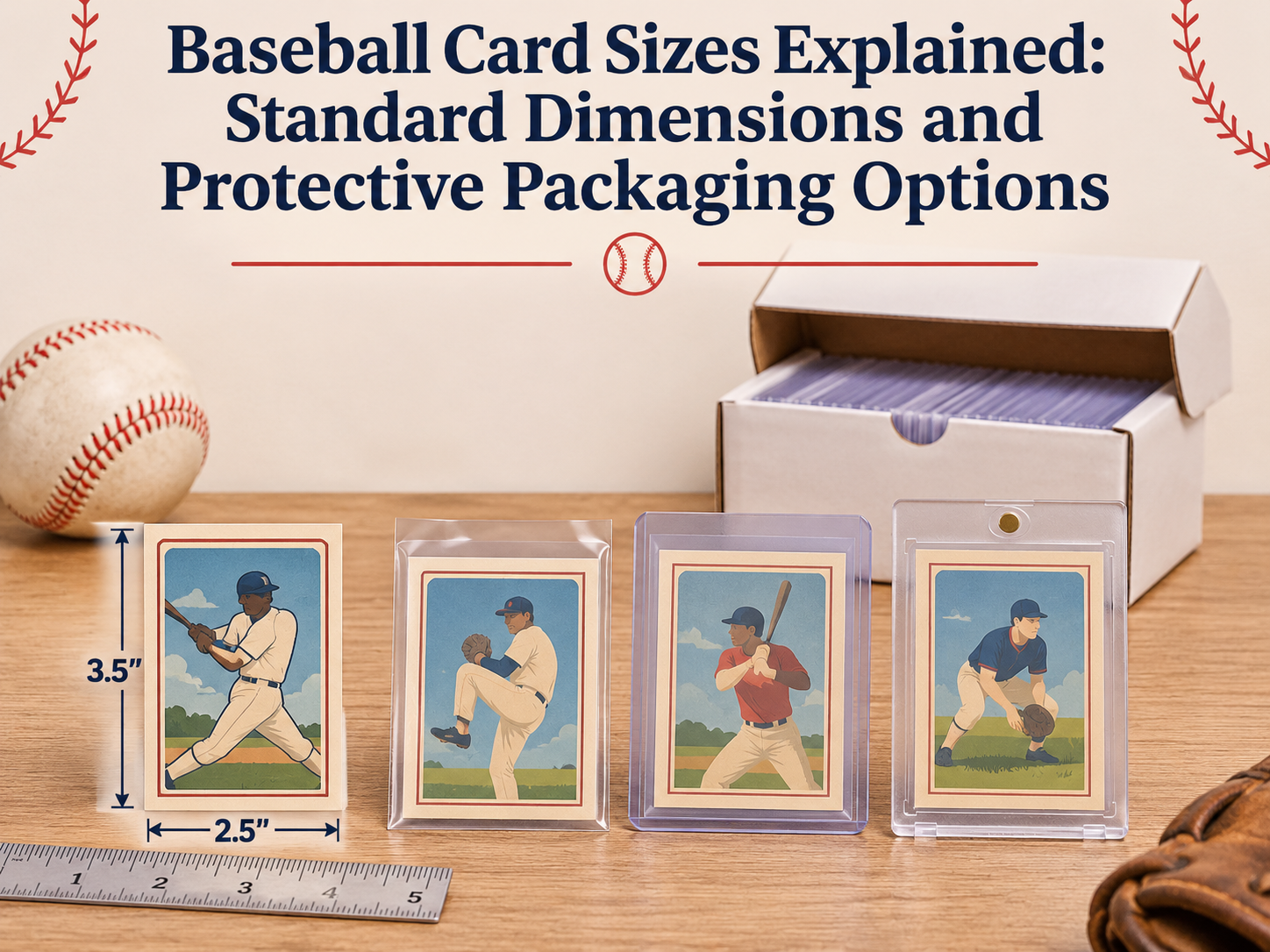
A baseball card may fit a standard sleeve but still need a different storage box once it is placed in a rigid holder. A print file may have the correct pixel dimensions yet produce the wrong physical size if its trim and bleed settings are confused.
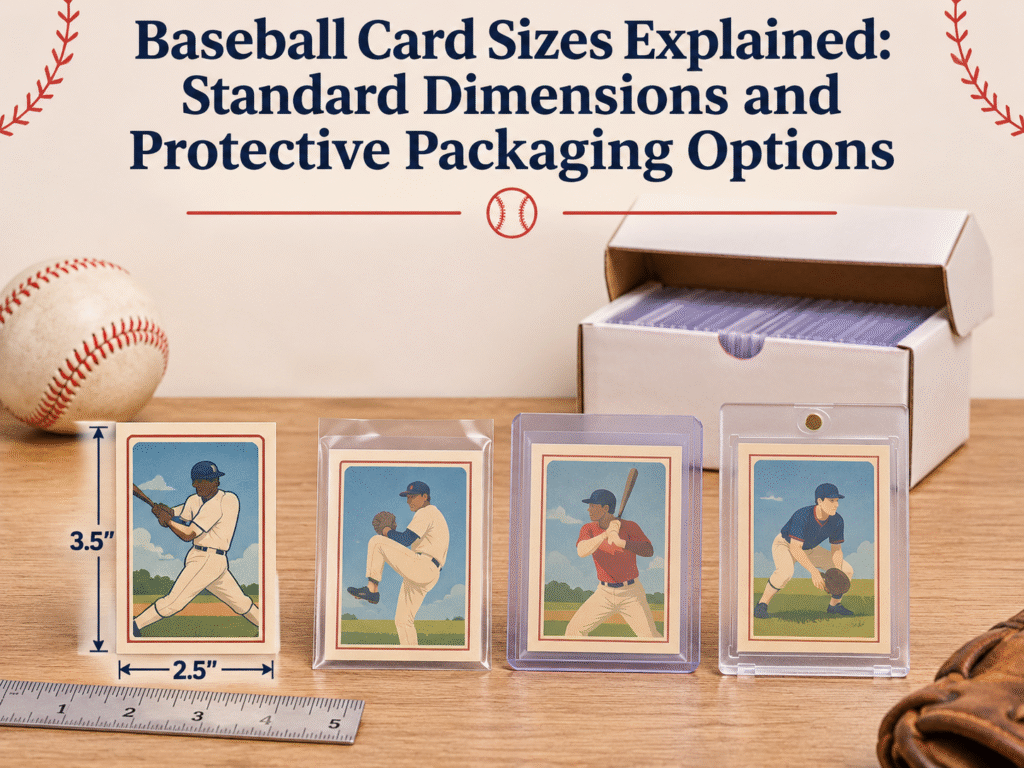
These are different sizing problems, even though they begin with the same familiar format.
The common modern baseball card measures 2.5 × 3.5 inches, equivalent to 63.5 × 88.9 mm. That is the starting point for artwork and accessory selection. Thickness, protective layers, and packaging requirements must be specified separately.
This guide explains those distinctions so designers, collectors, and packaging buyers can work from clear measurements rather than assumptions.
What Is the Standard Baseball Card Size?
The widely used modern format is 2.5 inches wide by 3.5 inches high.
| Measurement | Dimension |
|---|---|
| Finished width | 2.5 in |
| Finished height | 3.5 in |
| Metric width | 63.5 mm |
| Metric height | 88.9 mm |
| Width-to-height ratio | 5:7 |
The metric values are exact unit conversions because one inch equals 25.4 mm. An actual manufactured card can still have production variation.
These dimensions describe the finished card face. They do not include printing bleed, a sleeve, a holder, or the clearance needed inside a box.
Use the format as a reference rather than a guarantee that every baseball card matches it. Vintage, promotional, miniature, oversized, and specialty issues may differ.
Why the Common Format Matters
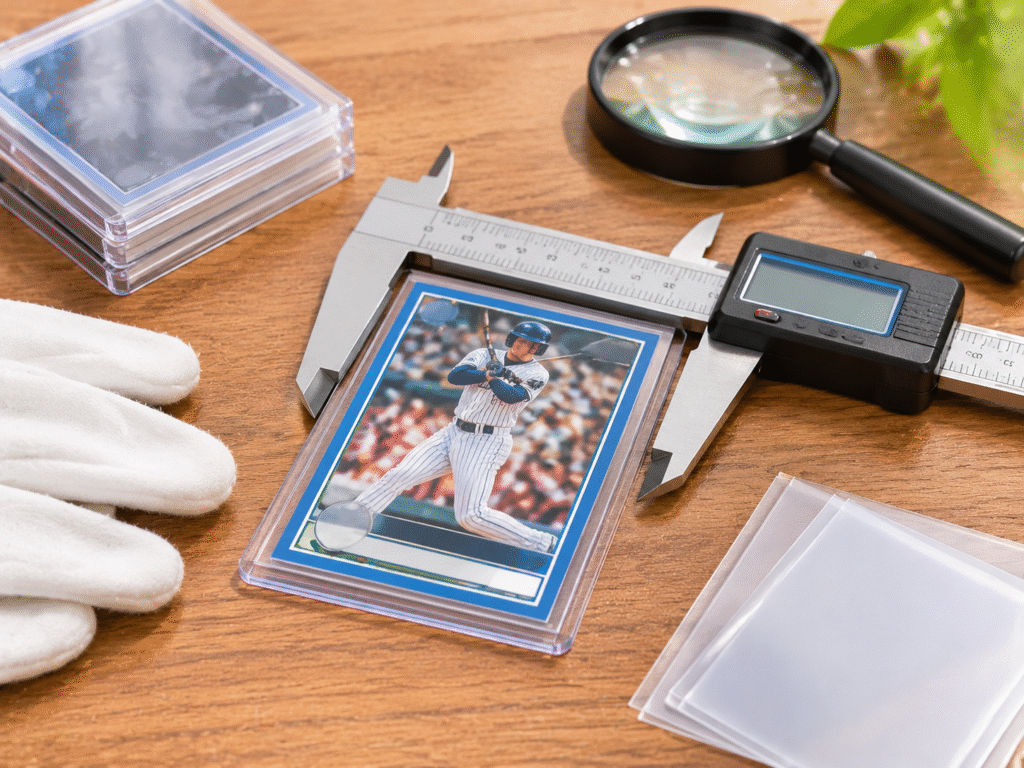
A shared footprint allows many cards to use broadly compatible accessories and storage systems.
For collectors, it makes sorting and presentation more manageable. For designers, it establishes a familiar space for photography, names, statistics, and supporting information.
Compatibility still depends on the accessory’s actual specification. A product labeled “standard size” may refer to the card it holds rather than its own exterior.
A thick specialty card can share the standard width and height while requiring a different sleeve or holder. A slabbed card may occupy considerably more space even though the card inside has not changed.
The useful principle is simple: identify which object each measurement describes.
Keep Five Sets of Dimensions Separate
| Object or file | What to measure or specify |
|---|---|
| Bare card | Finished width, height, and thickness |
| Artwork | Trim, bleed, safe area, and final-size resolution |
| Sleeved card | Complete sleeve envelope and packed thickness |
| Rigid holder or slab | Actual exterior dimensions and relevant fit details |
| Storage or presentation box | Usable interior, loading path, and finished exterior |
The card’s width and height are not suitable substitutes for all five.
For custom folding paper packaging, the correct starting point is the complete item going into the carton. That may be a bare stack, a sleeved set, or a collection of holders.
How to Measure a Baseball Card
Use a clean, stable surface and a measuring method that will not damage the card.
Measure width and height along perpendicular edges. Do not use a diagonal measurement or force a curved card flat to obtain a convenient number.
For valuable cards, avoid pressing measuring jaws against printed surfaces or corners. Use a suitable non-damaging reference or specialist assistance when needed.
Record whether the card is loose, sleeved, or enclosed. A measurement without that information can mislead the next person.
If working with a production batch, check representative samples rather than assuming one card describes the entire run.
Standard Cards and Alternative Formats
Not all collectible cards use the same footprint.
Miniature cards can have narrower or shorter faces. Oversized and promotional cards may be designed for display rather than conventional pages. Historical issues can have dimensions specific to their release.
The labels “mini,” “jumbo,” and “oversized” do not establish exact dimensions across suppliers or collections.
Measure or obtain the specification for the particular issue before buying protective accessories or commissioning packaging.
Even when the face dimensions match, thickness and corner construction can affect fit. A specialty card should not be forced into an accessory simply because both products use the word “standard.”
Print Size: Trim, Bleed, and Safe Area
The finished card and print file serve different purposes.
Trim identifies the intended final edge. Bleed extends backgrounds beyond that edge to accommodate normal cutting variation. Safe area keeps important content sufficiently inside the trim.
Bleed is not extra material that remains around the finished card. It is removed during trimming.
A Common Bleed Example
If the printer requests 0.125 inch of bleed on every side:
Artwork width = 2.5 + 0.125 + 0.125 = 2.75 inches
Artwork height = 3.5 + 0.125 + 0.125 = 3.75 inches
That gives an overall artwork area of 69.85 × 95.25 mm.
These figures apply to the stated bleed requirement. Follow the actual printer’s template rather than assuming every production route uses the same allowance.
Important names, statistics, logos, and other essential details belong inside the specified safe area. Background colors and images intended to reach the edge extend through the bleed.
Border Designs Need Particular Care
A narrow printed border can make small cutting differences more visible. Bleed prevents exposed paper edges but does not guarantee visually perfect centering.
Review the printer’s tolerances and choose a border design that suits the process.
Front-to-back orientation should also be clear. Mark the intended top edge in the production brief so the reverse does not appear inverted when the card is turned as expected.
Pixel Dimensions at 300 PPI
For raster artwork:
Pixels = inches × pixels per inch
At 300 PPI, the finished 2.5 × 3.5-inch face corresponds to:
750 × 1,050 pixels
Including the illustrative 0.125-inch bleed on every side gives:
825 × 1,125 pixels
| Artwork basis | Physical size | Raster dimensions at 300 PPI |
|---|---|---|
| Finished trim | 2.5 × 3.5 in | 750 × 1,050 px |
| With example bleed | 2.75 × 3.75 in | 825 × 1,125 px |
PPI describes image sampling. DPI usually describes a device’s dot output; the terms are often mixed in informal artwork discussions.
A 300-PPI image is a common planning reference, not a universal production rule. Confirm effective resolution, color setup, fonts, and file requirements with the printer.
Changing a file’s resolution label does not create missing image detail. Likewise, a large pixel count does not ensure the correct physical trim size unless the document is configured properly.
Baseball Card Thickness: What Points Mean
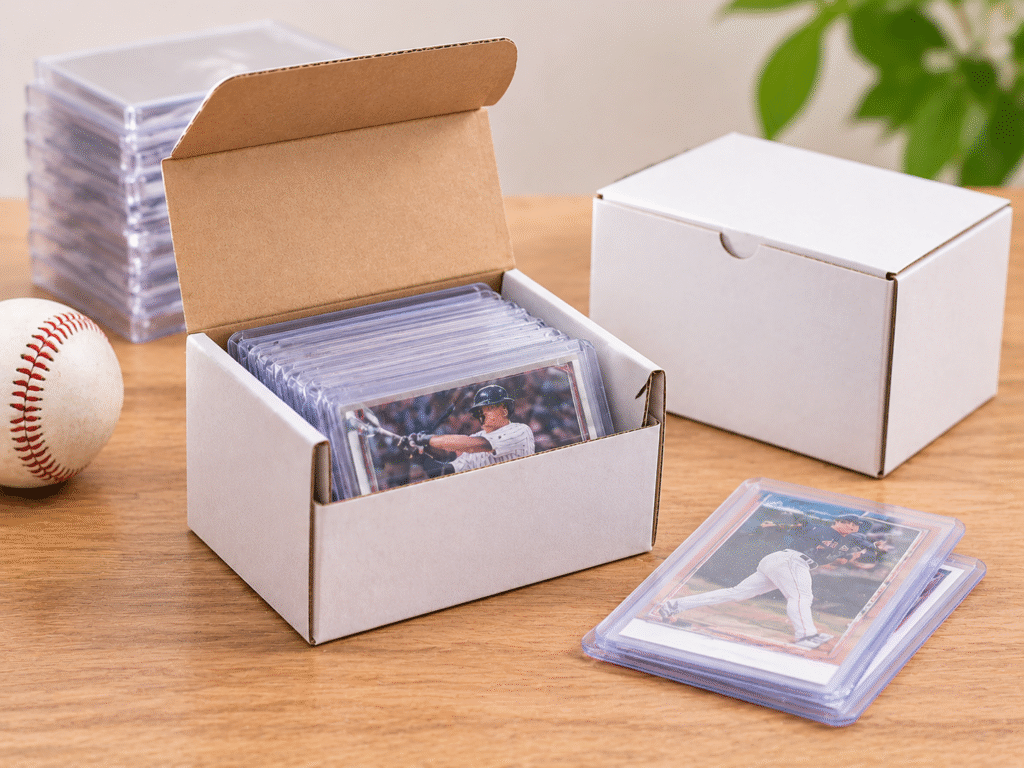
Thickness is independent of the 2.5 × 3.5-inch footprint.
In card-holder terminology, one point commonly equals 0.001 inch, or 0.0254 mm. This is different from a typographic point used for font sizes.
| Thickness designation | Inches | Millimeters |
|---|---|---|
| 20 pt | 0.020 | 0.508 |
| 35 pt | 0.035 | 0.889 |
| 55 pt | 0.055 | 1.397 |
| 100 pt | 0.100 | 2.540 |
| 130 pt | 0.130 | 3.302 |
| 180 pt | 0.180 | 4.572 |
These are unit conversions, not a claim that ordinary baseball cards all fall within one listed range.
A holder marked 35 pt describes a manufacturer’s capacity or cavity category. It does not prove that the card placed inside measures 35 pt.
Use the actual card thickness and the accessory maker’s fit guidance. Thick inserts, memorabilia constructions, and other specialty materials can require substantially different accommodation.
Choosing Sleeves for Standard Baseball Cards
A sleeve should accommodate the card without forcing the corners or creating excessive pressure.
Check the card dimensions the sleeve is intended to hold, the sleeve’s exterior size, and its suitability for the card’s thickness.
The outside dimensions include material and seams. They are therefore larger than the usable space available to the card.
As an accessory example, a sleeve with an exterior of 2.625 × 3.625 inches occupies approximately 66.675 × 92.075 mm. That exterior cannot be ignored when developing a carton around a sleeved set.
This is an example size, not a universal specification for every sleeve. Different products vary.
Double-sleeving changes the envelope again. Measure the completed arrangement rather than adding an assumed standard allowance.
Material suitability matters alongside fit. For long-term preservation, request appropriate composition information and guidance for the intended collection. A “clear plastic” description alone does not establish preservation performance.
Toploaders, Semi-Rigid Holders, and Magnetic Holders
Protective accessories serve different handling needs.
A rigid holder can reduce bending exposure, while an appropriate sleeve can provide a separate contact layer where the accessory is designed to accept one.
Do not assume every holder accommodates a sleeved card. Some cavities are intended for bare cards; others are specifically designed for an additional sleeve.
A very tight fit can put pressure on edges or surfaces. An excessively large cavity may allow movement. Follow the product’s fit guidance and check the actual card.
For thickness selection, use an appropriate gauge or measurement method. If a printed gauge is used, verify that it has been printed at the intended scale rather than reduced to fit the page.
Avoid forcing a holder closed. Mechanical closure is not evidence that the contents are fitted correctly.
Graded and Encapsulated Cards Need Their Own Measurements
A slab is a protective enclosure around the card. Its exterior dimensions control storage and presentation fit.
Different enclosure formats can vary in height, width, thickness, corner shape, and label area.
A box marketed by card count may not accept the same number of slabs, even when all the enclosed cards share the standard face size.
Measure representative examples from the intended collection. If a box must accept several enclosure types, identify the maximum envelope and check how smaller ones remain stable.
Do not design a fitted insert around the bare card dimensions when the actual product is an encapsulated card.
How to Calculate Stack Depth
A carton for a group of cards needs the stack thickness, not just the face dimensions.
A basic estimate is:
Stack depth = card count × average card thickness
Suppose 50 bare cards have an average measured thickness of 0.35 mm:
50 × 0.35 = 17.5 mm
That describes an illustrative bare stack. Sleeves, interleaves, wrapping, and instruction cards add space.
Measure a representative completed stack without excessive compression. Theoretical multiplication is useful for planning, but actual packing also depends on variation and how the layers settle.
Sleeve seams can contribute more thickness locally than expected. A stack may therefore be uneven.
For manufacturing, record the sample count, packed arrangement, and measurement method. “Fifty cards” is not enough information to establish a reliable carton depth.
Sizing a Custom Card Box
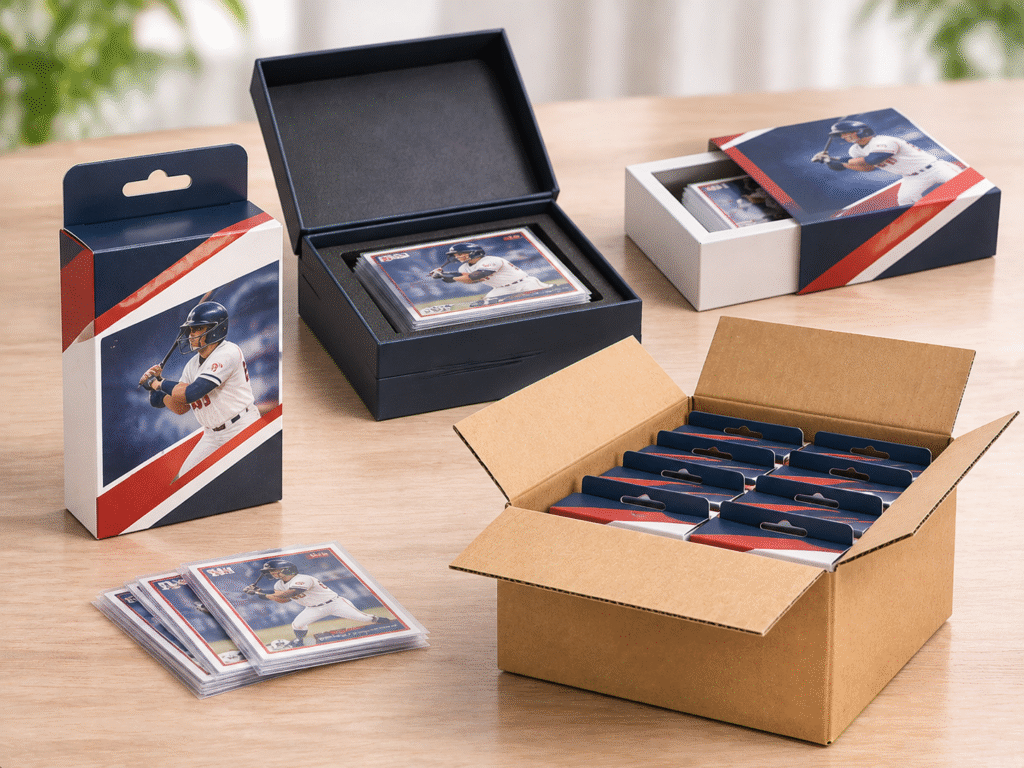
Begin with the complete protected set and the intended opening method.
For example, suppose a measured sleeved set occupies 67 × 94 × 27 mm. A trial carton cavity of 70 × 97 × 30 mm provides 3 mm of total additional space along each axis.
If centered, that is approximately 1.5 mm on each opposing side. It is a prototype allowance, not a universal recommendation.
Check whether the tuck tab enters without catching the sleeve tops. Assess product removal, including access for fingers or a suitable lifting feature.
A generous cavity may make loading easy while allowing the contents to rattle. A fitted support or different structure may be preferable to reducing the cavity until the cards become difficult to remove.
Packboxprint’s packaging material options can support the discussion of board, surface, and structural requirements. The material must work with the chosen dimensions and closure.
Internal, External, and Dieline Dimensions
These describe different stages of the package.
Internal dimensions concern usable fit. External dimensions matter for shelves, shipping, and master-carton layouts. Dieline dimensions describe the unfolded structure.
Board thickness, folds, overlaps, and closure features affect their relationship.
Do not create a box blank by treating the bare card’s width and height as panel dimensions without structural allowances.
Obtain an approved dieline for the intended material. If the board or construction changes, recheck the fit rather than assuming the original template remains valid.
For a multi-row storage system, also specify divider thickness, row width, orientation, and access. The outside box size alone does not establish usable capacity.
Printing and Finishing the Packaging
Card artwork and box artwork are separate files with separate structural requirements.
Packaging can show the collection name, quantity, orientation, and appropriate product information. A consistent identification system makes storage and retail handling easier.
Keep fine text away from cuts and folds. If a window is proposed, check its position against the actual protected contents and the support structure.
Finishes should suit handling. A collectible presentation may use a decorative accent, while a frequently opened storage carton may prioritize surface durability and closure life.
Packboxprint’s custom packaging design services can help coordinate the box artwork and structural brief.
Confirm the scope of the project separately: a packaging inquiry should not be assumed to include card printing, grading, or protective-accessory manufacture.
Retail Storage Is Not Transit Protection
A tuck carton or presentation box can organize a set and communicate its identity. It should not automatically be treated as a complete shipping package.
For delivery, evaluate the card protection, internal restraint, outer container, closure, and expected handling.
The protected cards should not be exposed to damaging pressure from a closure or support. Nor should a holder be free to move repeatedly against neighboring components.
Packing tape belongs on the agreed packaging surfaces. Avoid an arrangement in which adhesive can contact a card or where removal requires pulling against a vulnerable edge.
Measure the completed parcel’s exterior and gross mass for shipping. The original card size is not a substitute for either value.
Storage Conditions and Handling
Protect collections from unsuitable moisture exposure, direct light, dirt, and damaging loads.
A cardboard storage box provides organization and some physical separation. It is not inherently a sealed humidity barrier or a guarantee against fading.
A holder described as offering light protection also has specific properties and limitations. Do not infer unlimited protection from a product name.
For sensitive or valuable collections, follow appropriate preservation guidance and the accessory manufacturer’s recommendations.
Handle cards and accessories using a method suited to their condition. A packaging improvement should not introduce additional transfers or unnecessary contact simply to create a more elaborate presentation.
Common Sizing Errors
| Error | Consequence | Better approach |
|---|---|---|
| Using bleed size as finished size | Incorrect card or accessory dimensions | Separate trim and artwork specifications |
| Treating holder capacity as card thickness | Wrong cavity or stack estimate | Measure the actual contents |
| Ignoring sleeve exterior dimensions | Tight or undersized packaging | Measure the protected envelope |
| Ordering by card count alone | Stack depth does not match | Specify stock and packing arrangement |
| Assuming every slab is identical | Inconsistent row or insert fit | Check representative enclosures |
| Using one flat sample for approval | Loading and closure problems remain hidden | Evaluate a filled package |
Small distinctions in the brief can prevent large errors in a production order.
What to Confirm Before Ordering Packaging
Provide card format, maximum thickness, count per set, and whether the contents are bare, sleeved, held, or encapsulated.
Include measurements of the completed arrangement, the required opening method, quantity, artwork, and sales or distribution channel.
When evaluating a custom packaging manufacturer, discuss tolerances, samples, material substitutions, and approval responsibilities.
For a Packboxprint packaging inquiry, representative accessories or accurate drawings are especially useful.
Approve a filled sample for loading, closure, removal, movement, and the intended handling conditions. The familiar 2.5 × 3.5-inch format is a useful reference; a reliable package requires the rest of the measurements too.
Frequently Asked Questions
1. What is the standard baseball card size?
The common modern format is 2.5 × 3.5 inches, equivalent to 63.5 × 88.9 mm. Specialty and historical formats may differ.
2. Are all baseball cards the same size?
No. Miniature, oversized, promotional, and historical issues can use different dimensions. Standard-footprint cards can also vary significantly in thickness.
3. What is the aspect ratio of a standard card?
The width-to-height ratio is 5:7. That describes the face proportions and does not include bleed or protective accessories.
4. What size should the artwork be with bleed?
If the printer requests 0.125 inch on every side, a 2.5 × 3.5-inch card uses a 2.75 × 3.75-inch artwork area. Confirm the actual template.
5. How many pixels are needed at 300 PPI?
The finished face corresponds to 750 × 1,050 pixels. With the example bleed, the area corresponds to 825 × 1,125 pixels.
6. How thick is a standard baseball card?
There is no single thickness established by the standard face dimensions. Measure the specific card and distinguish its thickness from a holder’s capacity rating.
7. What does 35 pt mean?
In this context, it equals 0.035 inch or 0.889 mm. On an accessory, it usually identifies a capacity or cavity category that must be interpreted using the manufacturer’s guidance.
8. Will a box for bare cards fit sleeved cards?
Not necessarily. Sleeves increase the envelope and stack depth. Measure the completed set and test it in a representative box.
9. Can one box fit different graded-card holders?
Possibly, but exterior dimensions and shapes vary. Design around the intended enclosures and ensure smaller ones remain appropriately supported.
10. What should I send for a custom card-box quote?
Provide the completed protected dimensions, card count, stack depth, packed weight, opening preference, quantity, artwork, and intended use. Include representative samples where possible.