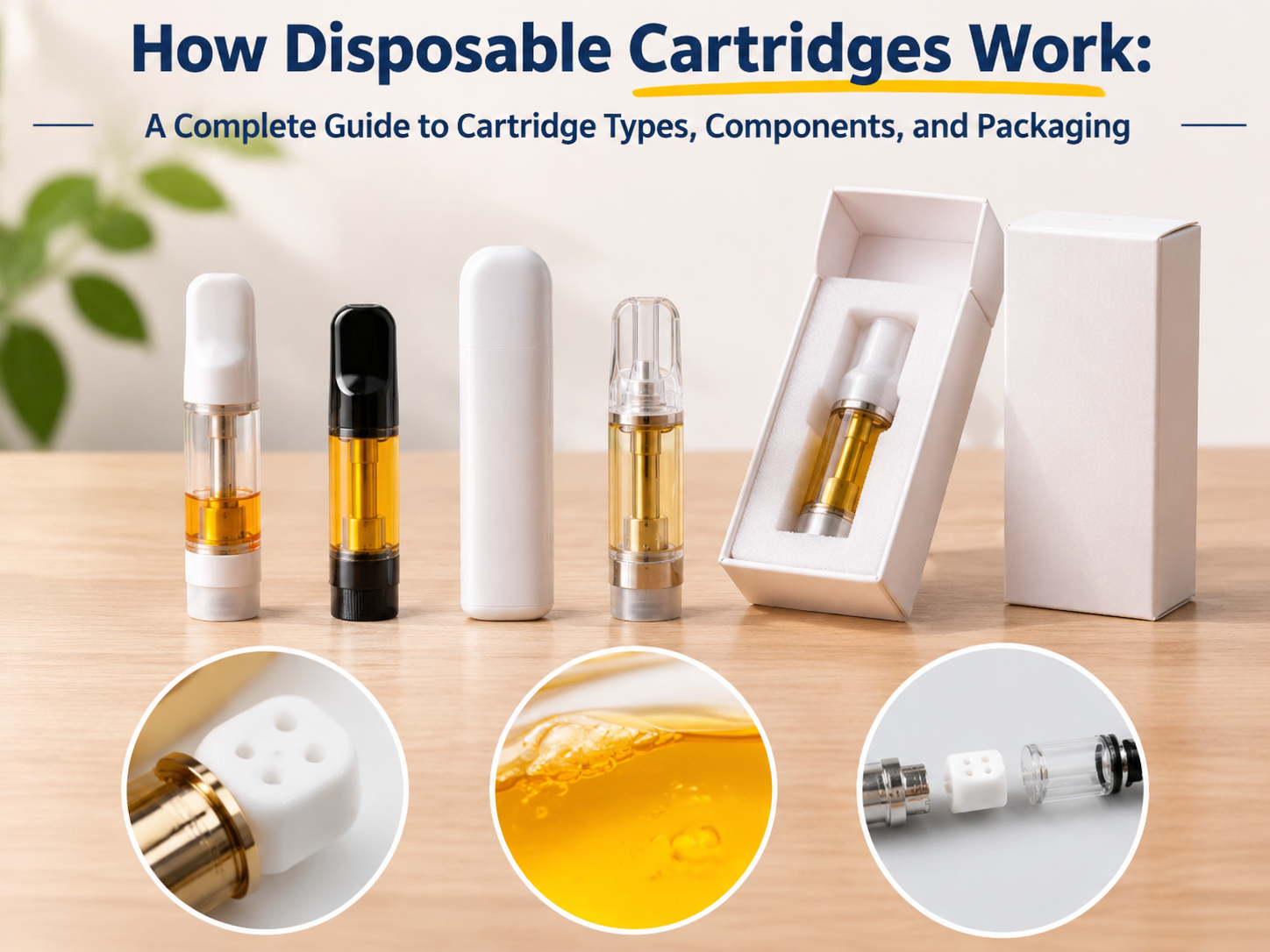
Cartridge design has become an important part of the electronic vaporizer industry. As product formats have evolved, manufacturers have introduced different cartridge structures to address liquid storage, heating consistency, leakage prevention, and compatibility with electronic devices.
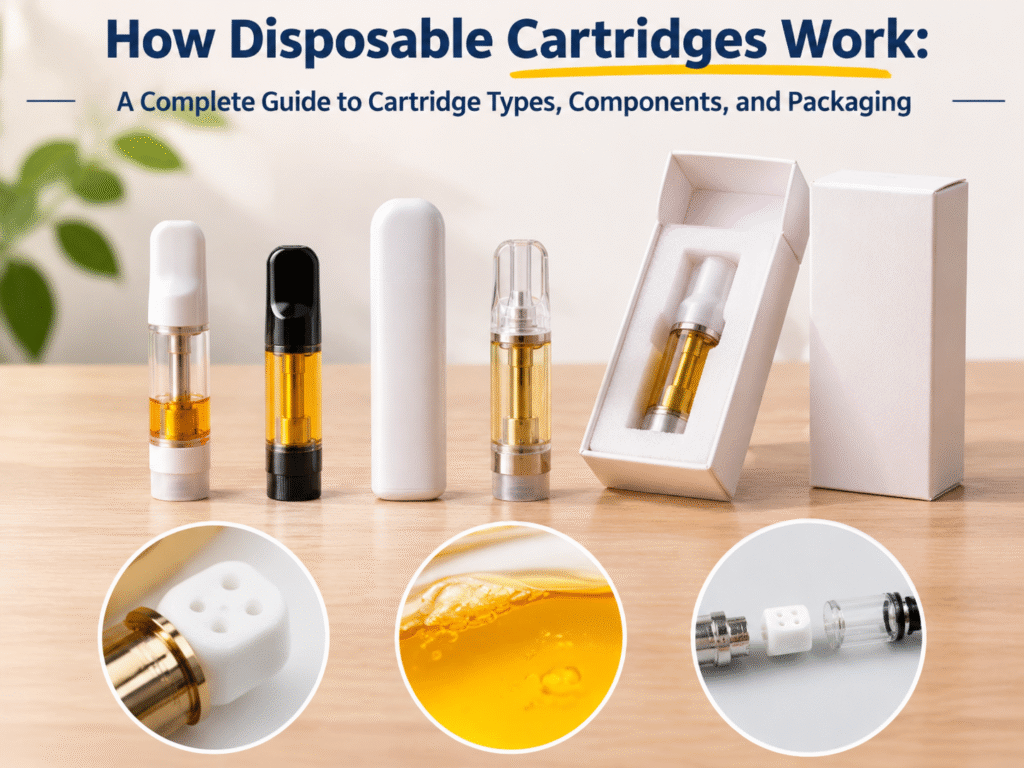
Among the available designs, ceramic-based cartridges have attracted attention because of their heating characteristics and their ability to accommodate different liquid formulations. Disposable and refillable cartridges also serve different product requirements, making it important to understand their construction before selecting a suitable format.
However, cartridge performance depends on more than the heating material alone. Reservoir construction, sealing components, airflow channels, electrical connections, and storage conditions all influence product reliability.
Packaging is another important consideration. A cartridge may contain sensitive components that need protection from impact, dust, leakage, and environmental exposure during storage and transportation. The packaging must also accommodate the product’s dimensions and any applicable labeling and regulatory requirements.
This guide examines disposable cartridges, CCELL ceramic technology, cartridge components, differences between disposable and refillable structures, common product issues, storage considerations, and the role of customized packaging in product protection.
What Are Disposable Cartridges?
Disposable cartridges are sealed or otherwise non-refillable cartridge units designed for a limited product lifecycle. Depending on the device architecture, they may be integrated into a disposable electronic device or supplied as a separate component.
Unlike refillable cartridge systems, disposable formats are generally not intended to be opened, cleaned, or filled again by consumers.
Their construction typically focuses on minimizing the number of user-serviceable components while maintaining a compact structure.
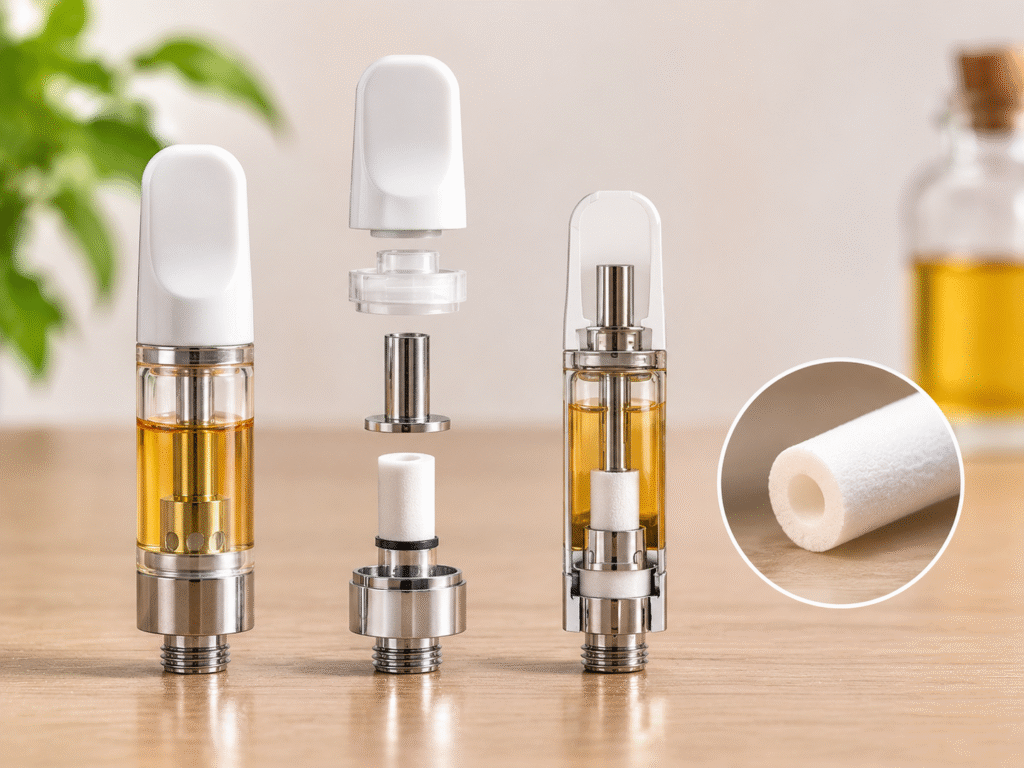
Common cartridge components include:
- Reservoir: Holds the liquid formulation.
- Heating element: Converts the liquid into an aerosol when the device operates.
- Ceramic or wick-based material: Supports liquid delivery to the heating element.
- Airflow channel: Provides the internal passage for airflow.
- Mouthpiece: Forms the user-contact interface.
- Housing: Protects and supports the internal components.
- Electrical contacts: Connect the cartridge to the compatible device where applicable.
- Seals and gaskets: Help prevent unwanted liquid leakage.
Not every cartridge contains all these components in the same arrangement. Some designs integrate multiple functions into a single assembly, while others use separate internal structures.
Understanding the actual product construction is essential when evaluating cartridge compatibility, packaging dimensions, and storage requirements.
What Is CCELL Ceramic Cartridge Technology?
CCELL is commonly associated with ceramic-based heating technology used in certain vaporizer cartridges.
Traditional wick-based cartridge designs use absorbent materials to transfer liquid toward a heating element. Ceramic-based systems use a porous ceramic structure that can support liquid distribution and heating.
The design of the ceramic material, including its pore structure, composition, and manufacturing consistency, influences its performance.
How Ceramic Heating Structures Work
Porous ceramic materials contain microscopic openings throughout their structure.
These pores can support the movement and distribution of liquid within the heating assembly. When the heating element operates, thermal energy is transferred through the ceramic structure.
The performance depends on several engineering variables:
- Ceramic composition.
- Pore size and distribution.
- Material density.
- Heating element design.
- Liquid viscosity.
- Electrical operating conditions.
- Manufacturing tolerances.
It is important not to assume that every ceramic cartridge uses identical technology. Different manufacturers may employ different ceramic formulations, heating configurations, and internal geometries.
Ceramic Cartridges vs. Traditional Wick-Based Designs
The following comparison highlights general structural differences.
| Comparison Factor | Ceramic-Based Cartridge | Wick-Based Cartridge |
|---|---|---|
| Liquid transfer | Porous ceramic structure | Absorbent wick material |
| Heating design | Ceramic-supported heating system | Heating coil and wick assembly |
| Internal construction | Depends on ceramic and coil configuration | Depends on wick and coil arrangement |
| Liquid compatibility | Requires formulation-specific testing | Requires formulation-specific testing |
| Manufacturing requirements | Ceramic processing and assembly control | Wick preparation and coil assembly |
| Quality inspection | Ceramic consistency and heating performance | Wick positioning and coil consistency |
Neither design is automatically superior in every application.
The correct choice depends on the intended formulation, electrical design, manufacturing process, and applicable product requirements.
Understanding the Main Components of a Cartridge
Cartridges may look relatively simple from the outside, but their internal construction involves several components that must work together.
1. Reservoir Chamber
The reservoir is the section designed to contain the liquid formulation.
It may be manufactured from glass, polymer, or another material selected according to the product’s chemical compatibility and structural requirements.
Important considerations include:
- Internal capacity.
- Material compatibility.
- Wall thickness.
- Dimensional accuracy.
- Resistance to leakage.
- Environmental stability.
A reservoir must maintain its structural integrity during normal storage and transportation.
2. Heating Assembly
The heating assembly is responsible for converting electrical energy into thermal energy.
In ceramic cartridge designs, the heating system may incorporate a porous ceramic structure and an associated conductive heating element.
Manufacturing consistency is important because variations in component positioning, resistance, and material properties can affect overall performance.
3. Airflow Channel
The airflow channel provides a passage through the cartridge assembly.
Its dimensions and geometry influence airflow characteristics and the internal arrangement of the components.
Manufacturers need to maintain dimensional consistency to ensure that the finished cartridge matches its intended device configuration.
4. Mouthpiece
The mouthpiece is the external component that forms the user-contact interface.
It may be produced using different polymer materials, depending on the product design.
Its surface finish, fit, dimensional accuracy, and material suitability should be evaluated during product development.
5. Seals and Gaskets
Sealing components help control liquid movement and reduce the risk of leakage.
Common materials may include selected elastomers or other compatible sealing materials.
The selection depends on chemical compatibility, temperature conditions, mechanical compression, and expected storage duration.
6. Electrical Connections
Some cartridges include conductive contacts that connect to an external battery or electronic device.
These contacts need to maintain consistent dimensions and electrical characteristics.
Poor connections, contamination, or mechanical damage can affect device compatibility and reliability.
Disposable vs. Refillable Cartridges: What Is the Difference?
Disposable and refillable cartridges may share similar external appearances, but their internal structures and intended use differ.
Understanding these distinctions is important for manufacturers, product distributors, and packaging designers.
| Feature | Disposable Cartridge | Refillable Cartridge |
|---|---|---|
| Intended lifecycle | Limited-use product | Designed for repeated use |
| Reservoir access | Usually sealed or restricted | Designed with a refillable structure |
| Maintenance | Generally not consumer-serviceable | Requires manufacturer-approved maintenance |
| Internal components | May be integrated into a sealed assembly | Often designed for component access |
| Construction | Frequently simplified | May contain additional closures and seals |
| Packaging requirements | Protection for a finished sealed unit | Protection for reusable components |
| Product identification | Disposable designation | Refillable designation |
Disposable Cartridge Design
Disposable cartridges are generally designed around a fixed product specification.
Their housing, reservoir, heating assembly, and seals are configured during manufacturing.
The product is not necessarily designed to be disassembled after use.
For this reason, users should follow the manufacturer’s instructions rather than attempting to remove sealed mouthpieces or access internal liquid chambers.
Refillable Cartridge Design
Refillable cartridges are developed with components intended to support manufacturer-approved filling and maintenance procedures.
Depending on the design, they may include removable mouthpieces, dedicated filling openings, replaceable seals, or other serviceable elements.
These structures require careful consideration of compatibility, cleaning requirements, material degradation, and contamination control.
A cartridge should not be assumed to be refillable simply because its mouthpiece appears movable.
The manufacturer’s technical documentation is the appropriate reference for determining the intended product configuration.
Why Disposable Cartridges Should Not Be Forcefully Opened
One common misunderstanding is that a disposable cartridge can be treated like a refillable cartridge if its mouthpiece or upper housing can be removed.
This assumption can create several problems.
Risk of Liquid Leakage
Opening a sealed cartridge may damage internal seals or deform the reservoir.
Once the original sealing arrangement has been compromised, the cartridge may no longer provide reliable liquid containment.
Liquid leakage can contaminate surrounding surfaces, packaging, and other products.
Risk of Material Exposure
Cartridge contents may contain substances that should not come into direct contact with skin, eyes, or other surfaces.
The exact formulation varies by product.
Consumers should avoid handling leaked contents and follow the manufacturer’s safety instructions.
Risk of Component Damage
Small cartridge assemblies contain components that may be difficult to inspect or reassemble correctly.
Prying, twisting, or applying excessive force can damage:
- Mouthpiece connections.
- Internal seals.
- Reservoir walls.
- Ceramic heating structures.
- Electrical contacts.
Even when the exterior appears undamaged, internal components may no longer function as intended.
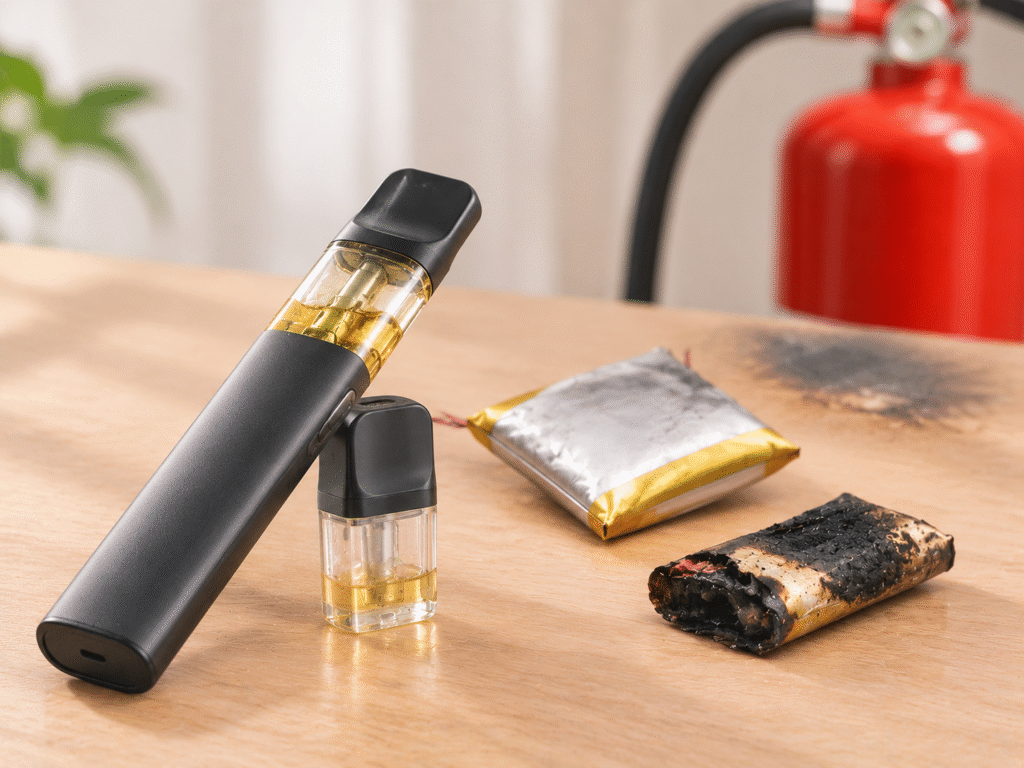
Risk Associated With Heating and Batteries
Some disposable electronic devices contain lithium-ion batteries.
Improper heating, puncturing, crushing, or attempting to dismantle battery-containing products can create fire and injury hazards.
The U.S. Fire Administration identifies battery failures as a potential cause of electronic cigarette fires.
For this reason, damaged or sealed cartridge assemblies should be handled according to manufacturer instructions rather than modified through improvised repair methods.
Common Problems Associated With Disposable Cartridges
Product reliability depends on the combined performance of the reservoir, seals, heating assembly, and external housing.
Several issues can occur when these components are not properly manufactured, stored, or handled.
1. Cartridge Leakage
Leakage is one of the most commonly discussed cartridge problems.
Potential contributing factors include:
- Damaged sealing components.
- Incompatible material selection.
- Incorrect component dimensions.
- Excessive mechanical stress.
- Temperature fluctuations.
- Improper transportation conditions.
Manufacturers should evaluate sealing performance during product development and establish appropriate inspection procedures.
2. Ceramic Component Inconsistency
Ceramic heating components require controlled manufacturing conditions.
Variations in material composition, pore structure, or assembly positioning may affect product consistency.
Quality control should therefore include material inspection and appropriate functional testing.
3. Mouthpiece Damage
Mouthpieces may become damaged through impact, compression, or incorrect handling.
This is particularly relevant during bulk transportation when individual products are not adequately separated.
Protective packaging inserts can help reduce movement and prevent contact between individual cartridge units.
4. Electrical Connection Problems
For cartridge systems that use external batteries, electrical contacts need to remain clean and structurally intact.
Damage during handling or storage may affect compatibility.
Packaging should therefore protect exposed contact areas from impact, contamination, and unnecessary friction.
5. Environmental Exposure
Temperature, humidity, and light conditions may influence the stability of cartridge materials and formulations.
The acceptable storage range should be established by the product manufacturer.
Packaging specifications should be developed around the actual environmental requirements rather than relying on general assumptions.
How to Store Disposable Cartridges Properly
Storage conditions influence the physical condition of cartridge assemblies and their packaging.
Manufacturers should establish appropriate storage recommendations based on material compatibility, product composition, and the intended distribution environment.
Temperature Control
Extreme temperatures may affect liquid viscosity, sealing materials, and certain housing components.
Products should be stored within the temperature range specified by the manufacturer.
Avoid exposing cartridges to direct heat sources or uncontrolled temperature conditions.
Protection From Direct Light
Certain formulations may be sensitive to light exposure.
Opaque or light-resistant packaging can be considered where the product’s stability requirements justify it.
The packaging material should be selected according to the actual light-protection requirements established during product testing.
Moisture Protection
Humidity can affect paper-based packaging, labels, and some external components.
Appropriate packaging construction and storage controls help maintain dimensional stability and prevent unnecessary deterioration.
Physical Protection
Individual cartridge units should be protected from excessive compression, vibration, and impact.
Custom inserts can help maintain positioning and reduce movement inside the outer carton.
For products with battery components, storage and transportation procedures should also follow the relevant battery safety requirements.
Why Packaging Matters for Disposable Cartridges
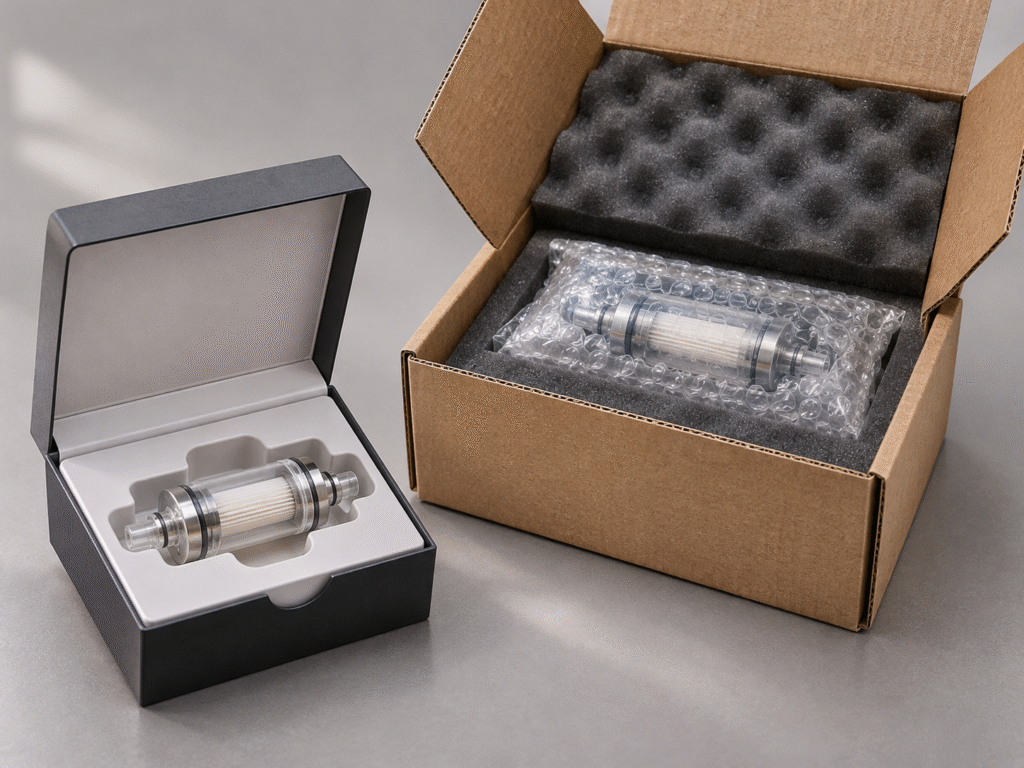
Packaging plays a practical role in protecting sensitive cartridge assemblies.
Although the cartridge itself contains the functional components, its external packaging contributes to protection, identification, regulatory communication, and supply-chain handling.
A poorly designed package may allow products to move excessively, expose components to unnecessary pressure, or become damaged during transportation.
1. Structural Protection
Packaging should be designed around the cartridge’s actual dimensions.
Important measurements include:
- Overall cartridge length.
- Maximum external diameter.
- Mouthpiece dimensions.
- Connector dimensions.
- Product weight.
- Required clearance.
- Insert thickness.
The internal box dimensions should accommodate the finished product without excessive pressure.
2. Custom Inserts
Inserts provide individual positioning and help prevent products from moving inside the box.
Depending on the product and its distribution requirements, possible materials include:
- Paperboard inserts.
- Corrugated paper inserts.
- Molded pulp.
- Suitable protective foam.
- Other compatible internal supports.
For businesses developing custom packaging, Packboxprint’s custom packaging solutions provide options for structural development, material selection, printing, and customized inserts.
The final construction should be validated using physical samples and representative transportation conditions.
3. Protection During Transportation
Cartridges may pass through several handling stages before reaching their intended destination.
Packaging should account for:
- Warehouse storage.
- Carton stacking.
- Loading and unloading.
- Transportation vibration.
- Compression during distribution.
- Environmental exposure.
Secondary corrugated packaging may be used to provide additional protection for grouped retail cartons.
The appropriate packaging configuration depends on the product’s weight, dimensions, fragility, and shipping conditions.
4. Product Identification
Packaging can also support product identification and traceability.
Depending on applicable regulations, relevant information may include:
- Product identification.
- Manufacturer information.
- Batch or lot number.
- Manufacturing date.
- Required warnings.
- Storage instructions.
- Regulatory information.
The required information differs between product categories and markets.
For electronic nicotine delivery systems, the FDA regulates relevant products and components, including cartridges, as well as their manufacturing, packaging, labeling, advertising, and distribution. <Cite refs={[“turn747567search0”]}/>
Custom Cartridge Packaging Design Options
A suitable packaging structure should balance product protection, production efficiency, material selection, and applicable regulatory requirements.
Folding Carton Packaging
Folding cartons are manufactured from paperboard and supplied in flat form before assembly.
They are useful for compact retail packaging and can be developed in different dimensions and closure styles.
Common structural options include:
- Straight tuck-end boxes.
- Reverse tuck-end boxes.
- Auto-bottom boxes.
- Sleeve-style boxes.
- Custom insert cartons.
The appropriate structure depends on the product dimensions and required internal support.
Packboxprint’s folding carton and custom box solutions can be considered when evaluating paperboard structures for different product categories.
Rigid Box Packaging
Rigid boxes use thicker structural board and are generally intended for applications requiring a more substantial presentation.
They may be suitable for certain multi-component electronic product packages or presentation sets.
However, rigid boxes are not automatically necessary for small cartridge products. Material consumption, shipping volume, and overall production cost should be considered before selecting this structure.
Sleeve Packaging
Sleeve packaging consists of an outer paperboard cover designed to slide over an inner tray or product structure.
It can provide an additional printed surface while allowing the inner component to remain separately positioned.
This format may be considered for selected product presentation applications where the dimensions and opening mechanism are appropriate.
Custom Corrugated Packaging
For bulk distribution, corrugated packaging can provide additional protection during storage and transportation.
Its structural properties depend on flute type, linerboard specifications, and overall construction.
The outer shipping carton should be evaluated separately from the individual retail packaging.
Printing and Finishing Options for Cartridge Packaging
Packaging artwork should be developed according to the applicable product category and destination market.
The printing method influences color reproduction, production efficiency, and surface quality.
Offset Printing
Offset printing is suitable for paperboard packaging requiring detailed graphics and consistent color reproduction.
It is frequently used for repeat production where artwork remains relatively stable.
Digital Printing
Digital printing can be considered for shorter production runs, sample development, and projects with multiple packaging variations.
It may offer greater flexibility when evaluating alternative structural and graphic designs.
Matte and Gloss Finishes
Surface finishes influence the appearance and handling characteristics of paperboard packaging.
Matte finishes provide a relatively subdued appearance, while gloss treatments produce a more reflective surface.
The suitability of each finish depends on the substrate and intended packaging application.
Foil Stamping and Embossing
Foil stamping and embossing are decorative processes that modify the visual or tactile characteristics of packaging.
Their use should be assessed according to product-category restrictions, market regulations, and the intended packaging specification.
Decorative finishes must never replace required health warnings or mandatory labeling.
Regulatory Considerations for Cartridge Packaging
Regulatory requirements are a critical part of electronic cartridge packaging development.
Different countries regulate nicotine-containing products, electronic devices, and associated components in different ways.
For example, the U.S. FDA identifies cartridges and other electronic nicotine delivery system components as regulated products. <Cite refs={[“turn747567search0”]}/>
The European Union also establishes specific requirements for electronic cigarettes under the Tobacco Products Directive.
These requirements include child-resistant and tamper-evident features, product notifications, health warnings, and specified packaging information. <Cite refs={[“turn747567search2”]}/>
Before packaging production begins, businesses should confirm:
- Product classification in the destination market.
- Required warning statements.
- Mandatory product information.
- Applicable child-resistant packaging requirements.
- Tamper-evident requirements.
- Label and artwork restrictions.
- Traceability information.
- Transportation and battery-related requirements where applicable.
A packaging supplier can assist with dimensions, materials, dielines, printing, and manufacturing. Final regulatory approval should remain with the responsible product manufacturer or qualified compliance specialist.
Quality Control in Cartridge Packaging Manufacturing
Consistent packaging quality requires inspection at different stages of production.
For small electronic products, dimensional accuracy and insert positioning are particularly important.
| Quality Control Item | Inspection Purpose |
|---|---|
| Paperboard thickness | Confirm material specification |
| Box dimensions | Verify product fit |
| Die-cut accuracy | Maintain structural consistency |
| Folding quality | Prevent irregular assembly |
| Adhesive bonding | Confirm joint strength |
| Printing registration | Maintain artwork alignment |
| Color consistency | Reduce production variation |
| Insert dimensions | Ensure correct product positioning |
| Closure performance | Check package integrity |
| Carton strength | Evaluate transportation protection |
Packboxprint provides customized packaging development and manufacturing services, including material selection, structural design, printing, and production coordination.
Its design services include structural engineering, dieline preparation, and packaging mockups.
For businesses developing new packaging formats, reviewing a physical sample before approving mass production is an important step.
How to Choose a Custom Packaging Manufacturer
Selecting a packaging manufacturer involves more than comparing unit prices.
The supplier should understand the relationship between product dimensions, material characteristics, structural requirements, and production processes.
Manufacturing Experience
Experience in paperboard converting, printing, die cutting, and box assembly can help reduce technical problems during development.
A manufacturer should be able to explain material options and identify potential structural limitations.
Design and Engineering Support
A packaging project may require more than an existing box template.
Custom dimensions, internal inserts, closure mechanisms, and product-specific protection may require structural development.
The manufacturer should be able to prepare dielines and prototypes for review.
Production and Quality Management
Consistent output depends on material control, machine settings, printing accuracy, and inspection procedures.
Businesses should ask how samples are approved and how production specifications are maintained between repeat orders.
Communication and Project Coordination
Clear communication is important when working with international suppliers.
Packaging specifications should be confirmed in writing, including dimensions, materials, printing requirements, tolerances, and delivery expectations.
For general custom paperboard packaging projects, businesses can learn more about Packboxprint’s manufacturing capabilities and submit project specifications through its contact page.
Conclusion
Disposable cartridges involve more engineering considerations than their compact exterior might suggest.
Ceramic heating structures, reservoirs, airflow channels, seals, mouthpieces, and electrical connections all contribute to the final product configuration. Understanding these components helps manufacturers and packaging professionals evaluate product requirements more accurately.
Disposable and refillable cartridges should also be distinguished by their intended construction. A sealed disposable cartridge should not be treated as a refillable unit or opened through improvised methods.
Packaging is an equally important part of the product supply chain. Properly designed cartons, internal inserts, protective materials, and accurate labeling can help maintain product condition during storage and transportation.
For businesses developing paper-based packaging, Packboxprint offers custom packaging design, material selection, printing, and manufacturing coordination. The final packaging specification should always be aligned with the product’s technical characteristics and the regulations of its intended market.
Frequently Asked Questions About Disposable Cartridges
1. What is a disposable cartridge?
A disposable cartridge is a sealed or non-refillable component designed for a limited product lifecycle. Depending on the device, it may contain a reservoir, heating assembly, airflow channel, mouthpiece, housing, and electrical connections.
2. What does CCELL mean?
CCELL is a term associated with ceramic-based heating technology used in certain vaporizer cartridge systems. Its porous ceramic structure supports liquid distribution within the heating assembly.
3. What is the difference between ceramic and wick-based cartridges?
Ceramic-based cartridges use porous ceramic structures, while wick-based designs use absorbent materials to transfer liquid toward the heating element. Their performance depends on material composition, heating configuration, and formulation compatibility.
4. Can disposable cartridges be opened?
Disposable cartridges are generally designed as sealed or non-serviceable units. Attempting to force them open may damage internal components, compromise seals, and expose users to cartridge contents. Follow the manufacturer’s instructions.
5. Can disposable cartridges be refilled?
Disposable cartridges are not generally designed for refilling. Refillable models have dedicated structures intended for manufacturer-approved filling procedures. Product documentation should be checked before determining whether a cartridge is reusable.
6. How can I identify a disposable cartridge?
Check the product specifications, manufacturer’s documentation, packaging, and model information. External appearance alone may not reliably distinguish a disposable cartridge from a refillable one.
7. Why do disposable cartridges sometimes leak?
Potential causes include damaged seals, material incompatibility, manufacturing defects, excessive pressure, temperature fluctuations, or physical damage during transportation.
8. How should disposable cartridges be stored?
Follow the manufacturer’s specified storage conditions. Avoid uncontrolled temperatures, direct heat, unnecessary moisture exposure, and physical compression. Products containing batteries should also follow applicable battery safety instructions.
9. What packaging is suitable for cartridge products?
Depending on product dimensions and distribution requirements, suitable options may include folding cartons, paperboard boxes, protective inserts, and corrugated shipping cartons. The final structure should be validated using physical samples.
10. Why are custom inserts important for cartridge packaging?
Custom inserts help maintain product positioning, reduce movement, and protect components from unnecessary contact or impact during transportation.
11. What information should appear on cartridge packaging?
Required information depends on product classification and destination-market regulations. It may include product identification, manufacturer details, health warnings, ingredient information, batch identification, and storage instructions.
12. Does the FDA regulate disposable vape cartridges?
The FDA regulates electronic nicotine delivery systems and relevant components, including cartridges. Applicable requirements may cover manufacturing, packaging, labeling, advertising, and distribution.
13. Can Packboxprint manufacture custom cartridge packaging?
Packboxprint offers custom paperboard packaging development and manufacturing services, including structural design, material selection, printing, inserts, and finishing. Product-specific regulatory requirements and manufacturing suitability should be confirmed before placing an order.