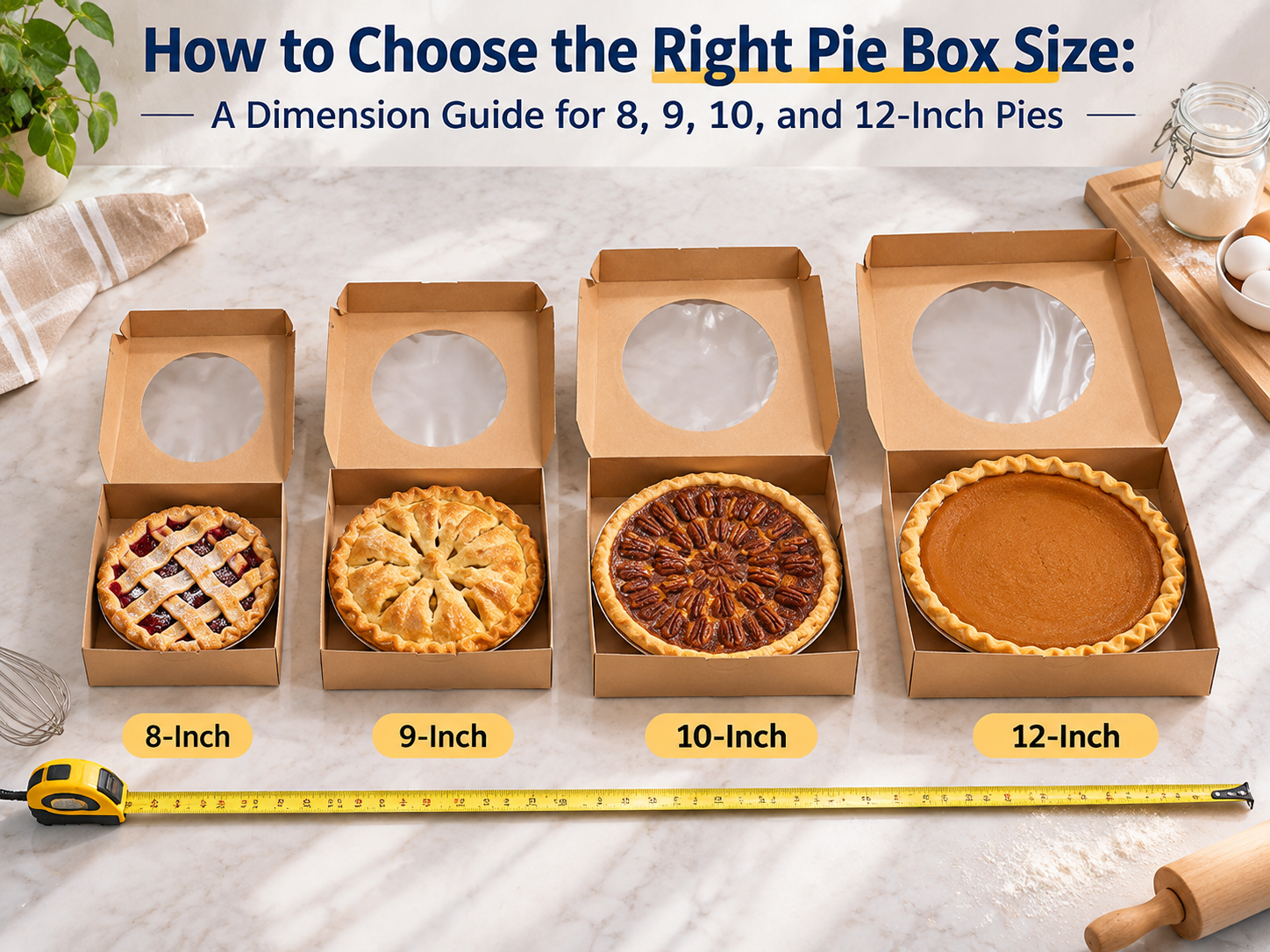
A pie described as nine inches may not fit comfortably inside a box described as nine inches. The pan rim, crimped crust, support board, and carton construction can all change the space required.
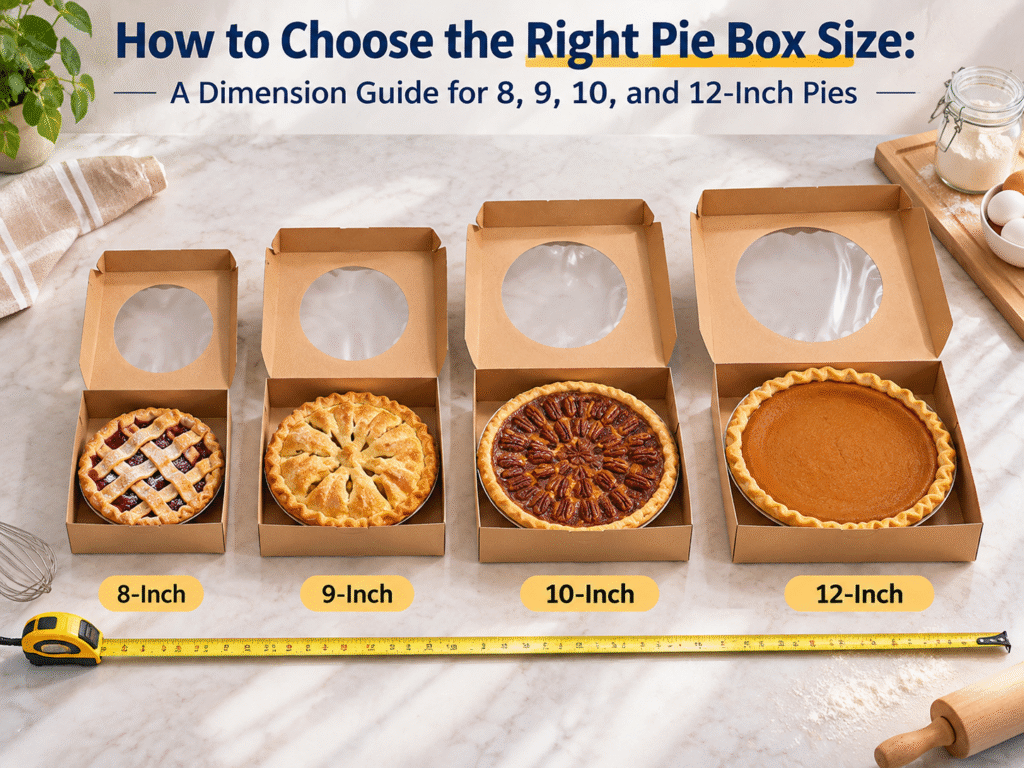
That mismatch becomes expensive during a busy pickup period. Staff may struggle to lower the pan into the carton, a decorative crust can catch on the wall, or the lid can touch a topping that looked well below the opening.
The practical starting point is the finished product as it will be sold. Measure its widest footprint and highest point, then select a box with suitable usable space, support, and loading access.
This guide explains how to size boxes for common pie diameters, distinguish shallow and tall formats, and check windows, materials, stacking, and multi-pie orders before purchasing.
The Quick Answer: Measure the Finished Pie and Pan
Pie diameter is a product description, not a complete packaging specification.
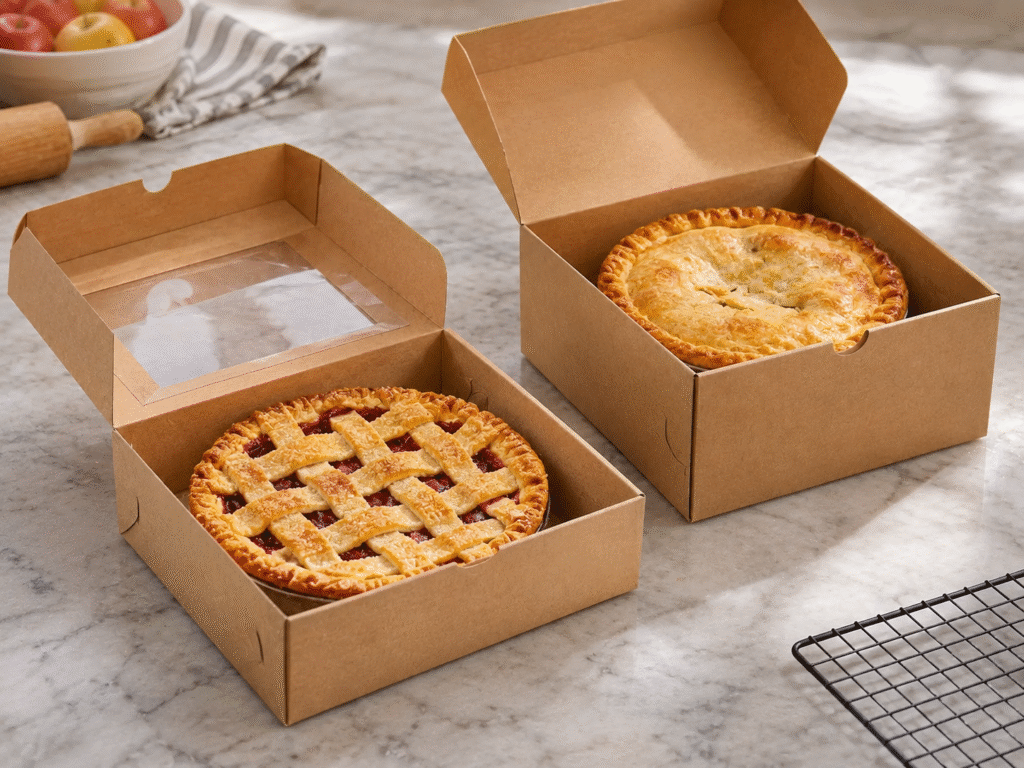
A box with the same number as the nominal pie diameter may work when its usable interior accommodates the complete product. Another pie carrying the same nominal description may need a larger footprint because of its pan flange, crust overhang, or support board.
Use the following relationship:
Required usable footprint = maximum packed-product footprint + validated clearance
Required usable height = packed-product height + validated headroom
Clearance must account for loading and removal. Headroom must accommodate the highest topping and expected lid movement without contact.
There is no universal rule that every nine-inch pie must use either a nine-inch or a ten-inch box.
Pie Box Size Chart for 8, 9, 10, and 12-Inch Products
The table below shows illustrative sizing examples, not mandatory dimensions or verified stock availability.
Each example assumes the finished pan-and-pie footprint extends half an inch beyond the nominal diameter. The trial box then provides another half-inch of total footprint space.
| Nominal pie diameter | Assumed maximum packed footprint | Trial usable interior footprint | Total horizontal clearance |
|---|---|---|---|
| 8 in | 8.5 × 8.5 in | 9 × 9 in | 0.5 in along each axis |
| 9 in | 9.5 × 9.5 in | 10 × 10 in | 0.5 in along each axis |
| 10 in | 10.5 × 10.5 in | 11 × 11 in | 0.5 in along each axis |
| 12 in | 12.5 × 12.5 in | 13 × 13 in | 0.5 in along each axis |
If centered, 0.5 inch of total clearance means approximately 0.25 inch on each opposing side. It does not mean 0.5 inch per side.
Your actual pan may be narrower or wider. Replace the assumed footprint with a measurement before selecting a size.
Height must be chosen separately. A footprint that works for a flat-topped pie may also work for a tall pie, but the two products can require different lids or wall heights.
For custom folding paper boxes, confirm that the quoted dimensions describe the usable assembled interior rather than an outside measurement or an approximate nominal size.
How to Measure a Pie for Packaging
Use a representative finished product in its intended pan, with any support board, protective component, or decoration included.
Measure Across the Widest Point
Measure the pan’s outside rim, not just the opening or bottom diameter.
Then check the crust. A decorative crimp may project beyond the rim. Rotating the product can reveal an irregular edge that one diameter measurement misses.
For a round product, record the largest horizontal envelope. If the support board is square or has handling tabs, those features may control the box size instead.
Measure from the Support Surface to the Highest Point
Place the packed product on a level surface and measure vertically to the highest topping or crust feature.
Include the pan base, board, and any raised tray. Pan wall height alone does not describe the complete packed height.
Meringue peaks, whipped toppings, fruit arrangements, and pastry decorations can be uneven. Measure a representative upper limit rather than the lowest part of the top.
Check the Loading Method
A pie that fits after being tilted may be difficult or inappropriate to load that way.
Determine whether staff will lower it through the top, slide it into an open-front carton, or build a box around the pan. The opening and wall arrangement must support that sequence.
Repeat the test with normal operators and handling conditions. A careful one-off demonstration may hide a problem that slows every order.
What Size Box Fits a Nine-Inch Pie?
Begin with the actual outside dimensions of the finished nine-inch product.
A 9 × 9-inch usable cavity can work only if the complete footprint and required clearance fit within it. It should not be selected solely because “nine-inch pie” appears on the menu.
If the measured pan-and-crust envelope is 9.5 inches across, it cannot fit within a true nine-inch square cavity without interference.
A 10 × 10-inch usable footprint would provide 0.5 inch of total horizontal space in that example. Whether that is enough depends on the carton, loading access, and the product’s variation.
Likewise, a smaller measured envelope does not automatically need a one-inch upgrade. Unnecessary space can let the pan move or make the presentation look oversized.
Test the candidate box with the intended product and any locating support.
Choosing the Right Box Height
Shallow bakery cartons are often encountered in heights such as 2.5 or 3 inches, while taller formats may be considered for higher products. These are candidate formats, not a universal depth specification.
The terms “standard” and “deep dish” do not define an exact packaged height. A deep pan with a flat filling may need less headroom than a shallower pie with a high decoration.
A Worked Height Example
Suppose the finished pie, pan, and support measure 2.2 inches from the supporting surface to the highest point.
If the initial design allows 0.4 inch of headroom:
Required usable height = 2.2 + 0.4 = 2.6 inches
A true 2.5-inch usable height is too low for that design. A three-inch candidate provides more room, subject to closure intrusion and lid behavior.
The 0.4-inch allowance is illustrative. Determine the necessary clearance through a filled sample and expected handling conditions.
Check the Lid After Closing
Inspect the underside of the closed lid and any window film. They may sit lower than the top edge suggests.
A flexible lid can also deflect under a load placed above it. A box that clears the topping when standing alone may fail during stacking.
Do not compensate by pressing the lid down or relying on the topping to hold it up.
Control Movement Without Gripping the Crust
A larger cavity can solve a loading problem while creating a movement problem.
Where needed, use a suitable support or locating feature that engages the pan or board rather than fragile pastry. Make sure it does not distort a thin pan or make removal difficult.
The insert’s outside dimensions and thickness become part of the packaging calculation. Avoid adding a support after the carton size has already been finalized.
For several pan types, check their differences. A locating opening developed for one rim profile may not retain another.
The objective is stable handling and easy access, not the tightest possible fit.
Paperboard or Corrugated: Which Material Is Appropriate?
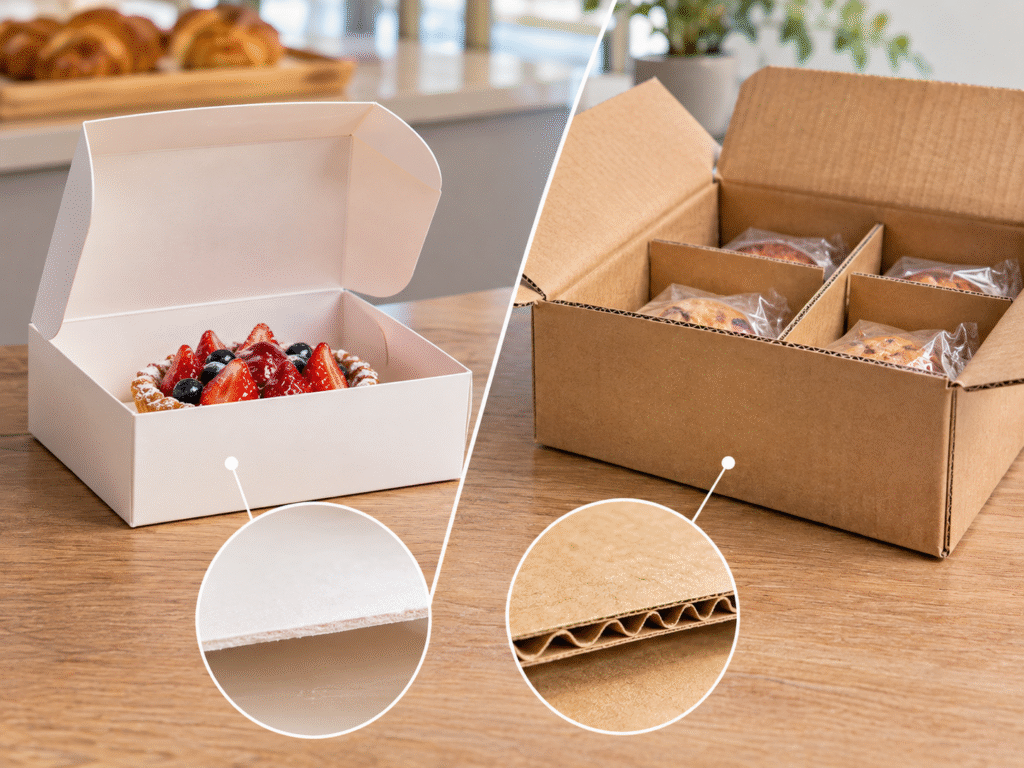
Many pie and bakery cartons use folding paperboard. Corrugated structures may also be appropriate where the package needs additional support or forms part of a delivery system.
These are different material constructions. A paperboard caliper in points should not be presented as though it describes the same structure as a fluted corrugated board.
Folding Paperboard
Paperboard can provide a printable surface and a convenient folding format for retail and local pickup.
Choose the grade, thickness, base design, and closure for the packed weight and conditions. A wide pie places a different demand on a base from a small, compact pastry.
Brown and white appearance alone do not establish strength, grease resistance, or food-contact suitability.
Corrugated Structures
Corrugated board can provide useful stiffness and structural options. Flute profile, liner grades, wall count, box dimensions, and conversion all influence the result.
There is no single flute or ECT rating that guarantees successful pie delivery. A stronger outer box does not prevent a loose pan from sliding or a soft topping from touching the lid.
Packboxprint’s packaging material options provide a starting point for discussing the required structure and surface. Confirm the proposed construction against the actual packed product.
Grease Resistance and Food Contact
A pie may sit in a pan, but grease or filling can still reach a board, liner, or carton during handling.
Define which components contact food and under what conditions. The pan, support, window adhesive, coatings, and printed surfaces can have different roles.
Request suitability information for the finished components and intended use. A generic material description is not enough to establish direct-contact performance.
Grease resistance and moisture resistance are also different properties. A treatment that limits visible oil staining does not automatically manage condensation.
Use a representative storage trial to check staining, odor, transfer, and appearance. Do not assume every crust leaks grease within a fixed period or that every box requires the same coating.
Designing a Pie Box Window
A window helps customers see the product, but its dimensions should follow the lid structure and presentation brief.
A universal window diameter or edge inset cannot account for every box size, board grade, and shape.
Retain sufficient material around folds, corners, and locking features. Assess lid stiffness after the opening is cut and the film is attached.
Window Position and Height Clearance
Moving a window within a flat lid does not create additional vertical headroom. The pan, topping, lid geometry, and film deflection still determine clearance.
Keep film and adhesive from contacting the product unless that contact is specifically intended and suitable.
Film and Attachment
Film thickness, clarity, adhesive, and attachment method should suit production and handling requirements.
A thicker film does not automatically prevent fogging. Condensation depends on temperature, moisture, and the packaging environment; film properties can influence its visible appearance.
Review a filled sample under the intended conditions. A clear empty display sample does not establish how the window will look after refrigeration or transport.
Packboxprint’s custom packaging design services can help coordinate artwork, window position, and the box structure before production files are approved.
Cooling, Condensation, and Refrigerated Products
Enclosing a warm pie can introduce moisture into the package. Condensation can affect window appearance, crust quality, and board performance.
The packaging workflow must also preserve food safety. Do not leave a perishable pie unrefrigerated simply to achieve a clearer window or drier carton.
Custard, cream, and egg-rich pies can require refrigeration. Use the bakery’s validated cooling and storage procedures for the actual recipe and production conditions.
There is no universal internal temperature at which every pie becomes ready for every box. A packaging suggestion such as “below 100°F” does not replace a suitable food-safety process.
For chilled products, evaluate the carton after realistic storage and temperature changes. Observe base stiffness, closure behavior, visible moisture, and label adhesion.
The carton provides containment and presentation. It is not automatically an insulated or temperature-controlled package.
Stacking Pie Boxes Safely
A board test value does not directly establish how many filled pie boxes can be stacked.
ECT measures an aspect of corrugated board performance. The finished carton also depends on geometry, windows, joints, moisture, load duration, and how the boxes align.
A lid can deflect into the pie before obvious wall collapse occurs. Define topping clearance as an acceptance criterion, not just whether the box remains upright.
Validate the proposed stack using filled representative boxes under relevant conditions. Include the heaviest product and expected holding time.
Avoid concentrating weight on an unsupported window. For collection and delivery, staff instructions should state the approved arrangement and handling method.
A larger shipping carton does not automatically solve stacking problems unless its internal layout and load paths are designed appropriately.
Planning a Four-Pie Master Carton
Use the external dimensions of the closed individual boxes when planning an outer carton.
For illustration, assume each filled pie box measures 10.25 × 10.25 × 3.25 inches outside.
Four boxes in a two-by-two single-layer layout need at least:
2 × 10.25 = 20.5 inches along each horizontal axis
Suppose the trial design then adds a 0.25-inch central separation and 0.25 inch at each opposing outside edge:
Required trial interior span = 20.5 + 0.25 + 0.25 + 0.25 = 21.25 inches
With 0.25 inch of support above and below:
Trial interior height = 3.25 + 0.25 + 0.25 = 3.75 inches
The resulting 21.25 × 21.25 × 3.75-inch usable interior is an illustrative layout calculation, not a validated transport specification.
The actual supports, tolerances, hand access, and protective requirements may change it. The master carton’s outside dimensions will be larger again.
An outer footprint smaller than the combined individual-box footprint cannot accommodate that layout simply because the pies themselves are smaller.
Local Pickup and Parcel Shipping Need Different Systems
A bakery carton used for a careful handover may not be suitable for unattended parcel distribution.
Local delivery still requires restraint, level handling, and suitable temperature management where applicable. A shallow box does not prevent filling from shifting during braking or cornering.
Parcel shipping adds further handling demands. Evaluate the complete product, primary container, supports, outer package, and any required thermal system.
Measure the finished shipping package and calculate costs under the applicable service rules. Do not use the retail carton’s nominal internal size as the parcel size.
A fixed dimensional-weight divisor or rounded weight should not be treated as a universal postage rule.
Keep a Manageable Size Range
A bakery does not necessarily need a separate carton for every recipe, but one tall box for every pie can also create unnecessary material use and movement.
Group products by measured footprint, maximum height, packed weight, and storage needs.
Trial whether several products can share a footprint while using different heights or supports. Check that the packing team can identify the correct version quickly.
During peak ordering periods, a simple packing guide can associate each menu item with its approved box and insert. Include exceptions for seasonal decorations or changed pans.
Review the specification when a pan supplier or recipe changes. The same menu diameter can conceal a different packed envelope.
Make Removal Part of the Customer Experience
A pie that loads neatly can still be awkward to remove. Check whether the customer can lift the pan without touching the crust or squeezing the side walls against it.
An opening front panel, suitable handling tabs, or a removable support may improve access, depending on the structure. These features also need evaluation for base stability and accidental opening.
Test removal from the closed, filled package rather than an empty demonstration box. If staff need to explain a particular opening sequence, make that sequence clear without relying on the customer to pull against a fragile window or decorated edge.
What to Approve Before Bulk Production
A useful brief includes:
- Nominal pie size and measured packed footprint
- Maximum height, packed weight, and product variation
- Pan, board, and insert details
- Required usable internal dimensions
- Window and closure requirements
- Storage, carrying, and distribution conditions
- Printing, labeling, and intended contact conditions
When evaluating a custom packaging manufacturer, discuss how samples, material suitability, and structural changes will be handled.
For a Packboxprint packaging inquiry, provide the actual pan or an accurate drawing alongside product measurements.
Approve a filled sample for loading, removal, closed-lid clearance, support, and handling. A neatly folded empty carton cannot reveal all the problems that matter to a bakery.
Frequently Asked Questions
1. What size box do I need for a nine-inch pie?
Measure the finished pan, crust, and support first. A nine-inch box may work for some products, while another nominal nine-inch pie may require a larger usable footprint.
2. Should the box be exactly the same size as the pie?
Not automatically. Nominal pie diameter may exclude the pan flange or crust overhang. Allow validated room for loading and removal without excessive movement.
3. What box size works for an eight-inch pie?
Use the actual packed envelope. In the illustrative chart, an 8.5-inch footprint is trialed in a nine-inch usable square cavity. Your product may require a different size.
4. Do ten- and twelve-inch pies need deeper boxes?
Diameter alone does not determine height. Measure the pan, support, filling, and highest decoration, then evaluate the required headroom separately.
5. Can one box hold standard and deep-dish pies?
Possibly, if both fit and remain stable. A common footprint with suitable height or support can simplify stock, but it should be tested with each product.
6. Are pie box dimensions internal or external?
Suppliers use different conventions. Confirm the measurement basis, usable assembled cavity, and any closure intrusion before ordering.
7. Does a window weaken the lid?
Removing board changes the structure. The effect depends on opening size, position, material, film, and load. Check lid stiffness and topping clearance on a sample.
8. How many pie boxes can be stacked?
There is no universal number. Establish an approved stack using representative filled boxes, actual conditions, and acceptance criteria that include lid deflection.
9. Can I ship pies in ordinary bakery boxes?
Do not assume suitability. Parcel shipment requires a validated complete system, including product restraint and temperature management where needed.
10. What information should I send for custom pie boxes?
Provide pan dimensions, maximum packed footprint and height, weight, quantity, window preference, artwork, and storage and delivery requirements. Include a product or pan sample where possible.