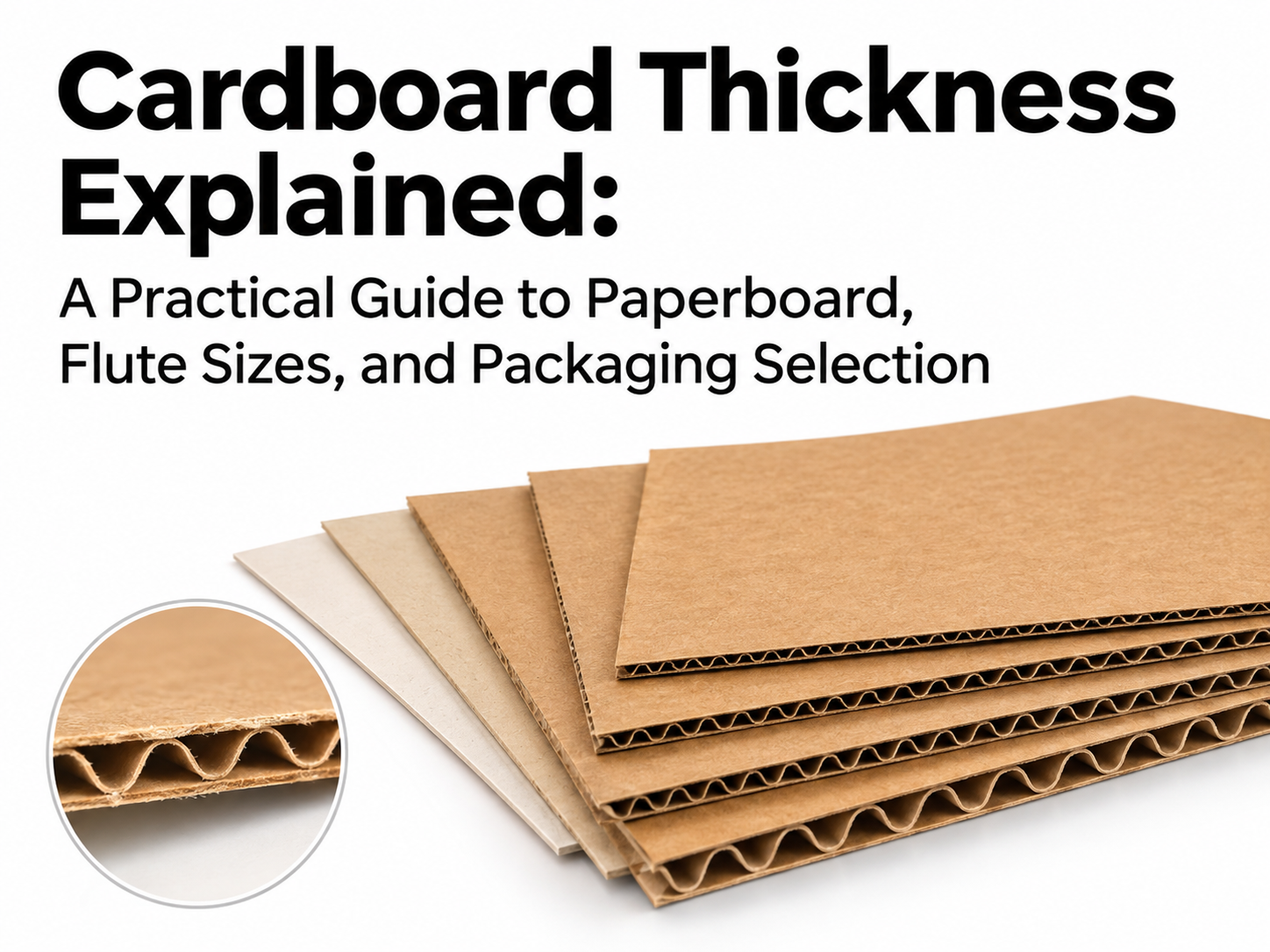
A carton can feel substantial and still crease poorly. A corrugated box can look thinner than another yet perform adequately because its papers, dimensions, and structure suit the load. Thickness matters, but it does not explain packaging performance on its own.
The difficulty often starts with terminology. A quotation may use GSM, points, millimeters, or a flute designation as though they describe the same property. They do not.
A useful specification separates material construction, thickness, mass per area, and performance. That makes samples easier to compare and helps prevent a seemingly small material change from creating a fit or production problem.
This guide explains the measurements, provides reference tables, and shows how to select cardboard thickness around the product and its intended use.
How Thick Is Cardboard?
There is no single cardboard thickness because “cardboard” is a broad commercial term.
It can refer to folding paperboard, dense supporting board used in presentation boxes, or corrugated board with a fluted middle structure. These materials serve different functions.
A folding-carton specification might identify a nominal caliper such as 0.4 mm. A rigid-box construction might use a supporting board specified at 2 mm. A corrugated specification needs the finished combined-board caliper as well as its construction.
Those are examples of how materials are described, not recommendations for every carton, rigid box, or shipment.
Start by identifying which material family is being discussed.
Three Material Families to Keep Separate
| Material family | Basic construction | Common role |
|---|---|---|
| Folding paperboard | Fiber-based board, often built in plies | Retail cartons, sleeves, and light inserts |
| Rigid supporting board | Thick structural board, often covered with a wrap | Presentation and gift-box construction |
| Corrugated board | Fluted medium bonded to flat liners | Mailers, shipping cases, and protective structures |
“Chipboard” can mean different products in different markets. Define the grade and intended application rather than relying on the word alone.
Also distinguish the structural board from a decorative wrap. A thin printed paper can cover a much thicker base, so the visible surface does not reveal the complete construction.
Packboxprint’s packaging material options provide a useful starting point for discussing those layers and their intended functions.
Thickness Units: Millimeters, Microns, Points, and Mils
Thickness is also called caliper.
Millimeters and microns are common metric units. One millimeter equals 1,000 microns.
In common paperboard thickness notation, one point equals 0.001 inch. A mil also equals 0.001 inch. This use of “point” differs from the point used for type size.
| Nominal thickness | Inches | Millimeters | Microns |
|---|---|---|---|
| 10 pt | 0.010 | 0.2540 | 254.0 |
| 12 pt | 0.012 | 0.3048 | 304.8 |
| 16 pt | 0.016 | 0.4064 | 406.4 |
| 18 pt | 0.018 | 0.4572 | 457.2 |
| 24 pt | 0.024 | 0.6096 | 609.6 |
| 32 pt | 0.032 | 0.8128 | 812.8 |
These are exact unit conversions for the stated nominal values. Actual supplied material has a specification and manufacturing variation.
Points are not limited to a narrow range such as 8–16 pt, and that range should not be presented as the full thickness range of corrugated board.
For thick supporting boards, millimeters can be clearer: 2 mm equals 0.07874 inch, or approximately 78.74 points.
GSM Measures Mass, Not Thickness
GSM means grams per square meter.
A material specified at 350 GSM has a nominal mass of 350 grams per square meter. That statement does not establish its caliper.
Fiber composition, density, ply construction, coating, and manufacturing treatment affect the relationship between grammage and thickness.
Two boards with equal GSM can have different calipers. Two boards with equal caliper can also have different GSM.
A Simple Mass Example
A rectangular piece measuring 0.40 × 0.50 m has an area of 0.20 m².
At 350 GSM:
Nominal material mass = 0.20 × 350 = 70 g
This calculation says nothing about how thick the piece is. It also excludes any additional layers not included in the quoted grammage.
For an equal area, higher GSM means greater nominal material mass. For complete boxes, however, the amount of material used can change with the design.
Do not estimate finished box weight from thickness alone.
Paperboard Caliper and Packaging Use
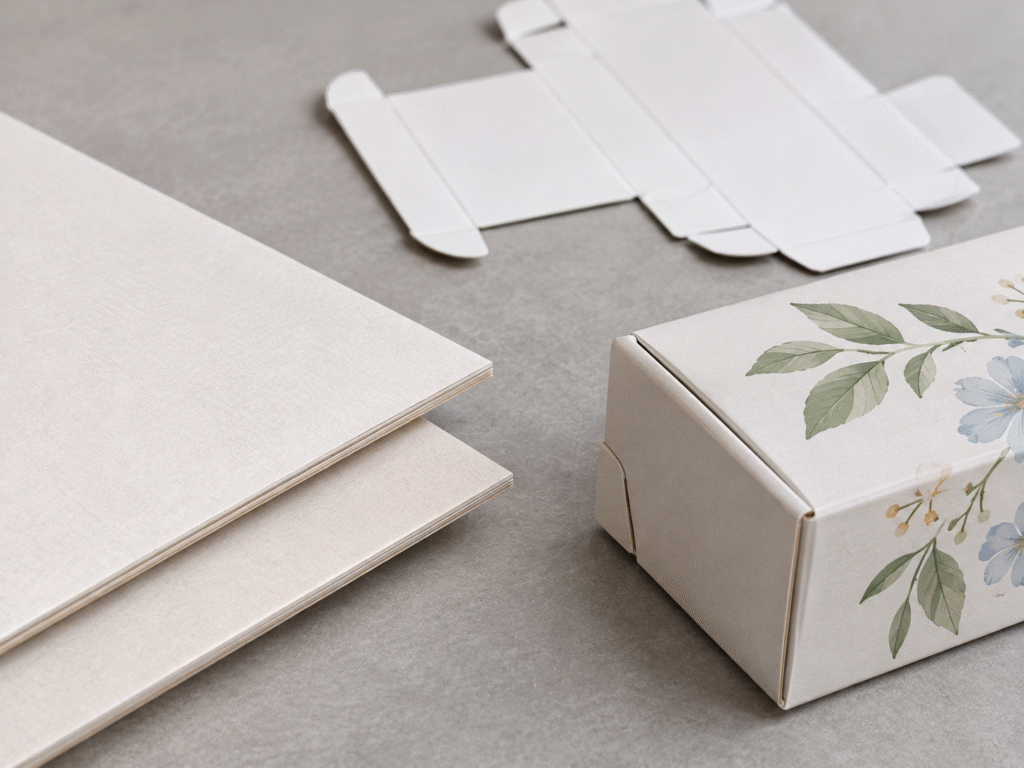
Folding paperboard is selected for a combination of stiffness, surface quality, crease behavior, and other relevant properties.
A nominal 0.4 mm board and a nominal 0.6 mm board differ by 0.2 mm in thickness. That difference can affect closure clearances and tool settings even if the change appears small by eye.
It does not prove that the second board will provide a particular percentage increase in package strength.
For custom folding paper boxes, specify the actual grade and caliper with the approved dieline. Review any replacement material before repeat production.
A smooth surface can support detailed graphics without requiring a large thickness. Conversely, a thick rough sheet does not automatically print fine text well.
Corrugated Flute Height Is Not Finished Board Thickness
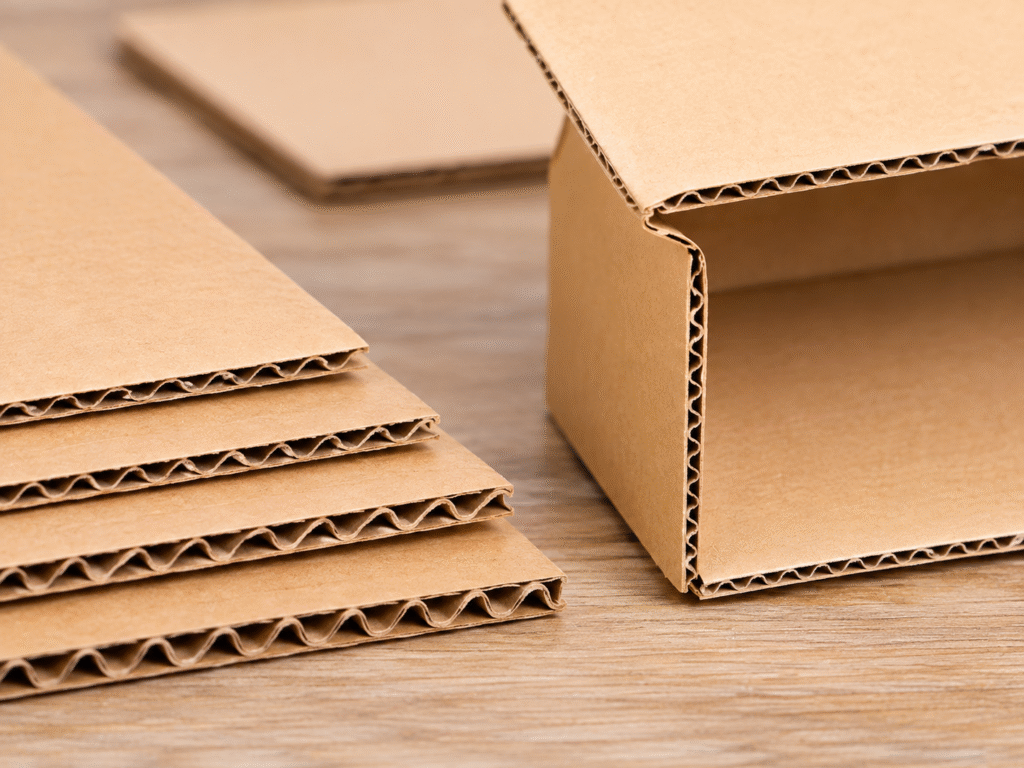
Corrugated board contains flat liners and a wave-shaped medium.
The flute height describes the geometry of the corrugated member. The finished board caliper also includes the liners and reflects the combined structure and processing.
Some published charts list flute height excluding facings. Others list approximate finished board thickness. Comparing them without identifying the basis creates unnecessary disagreement.
The following values are indicative flute-height references excluding facings, not finished-board calipers:
| Flute designation | Indicative flute height, excluding facings |
|---|---|
| A | About 4.8 mm |
| B | About 2.4 mm |
| C | About 3.6 mm |
| E | About 1.2 mm |
| Fine-flute group: F, G, and N | About 0.5–0.8 mm across the grouped examples |
These are reference examples rather than universal dimensions for every supplier. The grouped fine-flute value should not be interpreted as one identical profile shared by all three designations.
Ask the converter for the finished board’s nominal caliper, tolerance, and measurement basis.
Single Face, Single Wall, Double Wall, and Triple Wall
Layer count and thickness are related, but they are not interchangeable.
| Construction | Conventional layer arrangement |
|---|---|
| Single face | One liner and one fluted medium |
| Single wall | Two liners and one fluted medium |
| Double wall | Three liners and two fluted media |
| Triple wall | Four liners and three fluted media |
Single-face material can be used in protective components or wrapping arrangements. It is different from the enclosed single-wall structure familiar in shipping cases.
Double-wall combinations such as BC and EB use different flute profiles in one board. Their finished thickness depends on the actual profiles, papers, and conversion.
Do not add two single-wall finished calipers and assume the total is the double-wall thickness. The constructions do not contain the same duplicated liner arrangement.
Similarly, there is no universal multiplier that converts single-wall thickness into double- or triple-wall thickness.
Wall count helps describe the structure. It does not independently establish a safe payload or stacking height.
Why Thicker Does Not Automatically Mean Stronger
Thickness can influence stiffness and structural behavior, but packaging strength depends on the complete system.
Paper properties, board construction, panel dimensions, flute orientation, joints, cutouts, and loading conditions all matter. Humidity and load duration can also change performance.
A small carton with well-supported contents is not comparable to a large unsupported box made from the same board.
For corrugated materials, edge-crush testing measures one performance characteristic. Bursting and other tests assess different properties. None should be confused with caliper.
A test value is not a universal conversion into the maximum product weight or number of boxes that can be stacked.
For fragile products, the insert and cushioning can be as important as the outer board. Adding thickness without controlling movement may leave the actual damage mechanism unresolved.
How to Measure Cardboard Thickness Correctly
Use a suitable thickness-measuring instrument and an agreed procedure.
For paperboard, a micrometer or thickness gauge with controlled contact conditions is preferable to estimating thickness with a ruler.
For corrugated board, pressure matters because the structure can be compressed. A tightly closed general-purpose caliper can produce a reading that reflects crushing rather than the intended measurement.
Neither “manual” nor “automatic” alone establishes accuracy. Instrument condition, contact geometry, pressure, calibration, and sample handling matter.
A Practical Measurement Sequence
- Identify the board and whether it has already been printed, coated, laminated, or converted.
- Select representative areas appropriate to the measurement purpose.
- Avoid folds, damaged edges, or crushed regions when assessing nominal board caliper.
- Use the agreed instrument and contact conditions.
- Take several readings and record the locations, range, and average.
- Note the sample condition and any visible damage.
Where acceptance depends on the result, use the specified test method or a suitable laboratory procedure.
Measuring a stack and dividing by the number of sheets can provide a rough estimate for some flat materials. Trapped air, compression, coatings, and surface structure can distort the result, particularly for corrugated board.
Measure the Right Stage of Production
A base-board specification and a finished-package measurement may describe different constructions.
Printing, lamination, wraps, and bonded layers can add material. Corrugated conversion can also reduce local thickness through pressure.
A creased section is intentionally deformed. It should not be used as the sole measure of uncreased board thickness.
Where thickness is critical to fit, distinguish incoming material control from the completed assembly. A rigid box may meet the base-board specification yet have additional wrap and adhesive at the corners.
Record the relevant measurement stage so the buyer and supplier are comparing the same object.
Thickness Affects Dielines and Product Fit
A material change can affect a box before it creates any obvious strength difference.
Thicker panels occupy more space. Folded layers, tabs, and overlapping sections can change closure engagement and usable cavity dimensions.
An insert slot developed for one caliper may be too tight for another. A drawer or sleeve can become difficult to move after an unreviewed change.
For a simplified illustration, increasing each opposing single-layer wall from 1.5 to 2.0 mm adds 1 mm across that two-wall arrangement. Real boxes often contain multiple folds, so their geometry needs a structural review rather than a simple subtraction.
Packboxprint’s custom packaging design services can support coordination between the chosen material and the production dieline.
Do not preserve the artwork template unchanged simply because the supplier describes a new material as an upgrade.
Creasing and Folding Need Material-Specific Settings
A clean fold depends on the board and tool setup.
Caliper, grade, grain direction, and surface treatment influence how the material behaves during conversion. The crease must create a controlled hinge while limiting unwanted cracking and distortion.
An increase in thickness can require a different tool arrangement. Changing only pressure may not solve the problem.
Inspect the assembled carton for fold alignment, surface cracking, springing panels, and closure interference. Dark printed areas can make some defects more visible.
A successful flat print sample does not establish that the material will fold correctly.
Printing Quality Is Not a Thickness Ranking
Detailed graphics depend on the print surface, ink system, process, and production control.
A smooth coated paperboard can support fine work at a caliper selected for the structure. A thicker sheet with an unsuitable surface may not.
For corrugated packaging, flute geometry and the liner surface can influence the appearance. Print method and any applied printed facing also matter.
For custom mailer boxes, assess artwork and structure together. A finer flute may suit a compact presentation, but it is not automatically the correct option for every load.
For rigid presentation boxes, the printed wrap and supporting board perform different jobs. The wrap can carry the visual detail while the base board supplies structure.
Thickness Does Not Establish Moisture or Thermal Protection
Adding board thickness does not automatically make a package waterproof, vapor-tight, or suitable for a temperature-controlled application.
Water can reach fibers through exposed surfaces, edges, folds, and joints. Specific coatings, liners, or enclosures may be needed for defined exposure.
Similarly, air within a corrugated structure does not establish validated thermal performance for a sensitive product.
Describe the actual environment and required outcome. A chilled food, a humid warehouse, and a brief rain exposure need different evaluations.
Check the complete package after the relevant conditions, including whether it can still support its load.
Choose the Material Around the Application
| Application | Useful starting point | What must be verified |
|---|---|---|
| Compact retail product | Suitable folding paperboard | Fit, closure, surface, and shelf handling |
| Branded parcel shipment | Appropriately specified corrugated format | Product restraint and distribution performance |
| Gift or presentation set | Supporting board with suitable wrap and insert | Opening, fit, edge wear, and transit layer |
| Heavy or concentrated load | Engineered transport structure | Load distribution, joints, and handling |
| Humid or chilled environment | Material and barrier system suited to exposure | Performance after environmental conditioning |
The table identifies a development route, not a required thickness.
Begin with the product dimensions, weight, fragility, and vulnerable surfaces. Then describe loading, stacking, storage, and transport.
Select candidate materials and build filled prototypes. Compare the complete systems rather than choosing the thickest sample on the table.
Manage Cost and Material Use Together

A thickness increase may change material cost, sheet yield, tooling, assembly, storage, and packed exterior dimensions.
It does not always increase mass in direct proportion. Different board densities and constructions can break that assumption.
For weight estimation, use net material area and the specified grammage. For shipping, measure the final packed mass and external dimensions and apply the relevant service rules.
Right-sizing and improved support can sometimes reduce the required outer material. Removing necessary protection merely to reduce thickness can increase damage and rework.
Compare total cost per acceptable packed unit, including rejects and packing labor, rather than treating caliper as a simple price scale.
Specify Tolerances and Control Material Changes
A nominal value without an agreed tolerance is incomplete where fit or conversion is sensitive.
For illustration, a specification of 0.50 ± 0.03 mm defines a range from 0.47 to 0.53 mm. It does not mean every supplier can or should offer that tolerance.
Agree the appropriate range, measurement method, sample condition, and inspection approach for the actual material.
If the grade, caliper, flute profile, liner, or surface construction changes, review its effect on the approved package.
A material that meets one headline value may still differ in folding, stiffness, print appearance, or protective behavior. Repeat orders need a controlled specification, not just the phrase “same thickness.”
Sustainability Depends on More Than Caliper
Thin packaging is not automatically the most suitable environmental choice, and thick packaging is not automatically unrecyclable.
The full construction, coatings, films, windows, adhesives, contamination, and local recovery system influence disposal options.
Recycled content and certified sourcing are separate characteristics from thickness. Verify any claims for the specified material and finished package.
Reducing unnecessary material is useful when protection and usability remain adequate. Assess the complete design rather than using caliper as a stand-alone sustainability score.
What to Send Your Packaging Manufacturer
Provide the product dimensions, packed weight, box style, loading method, sales channel, and expected distribution conditions.
Add artwork, finishes, inserts, dimensional constraints, and any material or performance requirements already established.
When evaluating a custom packaging manufacturer, ask how caliper, material identity, conversion, and filled performance will be checked.
For a Packboxprint packaging inquiry, representative products and existing samples help explain the brief.
Approve the material and complete package together. Thickness becomes a useful decision tool when it is connected to a defined construction and tested purpose.
Frequently Asked Questions
1. What is the average thickness of cardboard?
There is no single average useful for every project. Folding paperboard, rigid supporting board, and corrugated board are different constructions with different specifications.
2. Is GSM the same as thickness?
No. GSM measures mass per unit area. Thickness measures caliper. Their relationship changes with the material’s density and construction.
3. How thick is 16 pt paperboard?
In common paperboard caliper notation, 16 pt equals 0.016 inch, or 0.4064 mm. The supplied grade still has its own nominal value and tolerance.
4. Is flute height the finished board thickness?
No. Flute height describes the corrugated member. Finished board caliper also includes the liners and reflects the combined construction and processing.
5. Is double-wall twice as thick as single-wall?
Not necessarily. Flute combinations, liners, and processing differ. Obtain the finished caliper for the actual proposed grade.
6. Can a thicker box carry more weight?
Thickness can contribute to performance, but it does not establish a universal capacity. The box design, papers, joints, environment, and load all matter.
7. How should I measure corrugated board?
Use a suitable gauge and controlled measurement conditions that do not unintentionally crush the structure. Record representative readings and the method.
8. Does thicker board print better?
Not automatically. Surface quality, substrate treatment, print process, inks, and production control influence print results.
9. Does a board change require a new dieline?
It requires a review. Caliper and grade changes can affect folds, clearances, insert slots, and closures. Some changes need revised tooling or dimensions.
10. Which thickness should I request for custom packaging?
Provide the product and handling requirements first. Select and validate a material and structure together instead of choosing caliper in isolation.