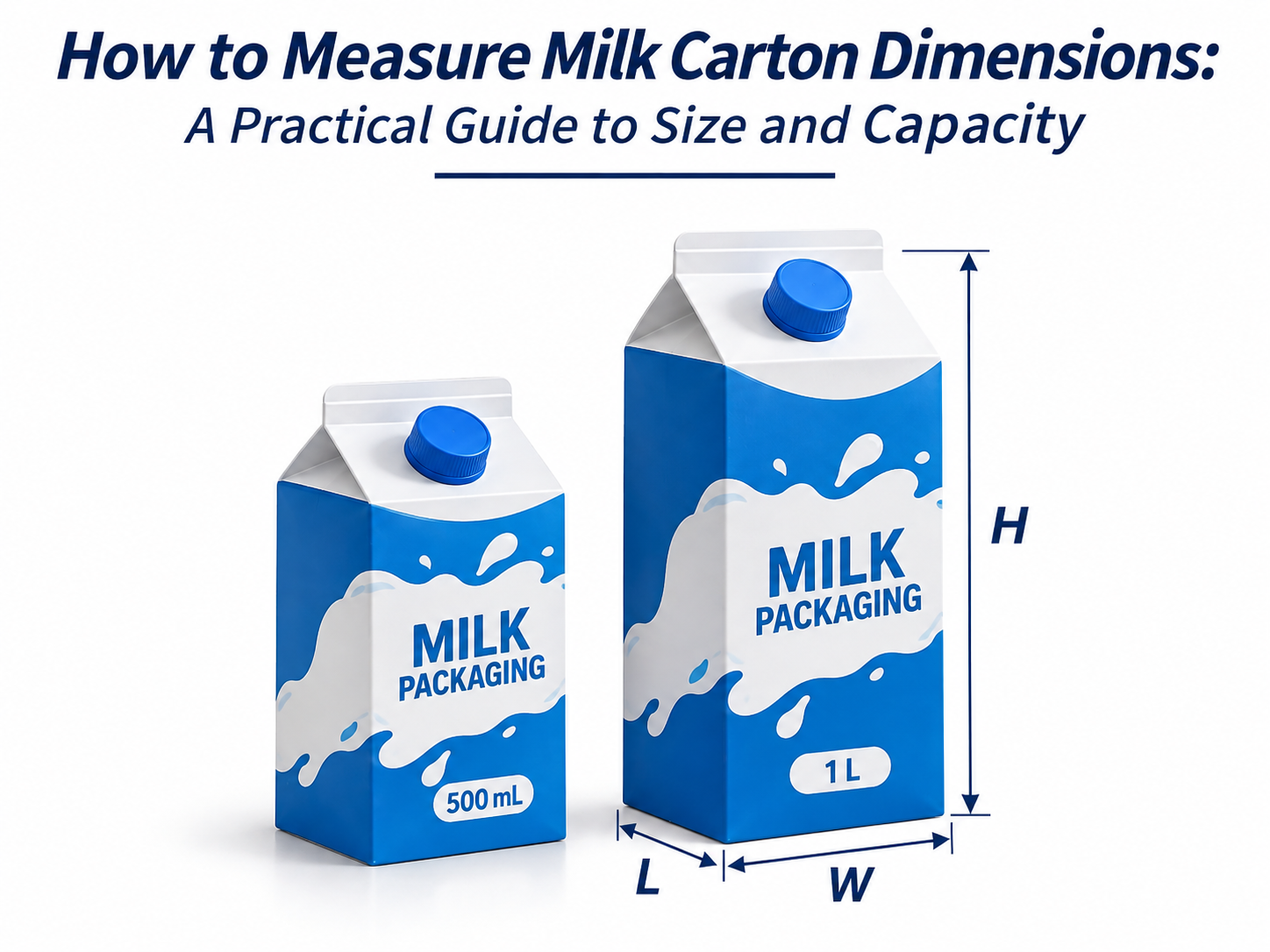
A carton labeled one quart tells you how much milk it contains. It does not tell you whether it will fit a refrigerator door, pass through a vending mechanism, or sit correctly inside a shipping case.
Those questions require the finished package dimensions, including the closure and any projecting features. They also require a clear distinction between the carton body, its usable internal space, and its nominal liquid fill.
For dairy brands, packaging buyers, and designers, that distinction prevents expensive errors. A drawing can look plausible while describing a package too small for the stated volume or incompatible with the filling equipment.
This guide explains how to measure milk cartons, interpret common capacities, calculate basic geometry, and prepare dimensions for packaging and distribution.
What Are Milk Carton Dimensions?
Milk carton dimensions describe the physical size of a defined carton.
They are commonly recorded as length, width, and height, although suppliers may use front width, side depth, and overall height instead. The labels must be confirmed on the drawing.
For a gable-top carton, several vertical measurements can matter:
- Body height up to the start of the roof
- Height to the sealed top ridge
- Maximum overall height, including any higher closure feature
- Clearance needed to open and use the package
These values are not interchangeable.
For fitting a shelf or secondary package, the maximum finished exterior usually matters. For manufacturing, the approved drawing must identify the exact reference points.
Common Milk Carton Capacities
The following table uses US customary liquid units, not Imperial measures.
| Capacity description | US fluid ounces | Approximate metric equivalent |
|---|---|---|
| Half-pint | 8 fl oz | 236.6 mL |
| Pint | 16 fl oz | 473.2 mL |
| Quart | 32 fl oz | 946.4 mL |
| Half-gallon | 64 fl oz | 1,892.7 mL |
| Gallon | 128 fl oz | 3,785.4 mL |
A US half-pint is eight fluid ounces. A twelve-fluid-ounce package is a different capacity.
A US quart is also not identical to one liter. The difference matters when comparing international product specifications.
Metric packages may use nominal quantities such as 250 mL, 500 mL, or 1 L. Do not treat them as exact substitutes for similarly described US sizes.
The capacities in the table do not prescribe an outer shape. Not every capacity is offered in every carton system, and milk can also be sold in bottles, jugs, or other containers.
Why There Is No Universal Dimension for Each Capacity
A fixed liquid quantity can be packaged in different proportions.
A taller, narrower format may have a different footprint from a shorter, broader one. Gable geometry, closure position, material construction, and filling-system requirements also affect the result.
Consequently, a list claiming that every half-pint or half-gallon carton has one exact length, width, and height is not a reliable purchasing specification.
Use a format-specific drawing from the supplier of the primary liquid package.
| Product format | Information to obtain |
|---|---|
| Half-pint carton | Finished footprint, total height, and opening details |
| Quart carton | Confirmed US capacity or metric quantity, plus format drawing |
| Half-gallon carton | Approved body, roof, closure, and filled dimensions |
| Gallon package | Actual container type, grip or closure envelope, and handling requirements |
If developing an outer sleeve or carton, measure the filled primary pack rather than selecting dimensions from its capacity name.
Primary Milk Cartons and Secondary Boxes Are Different
A liquid-food carton directly contains the milk. Its material, barrier layers, seals, opening, filling process, and hygienic requirements form an integrated system.
A secondary paper box may group or present those sealed containers. It is not automatically suitable for direct contact with liquid.
Likewise, a decorative carton with a roof-shaped top is not necessarily a functional milk container.
Packboxprint’s custom folding paper boxes are relevant to discussing paper-based outer packaging and presentation. Direct-fill dairy-carton requirements need separate confirmation with the supplier responsible for the liquid-packaging system.
Clarify the project scope before discussing material thickness or artwork. A visual similarity does not establish equivalent capability.
Tools for Measuring a Milk Carton
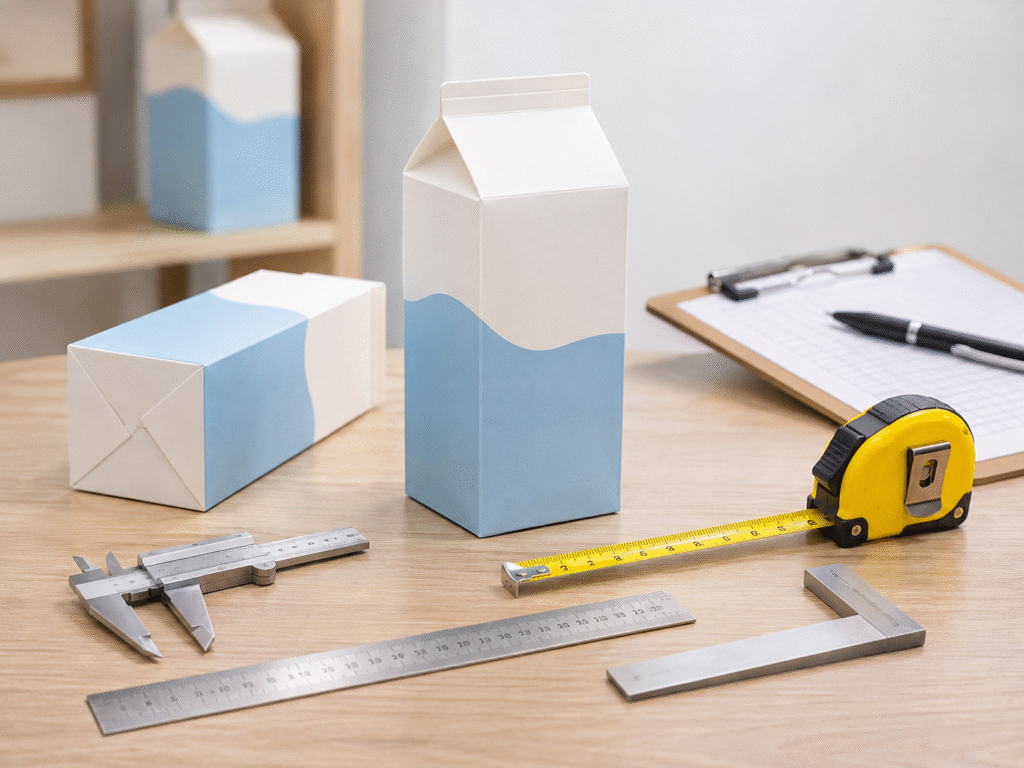
A rigid ruler, tape measure, flat surface, and straightedge are sufficient for many preliminary checks.
Calipers can help measure accessible features, but avoid squeezing flexible panels. A reading obtained by compressing the carton may understate its normal envelope.
For a filled package, inspect it in the condition relevant to the application. Side panels can behave differently when empty, filled, chilled, or handled.
Use a sound representative sample with its closure fitted correctly. Record the product, format, condition, date, and measurement basis.
For critical production approval, agree the method and tolerances with the carton-system supplier.
Step-by-Step: Measure the Finished Exterior
1. Establish the Orientation
Stand the carton in its intended upright position.
Identify the front face and label width, depth, and height on a sketch. A square base does not eliminate the need to identify closure direction and artwork orientation.
Use one unit throughout the measurement record.
2. Measure the Base Footprint
Measure the external width and depth across the formed base.
Do not include unused flat material or measure an unfolded blank as though it were the finished package.
Check whether the base sits evenly. Distortion can affect stability as well as the measured envelope.
3. Check the Maximum Body Width and Depth
Measure the body at relevant positions without forcing the walls inward.
A filled carton may have its widest point above the base. For a shelf guide, vending lane, or fitted outer box, that maximum may control clearance.
Record base dimensions and maximum body dimensions separately if they differ.
4. Measure Overall Height
Use the base support surface as the starting plane.
Measure to the highest point of the finished package, which may be the sealed ridge, cap, or another feature depending on the design.
A straightedge placed gently across the uppermost feature can help establish the reference plane.
Do not omit the roof simply because it contains less liquid than the body.
5. Record Projections and Opening Clearance
Check cap width, protruding features, and the space needed for opening.
A carton that fits beneath a refrigerator shelf may still need to be removed before the closure can be opened. Decide whether that is acceptable.
For vending or automated handling, include orientation, gripping areas, and the permitted range of package variation.
Convert Inches, Centimeters, and Millimeters Correctly
One inch equals 2.54 cm or 25.4 mm.
Convert each axis independently and keep the same labels.
For example, a hypothetical external envelope measuring 3 × 3 × 8 inches converts to:
7.62 × 7.62 × 20.32 cm
or:
76.2 × 76.2 × 203.2 mm
This is a unit-conversion example, not a specified milk-carton format or a capacity claim.
Keep appropriate precision in technical records. Rounding too early can hide a small clearance that matters in a fitted sleeve or machine guide.
A dimension conversion does not convert the package into a different capacity. Length units and liquid-volume units answer different questions.
Can You Calculate Milk Capacity from Outside Dimensions?
Not accurately enough to specify the liquid fill.
Multiplying external length, width, and overall height gives the volume of an enclosing rectangular envelope. It includes material, folds, seals, headspace, and, for a gable top, space outside the sloping roof.
That envelope is useful for space planning. It is not the liquid capacity.
A simple plausibility check can still reveal a problem. An enclosing rectangle measuring 7 × 7 × 19 cm has a volume of:
7 × 7 × 19 = 931 cm³
Because 1 cm³ equals 1 mL, that entire external envelope is only 931 mL. A package completely contained within it cannot provide a one-liter liquid cavity.
Passing this check does not establish a valid design. Failing it shows that the dimensions or claimed capacity need correction.
The Correct Geometry for a Gable-Top Shape
A square base does not make the carton a cube.
The formula side³ applies only when all three dimensions are equal and the object is a cube.
A rectangular body instead uses:
Body volume = length × width × body height
For an idealized roof shaped as a triangular prism:
Roof volume = ½ × roof span × roof rise × ridge length
If the roof span equals the body width and the ridge length equals the body length:
Idealized total volume = L × W × body height + ½ × W × roof rise × L
Worked Geometry Example
Consider a simplified shape with:
- Length: 7 cm
- Width: 7 cm
- Body height: 18 cm
- Roof rise: 3 cm
The body volume is:
7 × 7 × 18 = 882 cm³
The idealized roof volume is:
½ × 7 × 3 × 7 = 73.5 cm³
Total geometric volume is:
882 + 73.5 = 955.5 cm³
If those were outside dimensions, the usable interior would not simply equal that result. Real folds, seals, materials, and geometry differ from the model.
Even an idealized internal geometric volume is not the target fill. Headspace and the filling and sealing process must be considered.
Use this calculation to understand shape, not to approve a commercial dairy package.
Net Fill, Internal Capacity, and Headspace
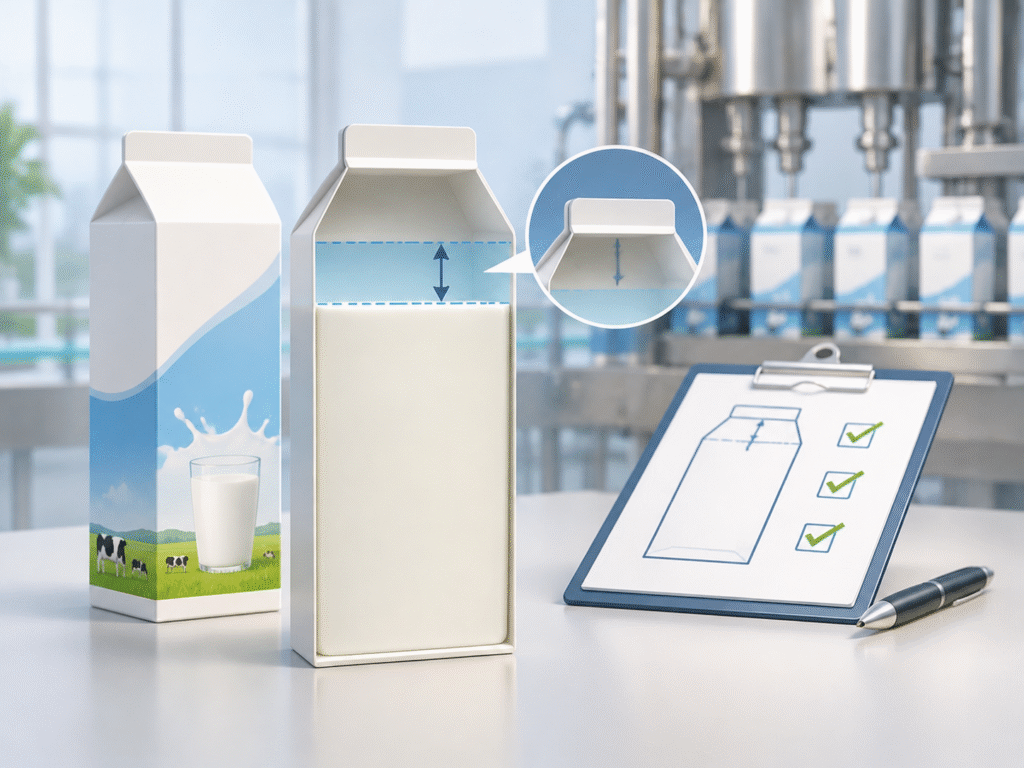
The declared net quantity describes the product supplied. The internal package has to accommodate that quantity within the validated filling arrangement.
Required headspace is not a universal percentage that can be added to every milk carton.
Product behavior, filling conditions, equipment, closure, and package construction influence the design. The responsible liquid-packaging supplier and dairy process team should establish the appropriate specification.
Do not increase the filled quantity beyond the approved operating range merely because an empty carton can physically hold more liquid.
Likewise, a consumer capacity label should not be treated as a drawing dimension. It is one requirement within the full packaging system.
Material Layers: What They Do
Liquid cartons combine structural and barrier functions.
Paperboard contributes structure and a printable surface. Polymer layers can contribute liquid resistance, sealing, and other functions according to the construction.
Some systems include an aluminum barrier; others use different barrier arrangements. Not every milk carton contains a metallic interior.
Aluminum and polyethylene are not simply interchangeable choices for preventing leakage. They perform different roles within a specified multilayer system.
Sealing quality, layer integrity, opening design, and manufacturing controls all matter. A metallic appearance alone does not establish leak resistance or shelf-life performance.
Packboxprint’s packaging material options can support discussions about paper-based outer packaging. The exact direct-fill laminate must be confirmed with the qualified supplier for that application.
Chilled and Ambient Products Need Different Evaluation
Carton shape does not determine whether milk can be stored without refrigeration.
Product processing, hygienic filling, package integrity, barrier design, and intended storage conditions work together.
An aseptic packaging system is not simply a conventional carton with a different printed label or thicker board.
Conversely, a barrier layer should not be credited with protecting milk from every temperature exposure. Follow the product’s validated storage and handling requirements.
When measuring a format for procurement, identify whether the project concerns chilled distribution, ambient distribution, or another defined process. That information can affect the approved carton and secondary packaging.
Avoid assigning a shelf life from carton dimensions alone.
Why Filling-Line Compatibility Limits Customization
A direct-fill carton is developed around forming, filling, sealing, and handling operations.
Changing width, height, score positions, closure location, or material construction can affect machine compatibility. Artwork may also need to respect coding areas, seal regions, and registration requirements.
Custom branding is therefore different from unrestricted structural customization.
Before commissioning a new primary format, confirm which dimensions and features are supported by the relevant equipment and package system.
For a secondary sleeve or display carton, customization can be more flexible, but it must still accommodate the filled primary container and its handling requirements.
Measuring for Shelves, Refrigerators, and Vending Equipment
Use the maximum exterior envelope and the intended orientation.
Shelf height should account for the roof and closure. Door compartments may introduce narrowed areas or angled surfaces that are not obvious from a simple shelf-width measurement.
For vending, fit involves more than static width. The package must travel, present, and release correctly within the equipment’s approved range.
Confirm the filled package’s variation and behavior with the machine supplier. A package that fits by hand may still jam during normal operation.
Evaluate realistic samples rather than relying on nominal capacity or an empty mockup.
Calculate a Shipping-Case Layout
Secondary cases should be sized from the exterior of the filled cartons.
Suppose a hypothetical package has a maximum width and depth of 70 mm and a total height of 220 mm.
A layout of three cartons by four cartons has a minimum geometric footprint of:
3 × 70 = 210 mm
4 × 70 = 280 mm
With all cartons upright, the minimum geometric height is 220 mm.
These figures exclude partitions, clearance, pads, tolerances, and closure requirements. The case’s finished exterior is larger than its usable interior.
This example is a layout calculation, not a recommendation for a particular milk capacity.
Check support and load transfer around gable tops. The roof or cap should not be assumed to carry a stacked load merely because it is the highest point.
Use representative filled packs to evaluate handling and distribution.
Milk Crates Do Not Have One Universal Dimension
Crate formats vary by market, handling system, package arrangement, and equipment.
Measure the usable interior, divider geometry, base support, and maximum package height. Record the exterior separately for transport and storage.
A crate described by a unit count may accept only certain package footprints and orientations. The same count does not establish compatibility across different carton families.
Obtain the crate manufacturer’s drawing and test the intended filled cartons. Avoid adopting an online “standard milk crate size” without confirming the application.
Coordinate Artwork with the Approved Structure
Primary-carton artwork must follow the approved production template.
Panels, roof folds, seams, cap areas, and variable coding affect placement. Important text should remain visible in the intended display position.
A secondary sleeve has its own dieline and must not obscure information or interfere with opening where those features remain necessary.
Packboxprint’s custom packaging design services can support the development of associated paper-based packaging and coordinated graphics.
Confirm which supplier controls each file and approval. A visually accurate mockup is not proof of filling-line suitability, sealing, or barrier performance.
What to Check Before Approving a Format
Agree the product, capacity, package system, and measurement basis first.
Then verify:
- Maximum filled width, depth, and height
- Closure and opening envelope
- Material and relevant contact requirements
- Filling and sealing compatibility
- Shelf, vending, crate, and case fit
- Handling, stacking, and distribution performance
- Artwork and coding placement
- Applicable storage instructions and recovery information
Recycling or compostability claims should address the actual multilayer construction and relevant collection system. A paperboard appearance does not establish either outcome.
Keep samples and drawings tied to a revision. A new closure or altered material can change fit even when the nominal capacity remains unchanged.
Working with a Packaging Manufacturer
A useful brief separates the primary liquid container from any sleeve, carton, tray, display, or transport case.
When evaluating a custom packaging manufacturer, confirm the production scope and responsibility for technical approvals.
For a Packboxprint packaging inquiry, provide the filled primary package or its approved drawing, packed weight, desired outer format, quantity, artwork, and distribution requirements.
Direct-fill dairy packaging should be handled by a supplier qualified for the required carton and filling system.
The most reliable dimensions are attached to a defined package, measured condition, and intended function. Capacity names are useful, but they cannot replace that information.
Frequently Asked Questions
1. How do you measure a milk carton?
Stand a representative filled carton upright and measure its external width, depth, and maximum height. Record the base footprint, roof, closure, and any projections separately where relevant.
2. How many ounces are in a half-pint carton?
A US liquid half-pint equals 8 US fluid ounces, approximately 236.6 mL. Twelve fluid ounces is a different quantity.
3. Is a quart the same as one liter?
No. A US liquid quart is approximately 946.4 mL. One liter is 1,000 mL.
4. Are all half-gallon cartons the same size?
No. Capacity does not establish one exterior shape. Obtain dimensions for the specific package format and closure.
5. Does overall height include the cap?
For clearance and secondary-packaging purposes, use the highest finished point, including the cap if it projects above the rest of the package.
6. Can I calculate milk volume using length × width × height?
That formula describes a rectangular geometric volume. External dimensions do not establish usable liquid capacity, especially for folded or gable-top formats.
7. Is a square-base carton measured using side cubed?
Only a true cube uses side³. A square base with a different height requires base area × height, with other geometry considered separately.
8. Do all milk cartons contain aluminum?
No. Barrier arrangements vary. Confirm the actual construction for the product, filling process, and storage conditions.
9. Can a decorative gable box hold milk directly?
Not unless it is a specifically qualified liquid-food package. A conventional paper gift or retail box is a different construction.
10. Can milk-carton dimensions be customized freely?
Primary formats must remain compatible with the approved material and filling system. Secondary packaging can be developed around them, subject to fit and performance validation.